

Original Article: Acute Coronary Syndrome: Diagnostic Evaluation
Issue Date: February 1, 2017
See additional reader comments at: https://www.aafp.org/afp/2017/0201/p170.html
To The Editor: In this article, Barstow and colleagues discuss two risk scores to evaluate the likelihood of coronary artery disease as a cause of chest pain. However, the authors did not discuss the HEART (history, electrocardiography, age, risk factors, troponin) score, an easy-to-use, well-validated risk score that I use daily as a hospitalist in a chest pain observation unit.
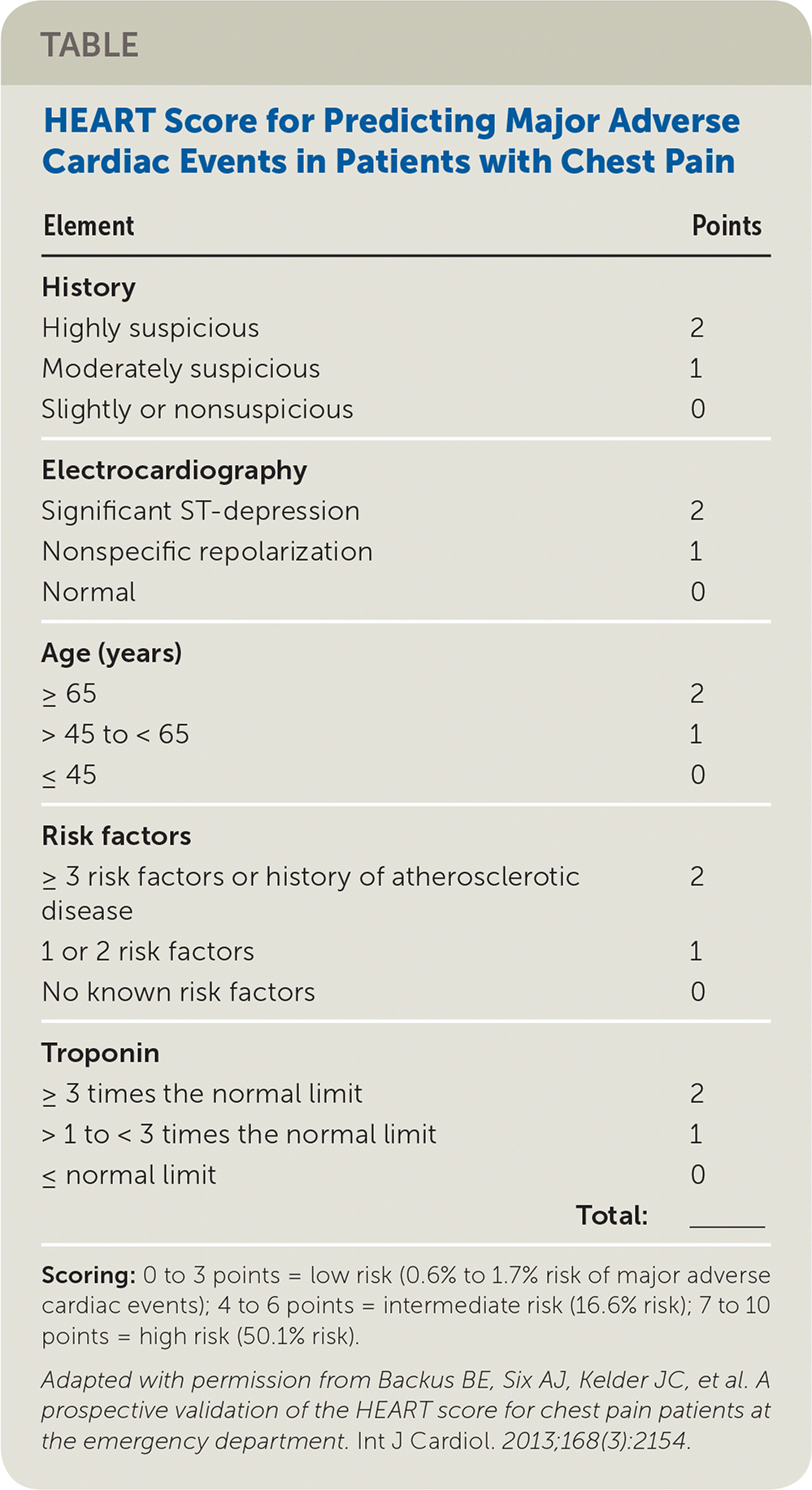
Compared with the TIMI (thrombolysis in myocardial infarction) score, the HEART score (see accompanying table) has a better predictive capacity for acute coronary syndrome (C statistic of 0.83 vs. 0.75 for TIMI).1 When used as part of an accelerated diagnostic protocol with serial troponin measurements, the HEART score can safely identify more patients for early discharge, reduce rates of objective cardiac testing, and significantly lower length of stay compared with usual care.2
TABLE HEART Score for Predicting Major Adverse Cardiac Events in Patients with Chest Pain
| Element | Points |
|---|---|
| History | |
| Highly suspicious | 2 |
| Moderately suspicious | 1 |
| Slightly or nonsuspicious | 0 |
| Electrocardiography | |
| Significant ST-depression | 2 |
| Nonspecific repolarization | 1 |
| Normal | 0 |
| Age (years) | |
| ≥ 65 | 2 |
| > 45 to < 65 | 1 |
| ≤ 45 | 0 |
| Risk factors | |
| ≥ 3 risk factors or history of atherosclerotic disease | 2 |
| 1 or 2 risk factors | 1 |
| No known risk factors | 0 |
| Troponin | |
| ≥ 3 times the normal limit | 2 |
| > 1 to < 3 times the normal limit | 1 |
| ≤ normal limit | 0 |
| Total: | ______ |
Scoring: 0 to 3 points = low risk (0.6% to 1.7% risk of major adverse cardiac events); 4 to 6 points = intermediate risk (16.6% risk); 7 to 10 points = high risk (50.1% risk).
Adapted with permission from Backus BE, Six AJ, Kelder JC, et al. A prospective validation of the HEART score for chest pain patients at the emergency department. Int J Cardiol. 2013;168(3):2154.
A total of 0 to 3 points on the HEART score is considered low risk, with a risk of 0.6% to 1.7% for major adverse cardiac events (MACE) in the four to six weeks after presentation. A score of 4 to 6 is intermediate risk (16.6% risk of MACE), and 7 to 10 points is high risk (50.1% risk of MACE).1–3
As part of an accelerated diagnostic protocol, a low-risk HEART score paired with repeat troponin measurements at three to six hours after presentation can further identify patients with minimal risk of complications. Two studies with a total of 1,287 patients found only one incidence of MACE in low-risk patients that was not identified by this protocol.3,4 These patients are good candidates for rapid discharge, and I usually refer them back to their primary care physician or cardiologist without pursuing other urgent ischemic evaluation.
The HEART score is easy to use at the bedside, provides reassurance that the patient is low risk and that early discharge is safe, and can help reduce costs associated with the evaluation of chest pain.
In Reply: Several protocols exist to assist physicians in ruling out acute coronary syndrome. Most protocols include serial electrocardiography (ECG) and troponin evaluation, and many include admission for additional testing.
One study has shown that patients with a modified TIMI score of 0 and two negative ECGs with two negative troponin results separated by two hours can be safely discharged from the emergency department and scheduled for a stress test within 72 hours. The 30-day risk of MACE was less than 1% in these patients.1
Unlike the TIMI and GRACE (Global Registry of Acute Coronary Events) scores, which were originally developed as prognostic tools for patients with an acute coronary syndrome diagnosis, the HEART score was prospectively developed and validated specifically to identify patients at low risk of acute coronary syndrome in the emergency department.2 Dr. Gomez did an excellent job of citing the data in support of the HEART score. In summary, a low-risk HEART score coupled with two negative cardiac troponin tests drawn three to six hours apart has a negative predictive value of 30-day MACE that approaches 100%.3
Although a recent study showed noninvasive testing for patients with negative troponin testing and a nonischemic ECG did not result in improved clinical outcomes,4 this was a retrospective analysis of a trial designed to evaluate the use of coronary computed tomography angiography in the early evaluation of chest pain. This trial probably should not be applied to general practice. For patients with an intermediate-risk HEART score, it is prudent to admit for additional testing, and patients with a high-risk HEART score should be evaluated for possible invasive testing.
