

A 71-year-old patient presented to the family medicine office for routine preventive care. The patient reported having a rash that developed one month earlier. The rash appeared spontaneously and was not associated with systemic symptoms, such as fevers or chills. The patient did not have photosensitivity.
The patient had no relevant contact exposures, including new personal hygiene or cleaning products, and was not taking any new medications. The patient did not have a history of dermatologic disease, diabetes mellitus, or known malignancy.
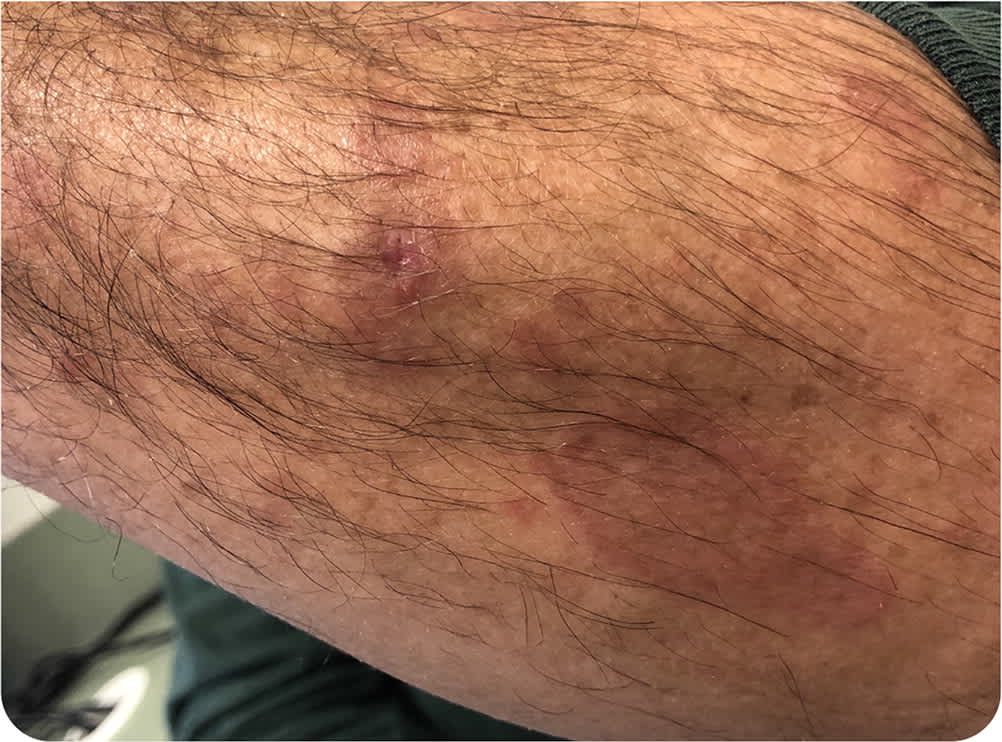
Physical examination revealed a pruritic, nonscaly, ring-like rash, mostly localized on the dorsa of both hands (Figure 1). Based on clinical appearance, the patient was empirically treated for a dermatophyte infection, but the rash persisted and spread to the forearms (Figure 2). A punch biopsy of the lesion on the hand was performed.
FIGURE 1
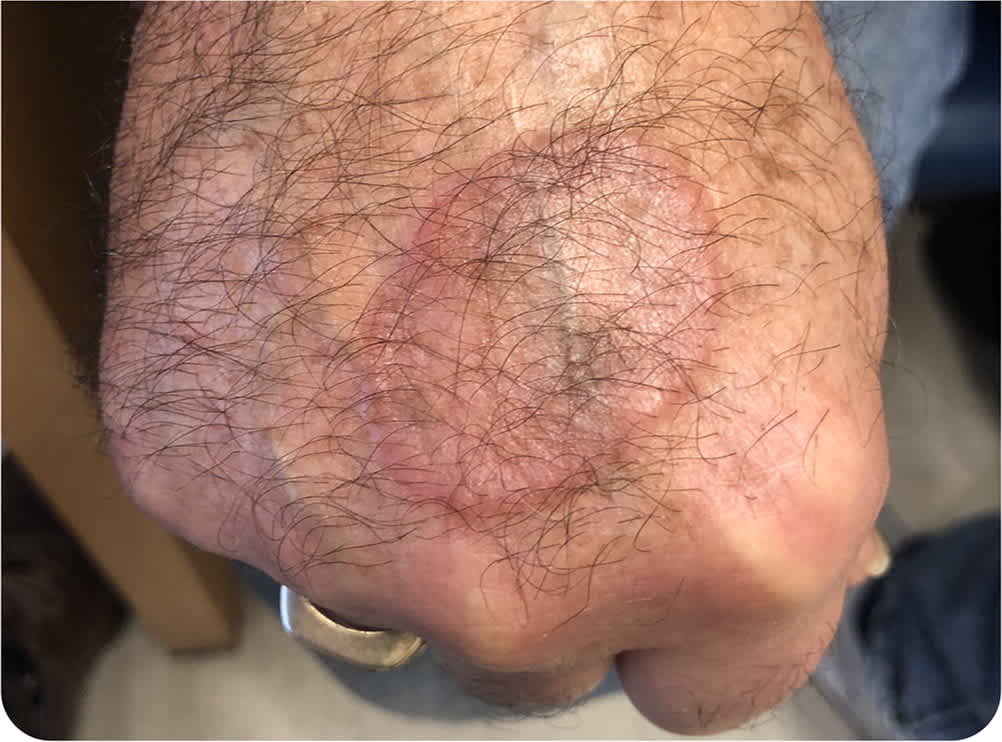
FIGURE 2
Question
Based on the patient's history and physical examination findings, which one of the following is the most likely diagnosis?
- A. Erythema annulare centrifugum.
- B. Granuloma annulare.
- C. Subacute cutaneous lupus erythematosus.
- D. Tinea corporis.
Discussion
The answer is B: granuloma annulare, a benign, idiopathic, granulomatous skin disease that is more common in women. Granuloma annulare can be localized or generalized. Localized granuloma annulare occurs most often on the dorsal or lateral surfaces of the hands or feet. The lesions present as nonscaly, skin-colored or erythematous, annular plaques with a firm, rope-like border and central clearing. Generalized granuloma annulare presents as multiple widespread, skin-colored to erythematous papules and plaques that vary in size and predominately occur on the trunk and extremities. Granuloma annulare can be distinguished from other annular skin conditions by the lack of scaling or other surface changes to the skin. The localized type is more common in younger adults, whereas generalized granuloma annulare has a bimodal distribution.1–3
Localized granuloma annulare is likely to resolve spontaneously within months or a few years, but the generalized form is more chronic and less responsive to treatment. The literature on treatment is limited to case reports and small uncontrolled studies. Typical treatments include topical therapies, systemic immunosuppressive therapies, and phototherapy. High-dose systemic steroids have been shown to be beneficial; however, symptoms often recur after discontinuation of treatment. The exact cause of the condition is unclear, but potential associations have been reported between both types of granuloma annulare and diabetes mellitus, thyroid disease, hyperlipidemia, malignancy, insect bites, and viral disease.1–3
Erythema annulare centrifugum is a delayed-type hypersensitivity reaction manifesting as annular, erythematous plaques with a trailing rim of scale. A paraneoplastic erythema annulare centrifugum eruption may also occur, with an erythematous lesion and urticarial type papules that enlarge centrifugally and then clear centrally.4
Subacute cutaneous lupus erythematosus is often associated with systemic lupus erythematosus. Lesions present as small, erythematous, scaly macules or papules that develop into psoriasiform or annular/polycyclic plaques. The predominant distribution is on sun-exposed areas such as the upper back, shoulders, neck, and anterior chest, and the rash is highly photosensitive. Up to one-third of cases are drug-induced. Causative medications include antihypertensives, anticonvulsants, proton pump inhibitors, and tumor necrosis factor–alpha inhibitors.5,6
Tinea corporis (ringworm) is a common, cutaneous dermatophyte infection that presents as a pruritic, well-demarcated, sharply circumscribed, erythematous, scaly patch with central clearing, leaving an actively advancing raised border. Most cases of tinea corporis respond to topical antifungals, although systemic therapy may be required with extensive skin involvement.7
SUMMARY TABLE
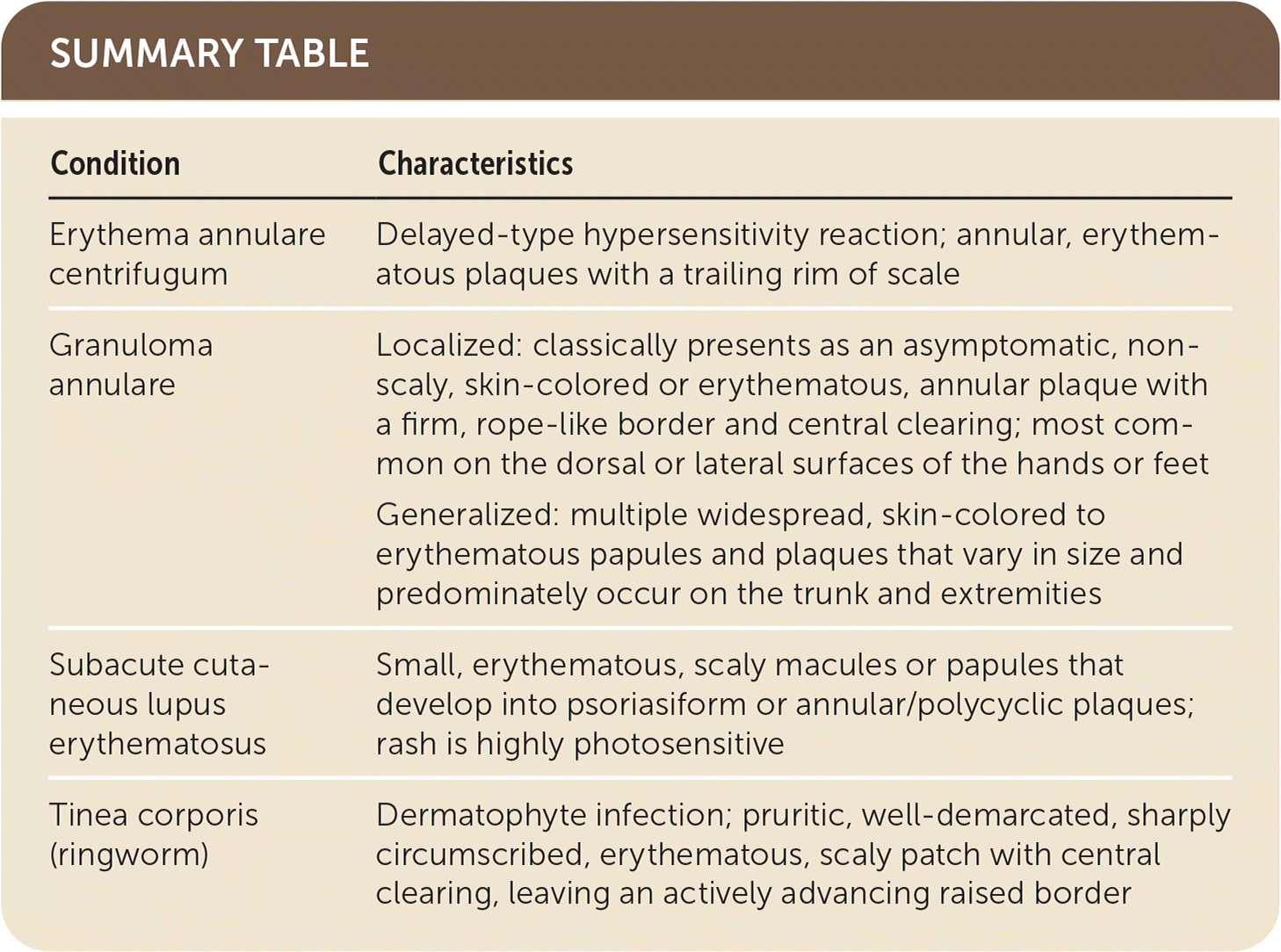
| Condition | Characteristics |
|---|---|
| Erythema annulare centrifugum | Delayed-type hypersensitivity reaction; annular, erythematous plaques with a trailing rim of scale |
| Granuloma annulare | Localized: classically presents as an asymptomatic, nonscaly, skin-colored or erythematous, annular plaque with a firm, rope-like border and central clearing; most common on the dorsal or lateral surfaces of the hands or feet |
| Generalized: multiple widespread, skin-colored to erythematous papules and plaques that vary in size and predominately occur on the trunk and extremities | |
| Subacute cutaneous lupus erythematosus | Small, erythematous, scaly macules or papules that develop into psoriasiform or annular/polycyclic plaques; rash is highly photosensitive |
| Tinea corporis (ringworm) | Dermatophyte infection; pruritic, well-demarcated, sharply circumscribed, erythematous, scaly patch with central clearing, leaving an actively advancing raised border |
