

Details for This Review
Study Population: Adults hospitalized with moderate to severe COVID-19 treated with remdesivir, placebo, or standard care
Efficacy End Points: All-cause mortality and need for respiratory support (high-flow oxygen, noninvasive or invasive ventilation) at up to 28 days of treatment, duration of invasive mechanical ventilation, quality of life, duration of hospitalization, intensive care unit (ICU) admission, and duration of ICU stay
Harm End Points: Any adverse event at up to 28 days of treatment
Narrative: SARS-CoV-2 has infected more than 300 million people and caused more than 5.5 million deaths worldwide.1 There has been an urgency to identify effective treatments, including antiviral medications, to decrease morbidity and mortality. Remdesivir is an antiviral drug that has been hypothesized to inhibit viral replication of RNA viruses such as SARS-CoV-2.2
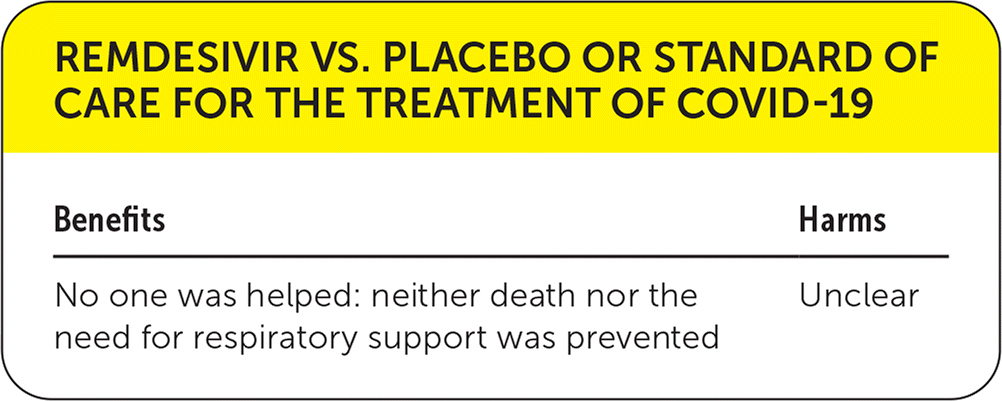
REMDESIVIR VS. PLACEBO OR STANDARD OF CARE FOR THE TREATMENT OF COVID-19
| Benefits | Harms |
|---|---|
| No one was helped: neither death nor the need for respiratory support was prevented | Unclear |
The Cochrane review identified five randomized controlled trials with 7,452 patients (mean age = 59 years) hospitalized with moderate to severe illness, most requiring low-flow oxygen or mechanical ventilation at baseline; studies were conducted in high- or upper-middle-income countries.3 Pooled data across the five studies found moderate-certainty evidence that treating COVID-19 with remdesivir resulted in no statistically significant difference in all-cause mortality at up to 28 days of treatment compared with placebo or standard care.4
Remdesivir did not reduce the need for overall respiratory support (high-flow oxygen, invasive ventilation, or noninvasive ventilation) and had no effect on the duration of invasive mechanical ventilation. However, the certainty of evidence was low to very low for these outcomes. Although remdesivir reduced the need for new invasive mechanical ventilation within 28 days compared with placebo or standard care (relative risk = 0.56; 95% CI, 0.41 to 0.77; absolute risk difference = 6.7%; number needed to treat = 15), the certainty of evidence was low. Therefore, we did not report this finding in our summary table. No studies measured quality of life, need for ICU admission, or duration of ICU stay.
The safety data were inconsistently reported in the original trials; therefore, the data on whether remdesivir increases or decreases adverse events were inconclusive, comprising very low-certainty evidence.
Caveats: The existing evidence has significant limitations. The Cochrane review downgraded the certainty of evidence for the mortality outcome from high to moderate because of possible problems with randomization in one of the included studies.5 For the outcomes of clinical improvement and adverse events, the level of certainty was downgraded because of limitations in the reported data, including missing data about the competing risks of death. For example, the duration of mechanical ventilation would be reduced if a patient died, and this would positively affect the duration of ventilation numbers. Another limitation was an open-label design used by one of the included trials.6
The randomized controlled trials used different scales for determining disease severity and progression because there are no standardized guidelines for determining whether a COVID-19 case is moderate or severe. The need for respiratory support, specifically the need for each method of respiratory support (high-flow oxygen, noninvasive ventilation, or invasive ventilation), is also determined by clinical judgment and subject to significant variability.
Despite the significant limitations of the study population, relative homogeneity of institutions, and the risk of bias, this Cochrane review is the largest and most recent review that included only randomized controlled trials comparing remdesivir with placebo or standard care.3
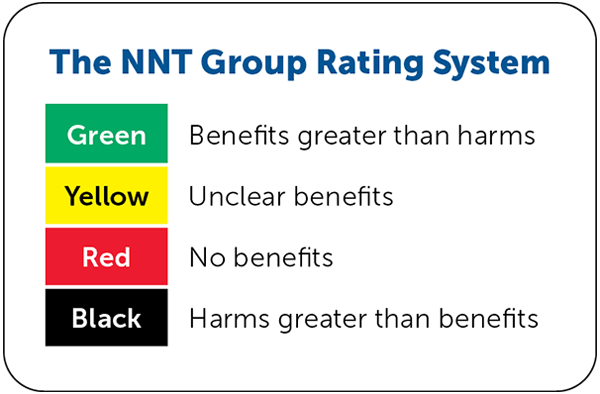
We have assigned a color recommendation of yellow (unclear benefits) for remdesivir use in patients hospitalized with COVID-19. Additional data are needed to clarify the effectiveness and safety of remdesivir for the treatment of COVID-19. Further studies are also needed to address the effectiveness and safety in different populations (e.g., age, disease severity), treatment protocols, and socioeconomic settings.
