

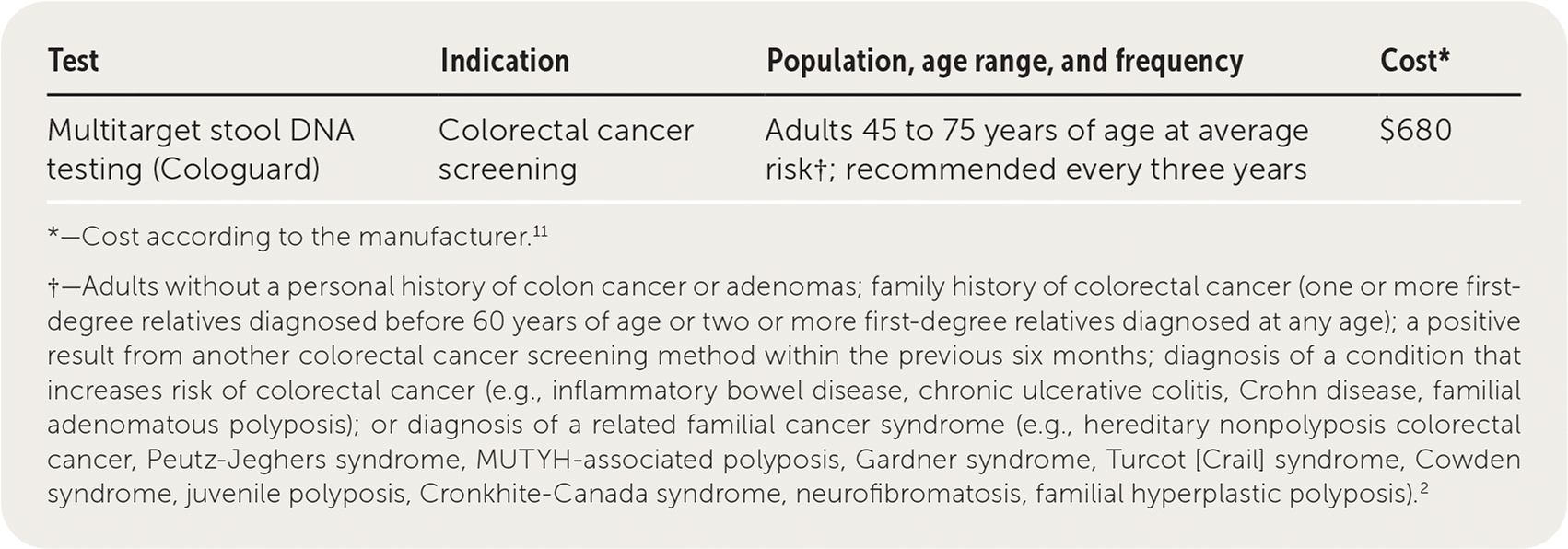
| Test | Indication | Population, age range, and frequency | Cost* |
|---|---|---|---|
| Multitarget stool DNA testing (Cologuard) | Colorectal cancer screening | Adults 45 to 75 years of age at average risk†; recommended every three years | $680 |
*—Cost according to the manufacturer.11
†—Adults without a personal history of colon cancer or adenomas; family history of colorectal cancer (one or more first-degree relatives diagnosed before 60 years of age or two or more first-degree relatives diagnosed at any age); a positive result from another colorectal cancer screening method within the previous six months; diagnosis of a condition that increases risk of colorectal cancer (e.g., inflammatory bowel disease, chronic ulcerative colitis, Crohn disease, familial adenomatous polyposis); or diagnosis of a related familial cancer syndrome (e.g., hereditary nonpolyposis colorectal cancer, Peutz-Jeghers syndrome, MUTYH-associated polyposis, Gardner syndrome, Turcot [Crail] syndrome, Cowden syndrome, juvenile polyposis, Cronkhite-Canada syndrome, neurofibromatosis, familial hyperplastic polyposis).2
Multitarget stool DNA (MT-sDNA) testing, or Cologuard, was approved by the U.S. Food and Drug Administration in 2014 as an option for stool-based colorectal cancer screening.1 It is used in adults 45 to 75 years of age at average risk.2 MT-sDNA testing detects not only hemoglobin, but also DNA mutations and methylations that may indicate the presence of colorectal cancer or precancerous advanced adenomas.1
Accuracy
A 2014 industry-funded study evaluated MT-sDNA testing for colorectal cancer screening in 11,016 asymptomatic, average-risk adults 50 to 84 years of age who were already scheduled for screening colonoscopy.3 Of 9,989 participants who provided a stool specimen within the 90 days before the screening colonoscopy, 65 (0.7%) had colorectal cancer and 757 (7.6%) had advanced precancerous lesions (advanced adenomas or sessile serrated polyps 1 cm or larger) on colonoscopy. Compared with fecal immunochemical testing (FIT) alone, MT-sDNA testing had higher sensitivity (92% vs. 74%) for colorectal cancer but lower specificity (87% vs. 95%). The number needed to screen to detect one cancer was 154 with colonoscopy, 166 with MT-sDNA testing, and 208 with FIT.
The Voyage study is an ongoing, large-scale, industry-funded prospective cohort study with a target enrollment of 150,000 participants whose clinician ordered colorectal cancer screening with MT-sDNA testing.4 The study aims to analyze health care utilization (i.e., the proportion of individuals who report having received a diagnostic colonoscopy) and evaluate rates of colorectal cancer incidence and mortality in patients who complete MT-sDNA testing. An interval analysis is expected to be completed in 2023.
Benefit
The U.S. Preventive Services Task Force includes MT-sDNA testing every one to three years as a recommended colorectal cancer screening option for adults 45 to 75 years of age. Other recommended strategies include high-sensitivity guaiac fecal occult blood testing (FOBT) or FIT every year, computed tomographic colonography every five years, flexible sigmoidoscopy every five years, flexible sigmoidoscopy every 10 years with annual FIT, and colonoscopy screening every 10 years.5
Unlike colonoscopy or sigmoidoscopy, MT-sDNA testing does not require a clinical visit, transportation, sedation, or bowel preparation. Although other stool tests are performed annually, MT-sDNA testing can be performed as little as every three years. Unlike FOBT, there are no dietary or medication restrictions with MT-sDNA testing.5,6
A cohort study of 393 Medicare patients 50 to 85 years of age in a multispecialty group practice setting who were previously screening nonadherent (i.e., more than 10 years since last colonoscopy or more than one year since last fecal test) showed that the availability of MT-sDNA testing led to high adherence to screening (88%) and diagnostic colonoscopy in patients with positive MT-sDNA results (96%).7 Although the Voyage study is underway, there are currently no data from prospective studies demonstrating that MT-sDNA improves patient-oriented outcomes.4
Harms
Harms of MT-sDNA testing are associated with colonoscopy performed as follow-up after positive results. The lower specificity of MT-sDNA testing resulted in nearly three times as many false-positive results as FIT (455 positive MT-sDNA test results with negative colonoscopy results vs. 162 positive FIT results with negative colonoscopy results).3 Additionally, there is uncertainty about the interpretation of a negative colonoscopy result following a positive MT-sDNA result because MT-sDNA tests do not report whether the hemoglobin or DNA portion caused the positive result. If the DNA component were positive, for example, colonoscopy findings may be normal because the lesion was not visualized, supracolonic lesions were present, or early cancerous changes were not yet visible. Subsequently, a patient with positive MT-sDNA test results followed by normal colonoscopy results may undergo more aggressive short-term surveillance, despite no evidence of benefit for this strategy.8 Two follow-up studies of patients with false-positive results on MT-sDNA testing (median follow-up of four years) did not show increased rates of colorectal cancer, although further study is warranted.9,10
Cost
MT-sDNA testing costs approximately $680.11 The manufacturer reports that the test is covered by Medicare and major insurers, with 94% coverage nationwide and no out-of-pocket cost for screening.11 From 2009 to 2014 in a screening program using colonoscopy, the cost was determined to be $3,153 per person for colonoscopy and $1,291 for FOBT or FIT followed by diagnostic colonoscopy.12 The current fair price for screening colonoscopy is $1,710.13 A 2016 Markov cohort model of average-risk colorectal cancer screening that compared MT-sDNA testing, FIT, and colonoscopy showed that FIT and colonoscopy were less costly and more effective than MT-sDNA testing when participation rates were equal for all strategies.14
If a patient requires a follow-up colonoscopy after a positive MT-sDNA result, some insurers consider the colonoscopy to be diagnostic rather than screening, potentially subjecting patients to cost-sharing.15 At least one state has banned cost-sharing for diagnostic colonoscopies following positive colorectal cancer screening results, and the Removing Barriers to Colorectal Cancer Screening Act of 2020 eliminated such cost-sharing for Medicare patients.16,17
Bottom Line
MT-sDNA testing is a stool-based screening method that is recommended by the U.S. Preventive Services Task Force and covered by most insurance plans. It has higher sensitivity than FIT or FOBT for advanced adenomas but leads to more false-positive results, has a higher likelihood of negative results on follow-up colonoscopy, and is less cost-effective. No clinical studies have established that this test improves patient-oriented outcomes.
