

Letters to the Editor

Case Report: Nirmatrelvir/Ritonavir and Tacrolimus in a Kidney Transplant Recipient With COVID-19

American Family Physician. 2022;105(6):569-570.

Author disclosure: No relevant financial relationships.

Published online April 19, 2022.

To the Editor: A 41-year-old female patient with a history of renal transplant presented to the emergency department with nausea, vomiting, and tremors. The patient had been prescribed nirmatrelvir/ritonavir (Paxlovid) for COVID-19 and had taken five of the 10 total doses. The patient was also taking 4 mg of extended-release tacrolimus (Envarsus) per day. Initial laboratory results showed an acute renal injury and hyperkalemia. The tacrolimus level was more than 60 ng per mL (therapeutic range is 4 to 10 ng per mL); therefore, tacrolimus and nirmatrelvir/ritonavir were held.

Figure 1 shows the patient's tacrolimus, potassium, and serum creatinine levels. The tacrolimus level decreased on day 3 of hospitalization. The patient was discharged on day 7 with tacrolimus and potassium returned to normal levels; the serum creatinine was elevated but returned to baseline three days after discharge.

FIGURE 1.
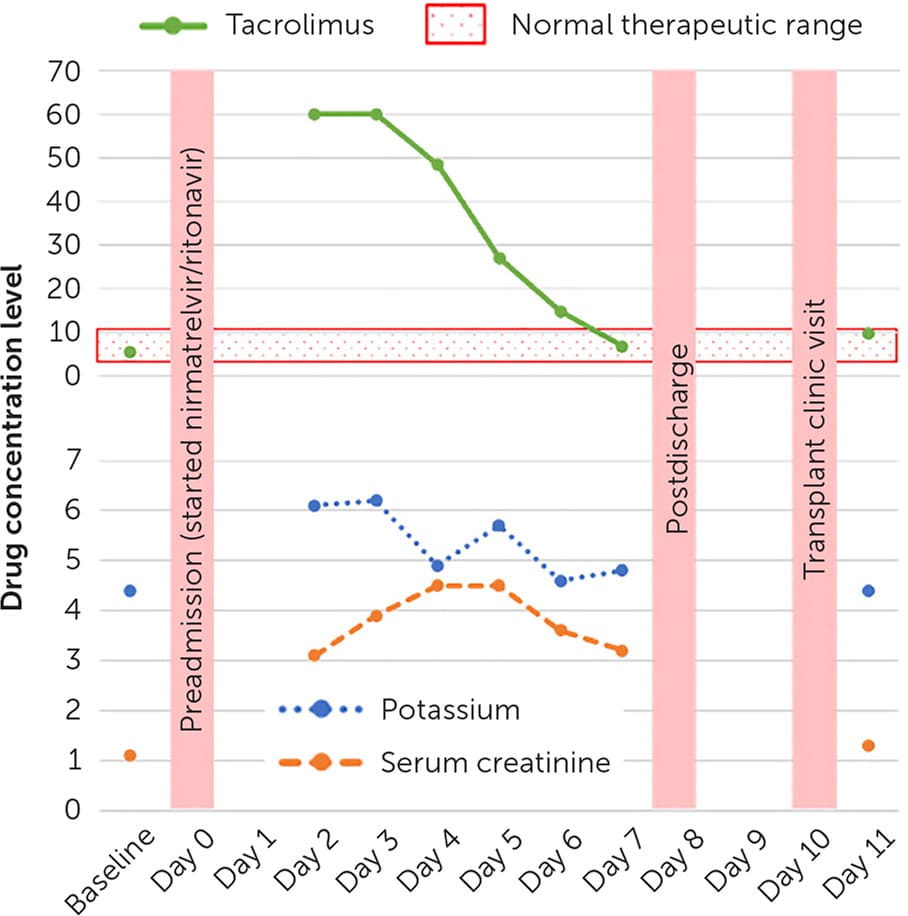
Tacrolimus, potassium, and serum creatinine levels in a kidney transplant recipient who was prescribed nirmatrelvir/ritonavir for the treatment of COVID-19.

Note: Tacrolimus reference range is 4 to 10 ng per mL, potassium reference range is 3.5 to 5.5 mEq per L (3.50 to 5.50 mmol per L), and serum creatinine reference range is 0.5 to 1.2 mg per dL (44.20 to 106.08 mmol per L).

In December 2021, the U.S. Food and Drug Administration granted emergency use authorization for the first oral antiviral drug treatment for COVID-19 (Paxlovid).1 Nirmatrelvir/ritonavir is a combination of nirmatrelvir, a SARS-CoV-2 main protease inhibitor, and ritonavir, a potent cytochrome P-450 3A and P-glycoprotein inhibitor.2 The emergency use authorization is for patients who have mild to moderate COVID-19 who are at high risk of progression to severe COVID-19.2

Solid organ transplant recipients are an at-risk population because they are prescribed immunosuppressant medications from the calcineurin inhibitor class (e.g., tacrolimus, cyclosporine) or mammalian target of rapamycin inhibitor class (e.g., everolimus, sirolimus).3,4 All are substrates of cytochrome P-450 3A and P-glycoprotein. Concomitant administration of tacrolimus and ritonavir can slow the rate of tacrolimus metabolism, increasing its blood concentration to toxic levels.

Published recommendations can help clinicians avoid drug-drug interactions when prescribing nirmatrelvir/ritonavir.5,6 It is recommended to hold all doses of calcineurin inhibitors during nirmatrelvir/ritonavir therapy. Prescribers should contact appropriate care team members (e.g., transplant coordinator) to schedule patient monitoring and follow-up.

Kristen E. Lindauer, PharmD

Norfolk, Va.

Ashlee G. Hamel, PharmD, BCPS

Norfolk, Va.

Author disclosure: No relevant financial relationships.

  1. 1.U.S. Food and Drug Administration. Coronavirus (COVID-19) update: FDA authorizes first oral antiviral for treatment of COVID-19. December 22, 2021. Accessed February 24, 2022. https://www.fda.gov/news-events/press-announcements/coronavirus-covid-19-update-fda-authorizes-first-oral-antiviral-treatment-covid-19
  2. 2.Paxlovid (nirmatrelvir tablets; ritonavir tablets), co-packaged for oral use [fact sheet for healthcare providers]. Pfizer. 2021. Accessed February 24, 2022. https://labeling.pfizer.com/ShowLabeling.aspx?id=16474
  3. 3.Pereira MR, Mohan S, Cohen DJ, et al. COVID-19 in solid organ transplant recipients: initial report from the US epicenter. Am J Transplant. 2020;20(7):1800-1808.
  4. 4.Centers for Disease Control and Prevention. COVID-19 vaccines for moderately or severely immunocompromised people. Published February 11, 2020. Accessed February 24, 2022. https://www.cdc.gov/coronavirus/2019-ncov/vaccines/recommendations/immuno.html
  5. 5.Lange NW, Salerno DM, Jennings DL, et al. Nirmatrelvir/ritonavir use: managing clinically significant drug-drug interactions with transplant immunosuppressants. Am J Transplant. January 11, 2022. Accessed February 24, 2022. https://onlinelibrary.wiley.com/doi/10.1111/ajt.16955
  6. 6.Stader F, Khoo S, Stoeckle M, et al. Stopping lopinavir/ritonavir in COVID-19 patients: duration of the drug interacting effect. J Antimicrob Chemother. 2020;75(10):3084-3086.

Email letter submissions to afplet@aafp.org. Letters should be fewer than 400 words and limited to six references, one table or figure, and three authors. Letters submitted for publication in AFP must not be submitted to any other publication. Letters may be edited to meet style and space requirements.

This series is coordinated by Kenny Lin, MD, MPH, deputy editor.

Copyright © 2026 by the American Academy of Family Physicians.

This content is owned by the AAFP. A person viewing it online may make one printout of the material and may use that printout only for his or her personal, non-commercial reference. This material may not otherwise be downloaded, copied, printed, stored, transmitted or reproduced in any medium, whether now known or later invented, except as authorized in writing by the AAFP. See permissions for copyright questions and/or permission requests.