

To the Editor: Family physicians play a vital role in diagnosing skin lesions.1 One study demonstrated that family physicians are second to dermatologists in the number of visits addressing skin disorders, accounting for 20.5% of all skin-related visits.1 In this case report, we describe a woman presenting with multiple supernumerary nipples distributed in a symmetric, classic pattern.
A 32-year-old woman with no notable medical history presented with four bumps on the chest and abdomen: one anterior to each axilla (Figure 1A) and one on each lateral lower abdomen (Figure 1B). The lesions had been visible and unchanged for as long as she could remember. They were mildly pruritic but not painful. Examination revealed a tan, flat-topped, minimally raised papule with a central component of hyperpigmentation anterior to each axilla. Two similar papules were present on the left and right lower abdomen. A shave biopsy of the lesion anterior to the left axilla showed pathologic findings consistent with a supernumerary nipple (Figure 1C).
FIGURE 1.
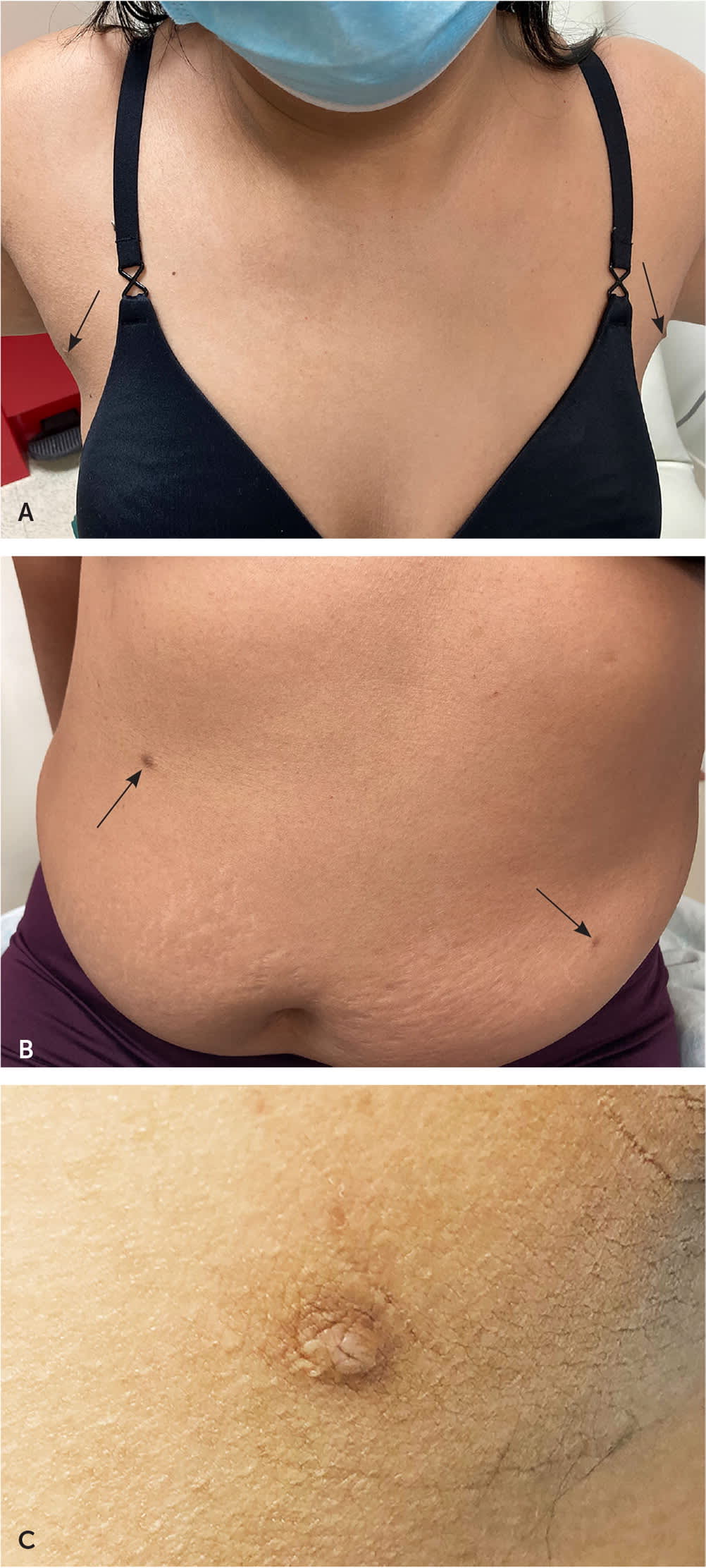
Symmetric distribution of supernumerary nipples (A) anterior to each axilla and (B) on each lateral lower abdomen. (C) Close-up view of lesion anterior to the left axilla.
Supernumerary nipples occur in up to 6% of the population.2 Supernumerary nipples are more common in males and can resemble other skin findings, including dermatofibromas.3 Supernumerary nipples have a characteristic distribution and are most common along the mammary ridges from the axilla to the groin.2
Supernumerary nipples are generally considered benign; although rare, supernumerary nipples and the corresponding accessory tissue may develop associated fibroadenomas, mastitis, or breast cancer.4 Retrospective reports have demonstrated an association of supernumerary nipples with urinary tract malformations in children.5
These associations highlight the importance of recognizing supernumerary nipples in the primary care setting. Although time constraints can be a barrier to performing comprehensive skin examinations,6 most supernumerary nipples can be identified during standard abdominal and chest examinations because of their unique distribution.
