Family Physicians Providing Obstetric Care in Maternity Care Deserts

Grace Walter, MD
Michael Topmiller, PhD
Anuradha Jetty, MPH
Yalda Jabbarpour, MD

American Family Physician. 2022;106(4):377-378.

Author disclosure: No relevant financial relationships.

Many communities in the United States have few or no clinicians providing maternity care services, contributing to a national maternal and infant mortality rate that is much higher than that in comparable developed countries.1 The March of Dimes defines maternity care deserts (MCDs) as counties that have no hospitals providing obstetric care and no practicing obstetrician-gynecologists (OB-GYNs) or certified nurse midwives (CNMs).2 However, this definition excludes the thousands of family physicians who provide maternity care, particularly in rural areas.3,4 We sought to determine the extent to which family physicians provide obstetric care within MCDs throughout the United States.

Using 2011 to 2019 data from the Family Medicine Certification Examination Application Practice Demographic Questionnaire provided by the American Board of Family Medicine, the office addresses of family physicians who reported performing deliveries were geocoded and mapped at the county level.5 These data represent roughly 90% of family physicians over nine years by capturing the 10% of family physicians continuing certification each year. County-level data from the Health Resources and Services Administration Area Health Resource File, 2020–2021, were then used to map OB-GYNs and CNMs.6 Finally, geographic information systems were used to create county-level maps displaying the distribution of family physicians delivering babies in relation to MCDs.

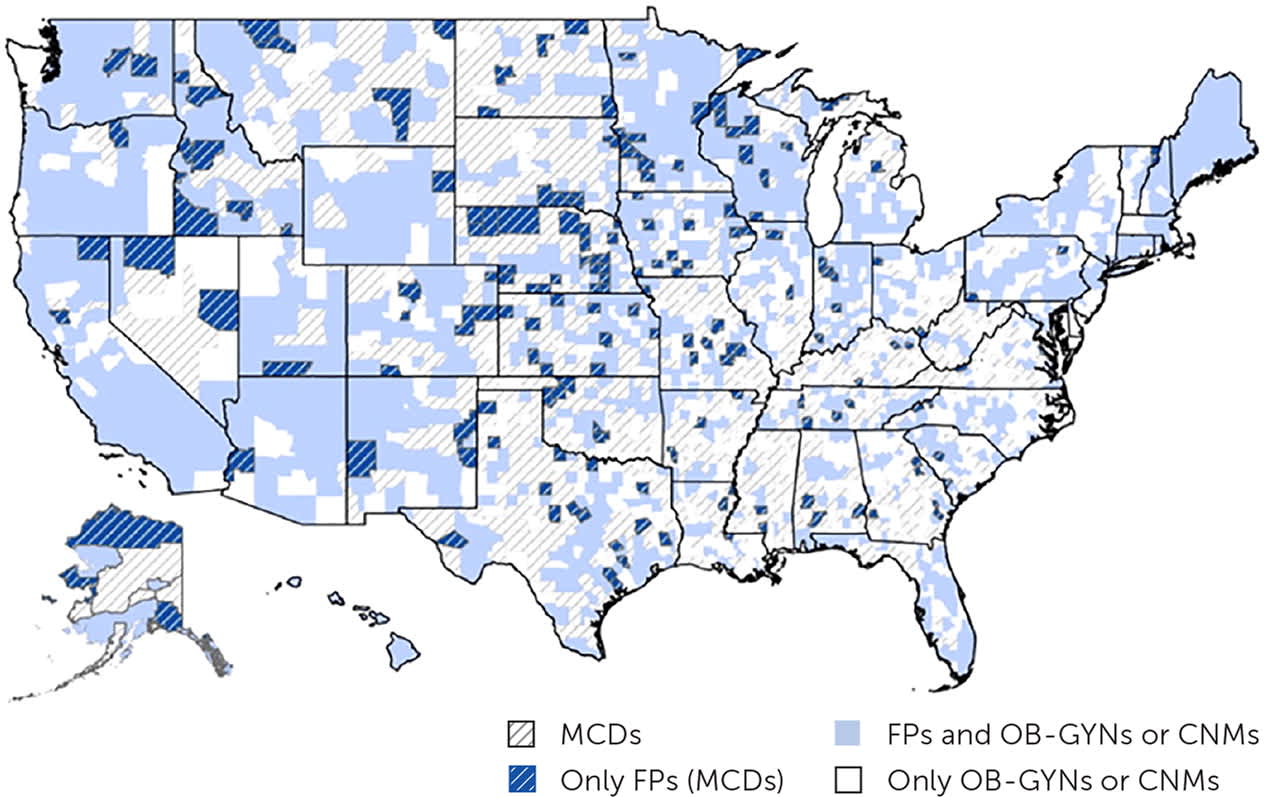
Figure 1 displays the location of all obstetric care clinicians relative to MCDs. More than one-third (35.8%) of counties in the United States have been identified as an MCD, with more than eight in 10 (81.3%) of these counties located in nonmetropolitan areas. Family physicians deliver babies in more than four in 10 (40.7%) of all U.S. counties, and more than five in 10 (52.4%) of these counties are located in nonmetropolitan areas. Family physicians are the sole maternity care clinicians delivering babies in 181 MCDs (about one in six [16.2%] of all MCDs), serving more than 400,000 women (18 to 44 years of age). Decreasing numbers of family physicians delivering babies, combined with the movement of these physicians away from nonmetropolitan areas, may cause fluctuations in the true count of family physicians delivering babies in MCDs at a given time.710

FIGURE 1.

Map of MCDs and of obstetric care clinicians by specialty in the United States.

CNMs = certified nurse midwives; FPs = family physicians; MCDs = maternity care deserts; OB-GYNs = obstetrician-gynecologists.

Sources: American Board of Family Medicine, 2011–2019; Area Health Resource File, 2021

The data demonstrate the significant role family physicians play in MCDs and nationwide. Despite their important contribution, family physicians are excluded from the Health Resources and Services Administration's definition of maternity care health professional target areas (MCTAs), which help to distribute maternity care clinicians to shortage areas.11 MCTAs receive a score partially based on the ratio of OB-GYNs and CNMs to women 15 to 44 years of age; however, the score does not include family physicians also providing care in that area.11 Overlooking family physicians providing care in MCTAs may result in the faulty allocation of maternity care clinicians away from the highest need areas.12 To ensure equitable distribution of clinicians who perform obstetrics, the contribution of family physicians to maternity care must be recognized and supported. Residency programs should continue to offer robust training opportunities and advanced fellowship opportunities.1316 The discipline, credentialing bodies, and health systems must also support family physicians who perform deliveries, particularly in nonmetropolitan areas, by simplifying credentialing, building interdisciplinary relationships, and ensuring adequate numbers of deliveries to maintain obstetric skills.9,14,17

Author disclosure: No relevant financial relationships.

  1. 1.Tikkanen R, Gunja MZ, FitzGerald M, et al. Maternal mortality and maternity care in the United States compared to 10 other developed countries. Commonwealth Fund. November 18, 2020. Accessed January 2, 2022. https://www.commonwealthfund.org/publications/issue-briefs/2020/nov/maternal-mortality-maternity-care-us-compared-10-countries
  2. 2.March of Dimes. Nowhere to go: maternity care deserts across the U.S. 2020 report. Accessed July 27, 2022. https://www.marchofdimes.org/materials/2020-Maternity-Care-Report.pdf
  3. 3.WWAMI Rural Health Research Center. University of Washington. The supply and rural-urban distribution of the obstetrical care workforce in the U.S. June 2020. Accessed December 30, 2021. https://depts.washington.edu/fammed/rhrc/wp-content/uploads/sites/4/2020/06/RHRC_PB168_Patterson.pdf
  4. 4.Deutchman M, Macaluso F, Bray E, et al. The impact of family physicians in rural maternity care. Birth. 2022;49(2):220-232.
  5. 5.Peterson LE, Fang B, Phillips RL, et al. The American Board of Family Medicine's data collection method for tracking their specialty. J Am Board Fam Med. 2019;32(1):89-95.
  6. 6.Health Resources and Services Administration. Area health resources files. Accessed July 29, 2022. https://data.hrsa.gov/topics/health-workforce/ahrf
  7. 7.McGrail MR, Wingrove PM, Petterson SM, et al. Mobility of US rural primary care physicians during 2000–2014. Ann Fam Med. 2017;15(4):322-328.
  8. 8.Barreto TW, Eden AR, Petterson S, et al. Intention versus reality: family medicine residency graduates' intention to practice obstetrics. J Am Board Fam Med. 2017;30(4):405-406.
  9. 9.Eden AR, Peterson LE. Challenges faced by family physicians providing advanced maternity care. Matern Child Health J. 2018;22(6):932-940.
  10. 10.Tong STC, Makaroff LA, Xierali IM, et al. Proportion of family physicians providing maternity care continues to decline. J Am Board Fam Med. 2012;25(3):270-271.
  11. 11.Federal Register. Criteria for determining maternity care health professional target areas. May 19, 2022. Accessed July 29, 2022. https://www.federalregister.gov/documents/2022/05/19/2022-10783/criteria-for-determining-maternity-care-health-professional-target-areas
  12. 12.Stewart AD. AAFP comments to HRSA on maternal health professional shortage scoring areas. November 18, 2021. Accessed August 16, 2022. https://www.aafp.org/dam/AAFP/documents/advocacy/prevention/women/LT-HRSA-MCTAScoring-111821.pdf
  13. 13.Barr WB. Women deserve comprehensive primary care: the case for maternity care training in family medicine. Fam Med. 2021;53(7):524-527.
  14. 14.Goldstein JT, Hartman SG, Meunier MR, et al. Supporting family physician maternity care providers. Fam Med. 2018;50(9):662-671.
  15. 15.Magee SR, Eidson-Ton WS, Leeman L, et al. Family medicine maternity care call to action: moving toward national standards for training and competency assessment. Fam Med. 2017;49(3):211-217.
  16. 16.Rayburn W. Who will deliver the babies? Identifying and addressing barriers. J Am Board Fam Med. 2017;30(4):402-404.
  17. 17.Loeven M. Credentialing family physicians who provide maternity care. Am Fam Physician. 2022;105(5):456-457.

The information and opinions contained in research from the Graham Center do not necessarily reflect the views or the policy of the AAFP.

This series is coordinated by Kenny Lin, MD, MPH, deputy editor.

A collection of Graham Center Policy One-Pagers published in AFP is available at https://www.aafp.org/afp/graham. One-Pagers are also available at https://www.graham-center.org.

Copyright © 2026 by the American Academy of Family Physicians.

This content is owned by the AAFP. A person viewing it online may make one printout of the material and may use that printout only for his or her personal, non-commercial reference. This material may not otherwise be downloaded, copied, printed, stored, transmitted or reproduced in any medium, whether now known or later invented, except as authorized in writing by the AAFP. See permissions for copyright questions and/or permission requests.