

A 26-year-old woman presented with a disseminated rash on her upper extremities and trunk that developed two months earlier. The rash did not resolve after treatment with multiple antihistamines. She recently had bilateral tonsillar hypertrophy with tonsilloliths. She had a family history of plaque psoriasis.
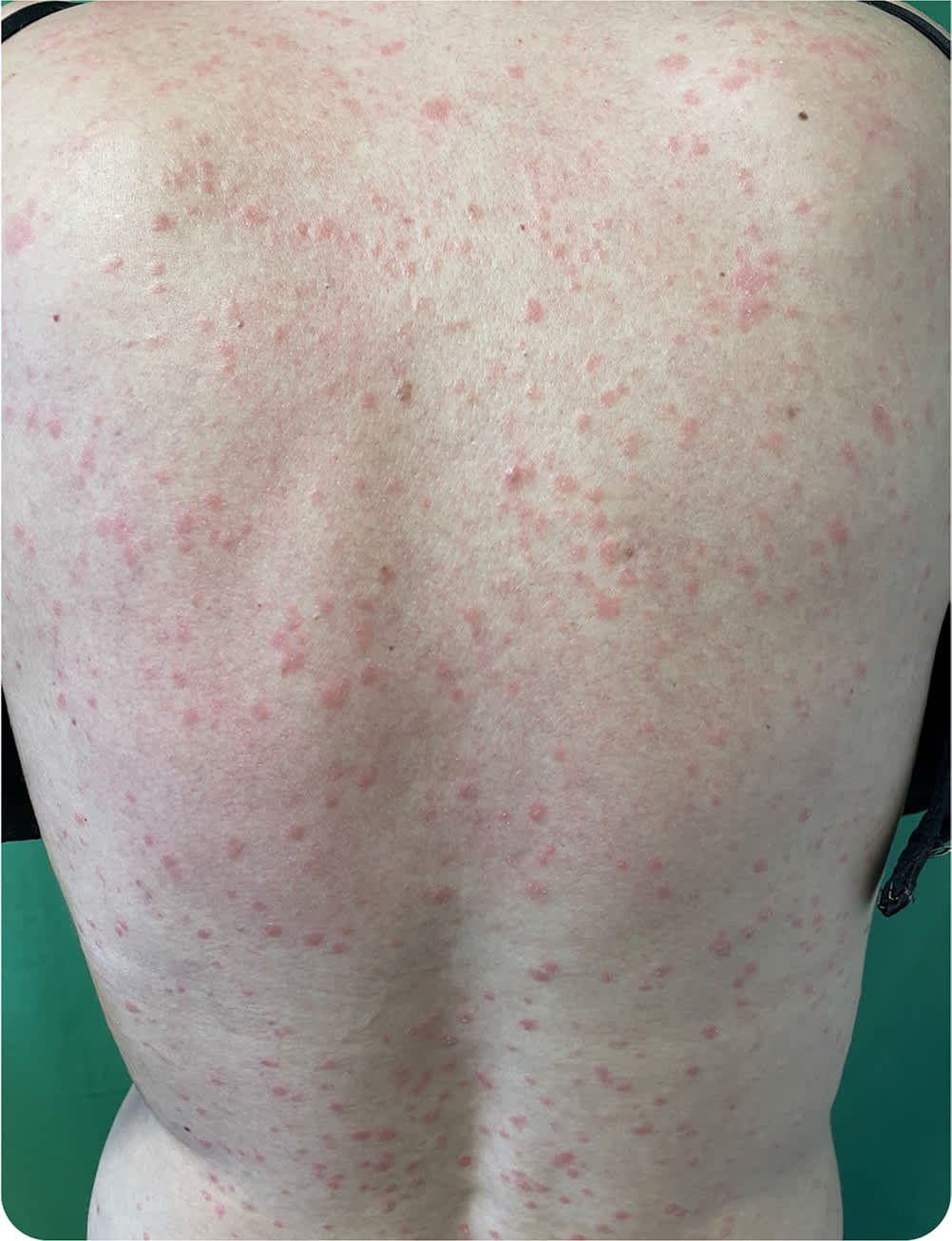
Physical examination revealed droplike, erythematous patches and plaques with scaling (Figure 1). Vital signs were normal.
FIGURE 1
Question
Based on the patient's history and physical examination findings, which one of the following is the most likely diagnosis?
- A. Guttate psoriasis.
- B. Nummular eczema.
- C. Pityriasis rosea.
- D. Secondary syphilis.
- E. Tinea corporis.
Discussion
The answer is A: guttate psoriasis. Guttate psoriasis comprises less than 30% of all psoriasis cases. It is most common in those younger than 30 years and affects men and women equally.1 The disease is more common in those with a family history of plaque psoriasis.
Guttate psoriasis presents as round, droplike, erythematous patches and plaques on the upper extremities and trunk with some scaling.1,2 Streptococcal infections may precede the rash.1,2 Guttate lesions progress to plaque psoriasis in 40% of cases, and positivity for the HLA-Cw6 allele plays an important role in the pathogenesis of the disease.1
Nummular eczema presents as coin-shaped, well-demarcated, erythematous, scaly plaques on the upper and lower extremities.3
Pityriasis rosea presents as scaly patches on the trunk and extremities. It can appear in a similar distribution as guttate psoriasis, but lesions are more oval in shape and classically follow a Christmas tree pattern. The rash is usually preceded by one larger plaque (herald patch).4
Secondary syphilis causes a diffuse eruption of brown to red lesions on the trunk and extremities, including the palms and soles. The lesions can take on various morphologies.3
Tinea corporis presents as numerous ringlike lesions with peripheral scaling and central clearing.3 It is often pruritic and can be located on the trunk and extremities.
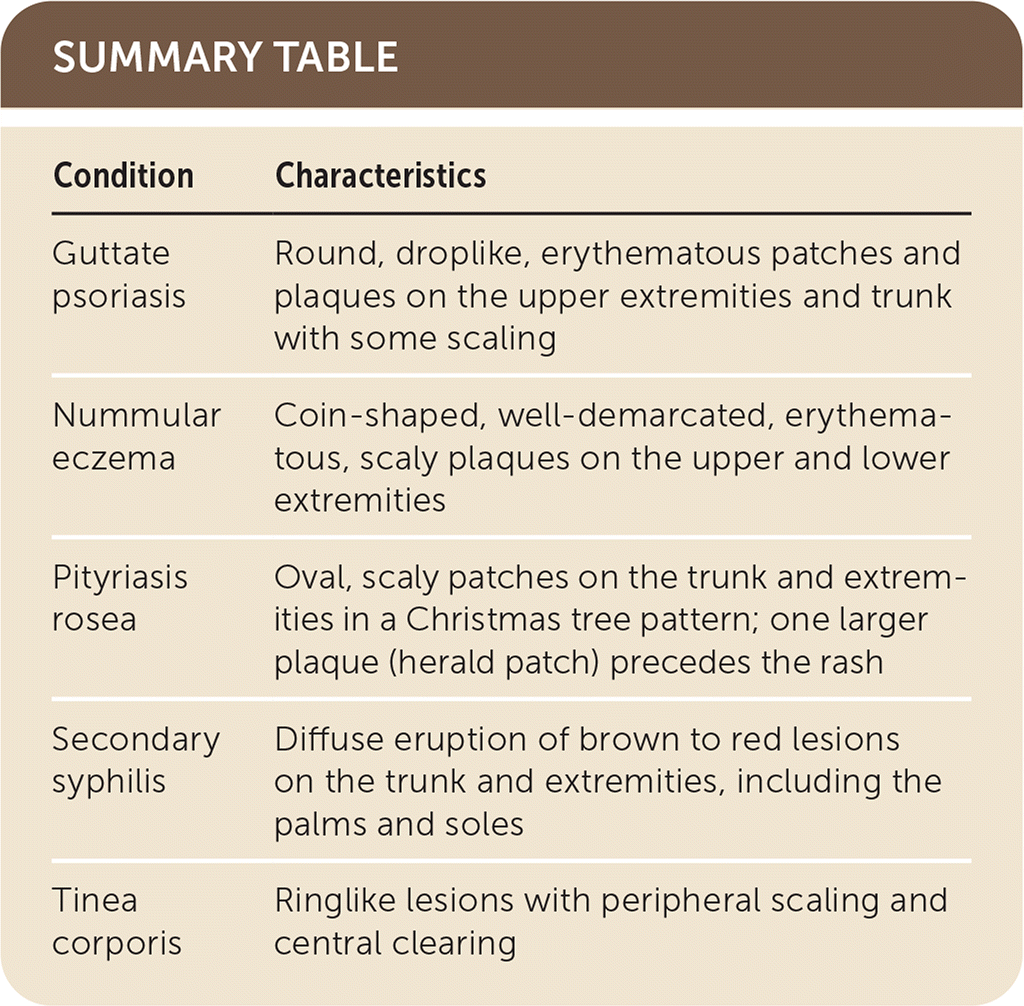
SUMMARY TABLE
| Condition | Characteristics |
|---|---|
| Guttate psoriasis | Round, droplike, erythematous patches and plaques on the upper extremities and trunk with some scaling |
| Nummular eczema | Coin-shaped, well-demarcated, erythematous, scaly plaques on the upper and lower extremities |
| Pityriasis rosea | Oval, scaly patches on the trunk and extremities in a Christmas tree pattern; one larger plaque (herald patch) precedes the rash |
| Secondary syphilis | Diffuse eruption of brown to red lesions on the trunk and extremities, including the palms and soles |
| Tinea corporis | Ringlike lesions with peripheral scaling and central clearing |
