

Starting in 2021, the 21st Century Cures Act mandated that patients have free access to their medical records. In this era of OpenNotes, we continue to uncover ways our written communication affects patient experiences, physician-patient relationships, and clinical care. For example, our documentation can cause patients to feel judged or offended and can affect their likelihood of seeking future care.1,2 Language can also influence us, as shown through studies that measure clinician attitudes and medical decision-making.3,4 Family physicians are well positioned to model best practices to decrease stigma and bias and increase clinician empathy through the language used in the medical record (Table 15 ).
TABLE 1. Strategies to Avoid Stigmatizing Language in Medical Records
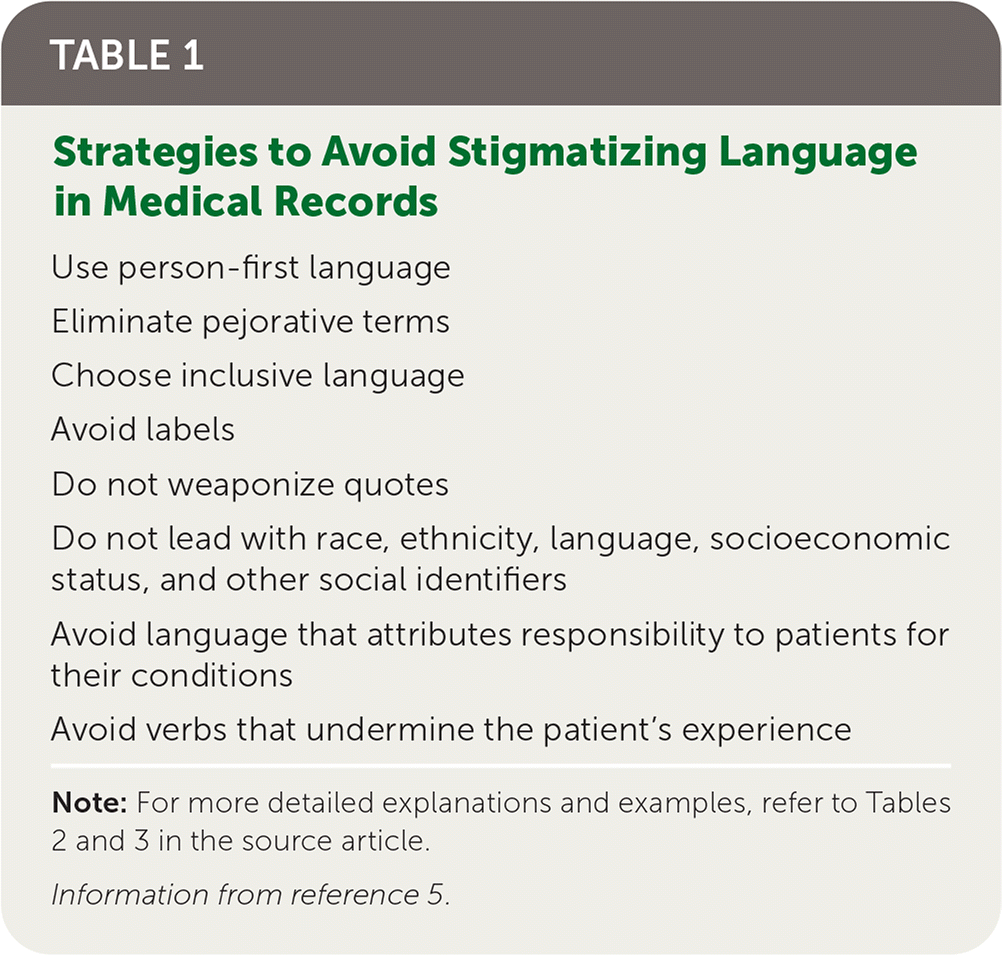
| Use person-first language |
| Eliminate pejorative terms |
| Choose inclusive language |
| Avoid labels |
| Do not weaponize quotes |
| Do not lead with race, ethnicity, language, socioeconomic status, and other social identifiers |
| Avoid language that attributes responsibility to patients for their conditions |
| Avoid verbs that undermine the patient's experience |
Note: For more detailed explanations and examples, refer to Tables 2 and 3 in the source article.
Information from reference 5.
To centralize guidance from diverse sources, including patient advocacy groups, medical organizations, and the academic literature, we compiled recommendations for health care professionals into a narrative review earlier this year.5 The guidelines, summarized in this editorial, apply to all health care team members but are especially important for those who have longitudinal caregiving relationships with patients.
Person-first language, which centers on the patient rather than their condition, is one of the most important humanizing aspects of medical documentation. For example, a “patient with asthma” is preferred to an “asthmatic.” A few exceptions exist; for example, some communities prefer identity-first language (i.e., Deaf or autistic person), and some communities lack consensus. However, most medical conditions should be recorded using person-first language.
Another core principle in clinical communication is to avoid blaming the patient. The biomedical framework in U.S. medical education primes us to focus on deficiencies at the individual or group level. This is further reinforced in our communication, which often centers on discussing risk factors and adherence. We often amplify patient blame in the face of structural failings of the U.S. health care system. Language regarding patient choice can carry undertones of our frustrations (patient “refuses” or “claims”). Neutral alternatives (e.g., chooses, has) improve objectivity while avoiding negative connotations and positions the patient and physician as collaborators rather than adversaries.
We can demonstrate solidarity with patients by documenting and interrogating the social and structural drivers of disparate outcomes, including social determinants of health, institutional racism, and policy failings. We must acknowledge the context in the medical record. For too long, physicians have contributed to the reification of race and other deeply flawed paradigms by essentializing these aspects of identity.6,7 When leading the history of present illness with wording such as “A 50-year-old Spanish-speaking woman with chest pain,” we risk activating unconscious bias in others. Harm can be compounded when this essentialism is propagated in the medical record or other clinical tools. Clinical documentation that is free of bias must recognize social identifiers such as race, primary language, and socioeconomic status as markers of marginalization. Physicians should avoid using these as shortcuts in communication, such as in the “one-liner.” Instead, these aspects of identity belong in the social history and should be verified by the patient rather than assumed. For example, we cannot assume sexual orientation or gender identity based on appearance, and we can ask patients in a respectful manner that acknowledges that these aspects of their identity may factor into their health-related decision-making.
Being open to reconsidering how our language affects patients can ameliorate the otherwise slow progress in medicine. Attention to language is insufficient to dismantle the systems that harm patients, but communication among clinicians is an area we can change right now. Although we have only begun to link biased language to outcomes, preliminary studies demonstrate that stigmatizing terms are used more often in the medical records of Black patients.8–10 While the mechanisms of stigma and bias continue to be untangled, physicians can reaffirm the value of neutral, respectful, patient-centered language.
Improvements in clinical language also reflect progress in other outdated aspects of clinical care. Older terminology that does not accurately portray our understanding of disease has been retired. For example, HIV was referred to in the early days as “gay-related immunodeficiency.”11 And as recently as 2010, child advocates championed legislation to support the removal of “mental retardation” from federal laws, replacing it with the more neutral “intellectual disability.”12 Some clinicians react with frustration to these evolving recommendations, but these changes reflect a positive dialogue among clinicians, patients, and advocates. Future developments such as predictive text, suggested alternate language, and updated International Classification of Diseases (ICD) codes are needed to streamline patient-centered documentation and unburden clinicians. When in doubt, we encourage individuals to consider the patient's perspective when writing notes in the electronic health record and to be open to feedback.
Family physicians are advocates who contextualize patient needs, distill the input of other clinicians, and create and sustain a care plan that best serves the patient. As master collaborators and champions for patients, family physicians have an important role as the stewards of patient stories. A continued conversation about best practices in clinical communication, driven by thought leaders in family medicine, has the potential to model these values for the rest of the medical community.
