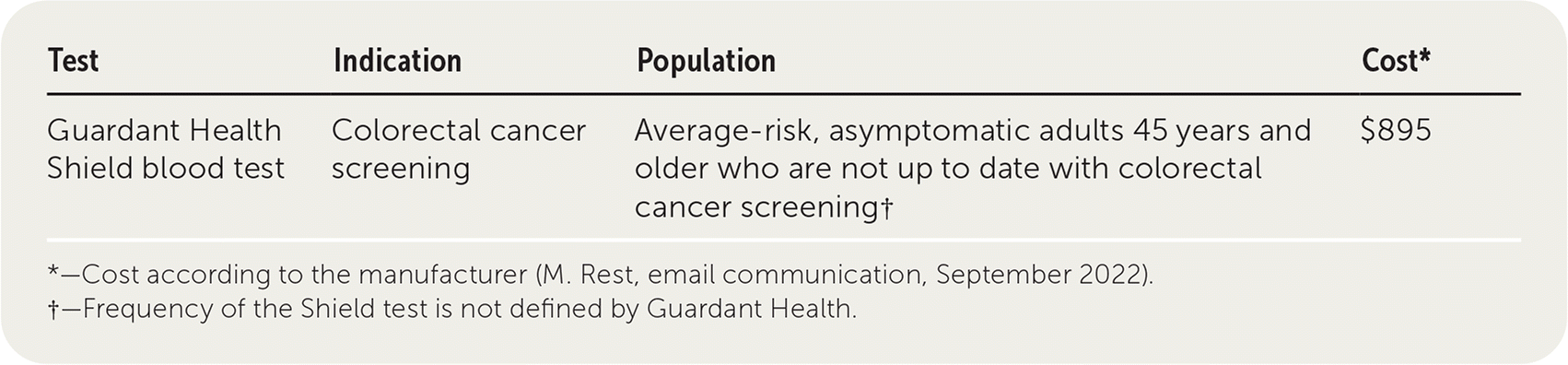
| Test | Indication | Population | Cost* |
|---|---|---|---|
| Guardant Health Shield blood test | Colorectal cancer screening | Average-risk, asymptomatic adults 45 years and older who are not up to date with colorectal cancer screening† | $895 |
*—Cost according to the manufacturer (M. Rest, email communication, September 2022).
†—Frequency of the Shield test is not defined by Guardant Health.
Guardant Health Shield is a proprietary blood test designed to identify genomic and epigenomic alterations in cell‐free DNA and proteomic changes in plasma for early detection of colon cancer.1‐3 The test aims to detect methylation sequences in circulating tumor DNA (ctDNA) present in the bloodstream.1,2 Although not studied for screening, ctDNA has been studied to assess the benefit of adjuvant chemotherapy after colorectal cancer surgery.4 Other early‐detection blood tests for cancer are available, although none have been approved by the U.S. Food and Drug Administration (FDA).5 Shield is not a replacement for currently recommended colorectal cancer screening methods and does not have FDA approval.6
Accuracy
The clinical accuracy of ctDNA for colorectal cancer screening is unknown. A prospective cohort study to evaluate the performance of colon cancer screening using ctDNA, sponsored by Guardant Health (the ECLIPSE trial), is scheduled to be completed in 2024.7 Based on the initial results from this trial, Guardant Health plans to complete its premarket approval submission to the FDA in 2023.
Shield was tested for performance in a cohort of 699 patients with a stage I to III colon cancer diagnosis and 297 control patients negative for advanced colorectal neoplasia. Among the 699 patients with known colon cancer, 671 patients had abnormal results on Shield testing, indicating a sensitivity of 96%. In the 142 asymptomatic patients with colon cancer, the sensitivity was 90%. The specificity in age‐matched cancer‐free control groups was 94%.8 Data from a case‐control study are not optimal in a screening population and will inflate the apparent accuracy of a test.
Shield may be compared with other colon cancer screening methods if it is validated in a screening population. For the detection of colon cancer, the OC‐Sensor fecal immunochemical test has a sensitivity of 74% and specificity of 94%, the multitarget stool DNA test (Cologuard) has a sensitivity of 93% and specificity of 85%, and the serum test that detects circulating methylated DNA (Epi proColon) has a sensitivity of 68% and specificity of 79%.9
Benefit
No clear clinical benefits have been demonstrated by Shield. If clinically validated for a screening population, approved by the FDA, and proven accurate, a colon cancer screening blood test could be a reasonable option for patients who do not wish to undergo screening by current methods. Only 71.6% of adults 50 to 74 years of age were up to date with colon cancer screenings in 2020.10 A blood test is minimally invasive and could be added as part of a comprehensive wellness examination.
Harms
Suboptimal sensitivity of Shield, especially for advanced adenoma, could lead to false reassurance. Poor specificity could lead to false‐positive results, especially in populations with a low prevalence of colorectal cancer.
Cost
According to the manufacturer (M. Rest, email communication, September 2022), Shield costs $895, and the recommended testing interval is not defined. It is not generally covered by insurance. A colonoscopy costs about $1,700 on average, and a fecal immunochemical test costs approximately $50.11 Multitarget stool DNA testing costs $680 and is recommended every three years.12 Health screening intervals would need to be determined to compare colon cancer screening strategies that include Shield.
Bottom Line
The Guardant Health Shield blood test should not yet be ordered for colorectal cancer screening. If validated in a prospective trial and approved by the FDA, Shield could add a noninvasive option for patients choosing to undergo colon cancer screening. More research is needed before comparing this test's accuracy, benefits, and harms with other colon cancer screening methods used regularly in primary care.
Editor's Note: Dr. Brown is a contributing editor for AFP.