

Treatment of Mild Hypertension: Seeing Through SPRINT

Stephen A. Martin, MD,
UMass Chan Medical School, Worcester, Massachusetts

American Family Physician. 2023;108(2):122-124.

Author disclosure: No relevant financial relationships.

Since 2015, hypertension care has been contentious because of a single study: SPRINT (Systolic Blood Pressure Intervention Trial).1 This study, sponsored by the National Institutes of Health, was designed to answer a question debated for more than half a century: Is treatment of mild hypertension with medications warranted and, if so, to what blood pressure targets?2 A 2014 review of mild hypertension that I coauthored found little, if any, benefit to treatment.3 Therefore, SPRINT's results surprised myself and others in primary care, as did differing specialty interpretations about how—or whether—these results should influence hypertension management.

SPRINT enrolled 9,361 patients between 2010 and 2013, with a maximum planned follow-up of six years. Participants were required to have an increased risk of cardiovascular events but notably could not have a history of stroke, diabetes mellitus, symptomatic heart failure within the past six months, or a left ventricular ejection fraction less than 35%. Participants were also excluded for arm circumference being too large or too small and the presence of any factors likely to limit adherence to interventions. After enrollment, participants were randomized to a systolic blood pressure target of less than 140 mm Hg (standard treatment) or less than 120 mm Hg (intensive treatment).

The study was abruptly halted in 2015 because an interim analysis suggested “potentially lifesaving information.” 4 Two months later, the authors published the number needed to treat to prevent a primary outcome event (61), death from any cause (90), and death from cardiovascular causes (172) during the median 3.26 years of the trial.1 The intervention group experienced 3.5 fewer deaths per 1,000 people per year compared to the control group.5

The American College of Cardiology went all in on SPRINT in 2017, establishing new definitions for hypertension and “normal” blood pressure levels, which recategorized nearly one-half of adults in the United States as hypertensive.69 However, the American Academy of Family Physicians and the American College of Physicians, relying on a broader meta-analysis, instead recommended a systolic blood pressure goal of 150 mm Hg for patients older than 60 years.10 The European Society of Cardiology also viewed SPRINT's findings with skepticism and did not incorporate them into the organization's recommendations.11 By 2018, international guidelines were significantly discordant.12

During the same period, researchers took a closer look at SPRINT's methodology. In SPRINT, blood pressure was measured using ideal techniques that are unlikely to be replicated in standard practice.1315 As described by a SPRINT principal investigator, the protocol included “. . . sitting quietly with your feet on the floor for 5 minutes, no smoking, no drinking coffee, no talking, no disturbance in the room. . . . So if you [in primary care] try to push those clinic pressures down to 120, you may get into trouble.”16

In July 2022, the American Academy of Family Physicians further refined its recommendations, returning to the well-supported goal of 140/90 mm Hg for most clinical situations.17 Later that year, we finally learned what happened when SPRINT participants returned to routine practice: blood pressure in the intensive treatment group increased, resuming parity with the standard treatment group.18,19 Authors of the companion editorial speculated that SPRINT's “vigorous” strategies, including at least six visits each year for participants in the intensive treatment group, may not be feasible for busy primary care practices.19 Also, the visit-to-visit variability in office-measured blood pressure in the real world makes it unlikely that SPRINT's transient benefits can be achieved safely and effectively.20

Recognizing that hypertension is the most important risk factor for disability and death,21 what can we do? Increasing staff could allow us to regularly perform the 19 steps of accurate blood pressure measurement described in the American College of Cardiology guideline,6 but the health care workforce is instead at a historic deficit.22 As for the overall time needed, colleagues in Norway have crunched the numbers: they would first need additional physicians, and then each one could provide only hypertension care.23,24 What health benefits would be achieved? For treated patients with mild hypertension, number needed to treat CIs for cardiovascular events over five years range from 55 to 1,188, translating to a personal probability benefit of 0.08% (1 in 1,188) to 1.8% (1 in 55) for any given patient.25,26

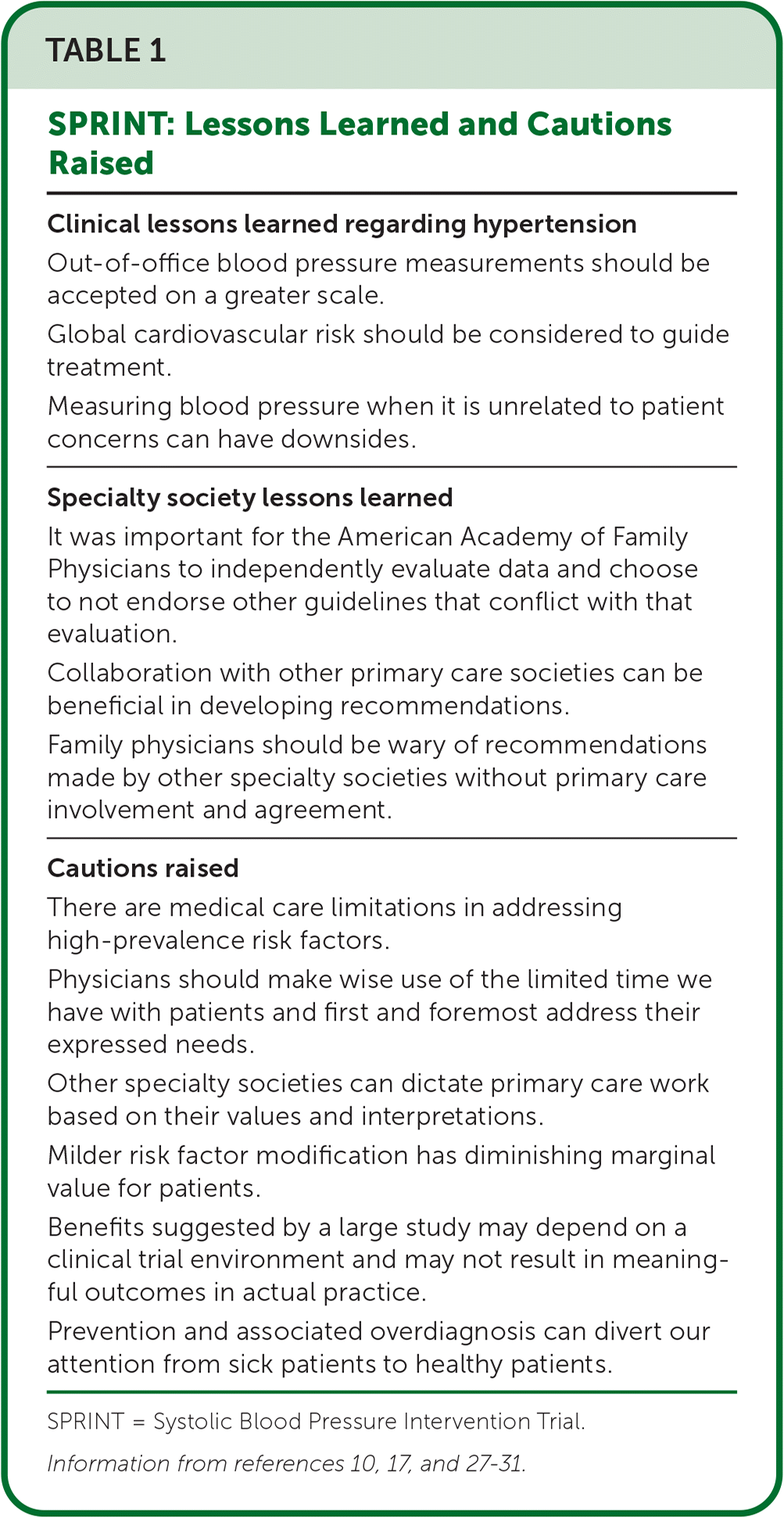
Shared decision-making to describe these unlikely benefits would be challenging at best. SPRINT's influence on the diagnosis and management of hypertension, particularly mild hypertension, has caused disagreement and confusion. There are a number of lessons and cautions to consider (Table 1).10,17,2731 The most profound concern is that primary care efforts are not translating into epidemiologic improvements. Despite our efforts to treat hypertension and diabetes, the prevalence of these conditions continues to rise, and they are becoming less controlled.32,33 We are increasingly asked to emphasize lifestyle measures, yet these recommendations are rarely effective.34,35 Does working harder and longer in primary care with individual patients address population-level prevention in a useful way? Are we right for this job?

TABLE 1. SPRINT: Lessons Learned and Cautions Raised
Clinical lessons learned regarding hypertension
Out-of-office blood pressure measurements should be accepted on a greater scale.
Global cardiovascular risk should be considered to guide treatment.
Measuring blood pressure when it is unrelated to patient concerns can have downsides.

Specialty society lessons learned
It was important for the American Academy of Family
Physicians to independently evaluate data and choose to not endorse other guidelines that conflict with that evaluation.
Collaboration with other primary care societies can be beneficial in developing recommendations.
Family physicians should be wary of recommendations made by other specialty societies without primary care involvement and agreement.

Cautions raised
There are medical care limitations in addressing high-prevalence risk factors.
Physicians should make wise use of the limited time we have with patients and first and foremost address their expressed needs.
Other specialty societies can dictate primary care work based on their values and interpretations.
Milder risk factor modification has diminishing marginal value for patients.
Benefits suggested by a large study may depend on a clinical trial environment and may not result in meaningful outcomes in actual practice.
Prevention and associated overdiagnosis can divert our attention from sick patients to healthy patients.

SPRINT = Systolic Blood Pressure Intervention Trial.

Information from references 10, 17, and 2731.

In 2008, toward the end of her career, Barbara Starfield—a champion of our work—expressed the same concern: “In its focus primarily on professionally defined disease entities, the practice of medicine (and particularly the practice of ‘prevention’) is moving increasingly further from its roots in the care of patients—true ‘patient-centered care.’ ”36

The four fundamental aspects of primary care Starfield identified are first-contact; long-term, person-focused (not disease-focused); comprehensive; and coordinated. She noted that these aspects concern true patient-centered care, not prevention.37 Prevention takes a lot of time,23 and patients are increasingly unable to access our essential work of “resolving undifferentiated illness and providing balanced care for complex medical conditions.”38,39 SPRINT is a cautionary tale of how harm can occur, directly and through opportunity costs, in the pursuit of prevention. Let's please learn from it.

Address correspondence to Stephen A. Martin, MD, at stmartin@gmail.com. Reprints are not available from the author.

Author disclosure: No relevant financial relationships.

  1. 1.Wright JT, Williamson JD, Whelton PK, et al.; SPRINT Research Group. A randomized trial of intensive versus standard blood-pressure control [published correction appears in N Engl J Med. 2017; 377(25): 2506]. N Engl J Med. 2015;373(22):2103-2116.
  2. 2.Perry HM, Smith WM. Mild Hypertension, to Treat or Not to Treat. New York Academy of Sciences; 1978.
  3. 3.Martin SA, Boucher M, Wright JM, et al. Mild hypertension in people at low risk. BMJ. 2014;349:g5432.
  4. 4.Kolata G. Lower blood pressure guidelines could be ‘life-saving,’ federal study says. The New York Times. September 11, 2015. Accessed March 12, 2023. https://www.nytimes.com/2015/09/12/health/blood-pressure-study.html
  5. 5.Lazris A. The SPRINT blood pressure study: small numbers, questionable significance. CuringMedicare. November 12, 2015. Accessed March 12, 2023. https://www.curingmedicare.com/single-post/2015/11/12/The-SPRINT-Blood-Pressure-Study-Small-Numbers-Questionable-Significance
  6. 6.Whelton PK, Carey RM, Aronow WS, et al. 2017 ACC/AHA /A APA /ABC/ACPM/AGS/APhA /ASH/ASPC/NMA /PCNA guideline for the prevention, detection, evaluation, and management of high blood pressure in adults: a report of the American College of Cardiology/American Heart Association Task Force on Clinical Practice Guidelines [published correction appears in J Am Coll Cardiol. 2018; 71(19): 2275–2279]. J Am Coll Cardiol. 2018;71(19):e127-e248.
  7. 7.Casey DE, Thomas RJ, Bhalla V, et al. 2019 AHA/ACC clinical performance and quality measures for adults with high blood pressure. Circ Cardiovasc Qual Outcomes. 2019;12(11):e000057.
  8. 8.High blood pressure redefined for first time in 14 years: 130 is the new high. American Heart Association/American College of Cardiology guidelines. November 13, 2017. Accessed March 12, 2023. https://newsroom.heart.org/news/high-blood-pressure-redefined-for-first-time-in-14-years-130-is-the-new-high
  9. 9.Estimated hypertension prevalence, treatment, and control among U.S. adults. Centers for Disease Control and Prevention. Accessed January 18, 2023. https://millionhearts.hhs.gov/data-reports/hypertension-prevalence.html
  10. 10.Qaseem A, Wilt TJ, Rich R, et al. Pharmacologic treatment of hypertension in adults aged 60 years or older to higher versus lower blood pressure targets: a clinical practice guideline from the American College of Physicians and the American Academy of Family Physicians [published correction appears in Ann Intern Med. 2018; 168(7): 530–532]. Ann Intern Med. 2017;166(6):430-437.
  11. 11.Goel H, Tayel H, Nadar SK. Aiming higher in hopes to achieve lower: the European Society of Cardiology/European Society of Hypertension versus the American College of Cardiology/American Heart Association guidelines for diagnosis and management of hypertension. J Hum Hypertens. 2019;33(9):635-638.
  12. 12.Messerli FH, Bangalore S. The blood pressure landscape: schism among guidelines, confusion among physicians, and anxiety among patients. J Am Coll Cardiol. 2018;72(11):1313-1316.
  13. 13.Cushman WC, Lin KW. Measuring BP is simple, right? Not so fast. Medscape. August 14, 2018. Accessed March 12, 2023. https://www.medscape.com/viewarticle/900370
  14. 14.Ortiz E, James PA. Let's not SPRINT to judgment about new blood pressure goals. Ann Intern Med. 2016;164(10):692-693.
  15. 15.Messerli FH, Bangalore S. Should we SPRINT toward new blood pressure goals or let the dust settle?. Am J Med. 2016;129(8):769-770.
  16. 16.Phend C. Hypertension: here's why to wait on the SPRINT trial strategy. Medpage Today. September 21, 2015. Accessed March 12, 2023. https://www.medpagetoday.com/cardiology/hypertension/53661
  17. 17.Coles S, Fisher L, Lin KW, et al. Blood pressure targets in adults with hypertension: a clinical practice guideline from the AAFP. Am Fam Physician. 2022;106(6) ): online. Accessed May 19, 2023. https://www.ncbi.nlm.nih.gov/pubmed/36521481
  18. 18.Jaeger BC, Bress AP, Bundy JD, et al. Longer-term all-cause and cardiovascular mortality with intensive blood pressure control: a secondary analysis of a randomized clinical trial. JAMA Cardiol. 2022;7(11):1138-1146.
  19. 19.Jones DW, Clark D, Hall ME. Blood pressure control after SPRINT—back to reality. JAMA Cardiol. 2022;7(11):1146-1147.
  20. 20.Lu Y, Linderman GC, Mahajan S, et al. Quantifying blood pressure visit-to-visit variability in the real world setting: a retrospective cohort study. Circ Cardiovasc Qual Outcomes. 2023;16(4).
  21. 21.McManus RJ, Mant J. Hypertension: new US blood-pressure guidelines – who asked the patients?. Nat Rev Cardiol. 2018;15(3):137-138.
  22. 22.Johnson SR. Staff shortages choking U.S. health care system. U.S. News & World Report. July 28, 2022. Accessed March 19, 2023. https://www.usnews.com/news/health-news/articles/2022-07-28/staff-shortages-choking-u-s-health-care-system
  23. 23.Johansson M, Guyatt G, Montori V. Guidelines should consider clinicians' time needed to treat. BMJ. 2023;380:e072953.
  24. 24.Petursson H, Getz L, Sigurdsson JA, et al. Current European guidelines for management of arterial hypertension: are they adequate for use in primary care? Modelling study based on the Norwegian HUNT 2 population. BMC Fam Pract. 2009;10:70.
  25. 25.Shaughnessy AF. Some benefit to treating mild hypertension to prevent stroke, CV deaths, and overall mortality [POEM]. Am Fam Physician. 2015;92(11):1020.
  26. 26.Heath I. Waste and harm in the treatment of mild hypertension. JAMA Intern Med. 2013;173(11):956-957.
  27. 27.LeFevre M. ACC/AHA Hypertension guideline: What is new? What do we do? [Editorial]. Am Fam Physician. 2018;97(6):372-373.
  28. 28.Porter J, Boyd C, Skandari MR, et al. Revisiting the time needed to provide adult primary care. J Gen Intern Med. 2023;38(1):147-155.
  29. 29.Thériault G, Grad R, Dickinson JA, et al. Beware of overdiagnosis harms from screening, lower diagnostic thresholds, and incidentalomas. Can Fam Physician. 2023;69(2):97-100.
  30. 30.Tesser CD. Why is quaternary prevention important in prevention?. Rev Saude Publica. 2017;51:116.
  31. 31.Rubin R. More Evidence that hypertension treatment decisions shouldn't depend solely on in-office blood pressure readings. JAMA. 2023;329(19):1630-1632.
  32. 32.Aggarwal R, Yeh RW, Joynt Maddox KE, et al. Cardiovascular risk factor prevalence, treatment, and control in US adults aged 20 to 44 years, 2009 to March 2020. JAMA. 2023;329(11):899-909.
  33. 33.Muntner P, Hardy ST, Fine LJ, et al. Trends in blood pressure control among US adults with hypertension, 1999–2000 to 2017–2018. JAMA. 2020;324(12):1190-1200.
  34. 34.Steinberg D, Bennett GG, Svetkey L. The DASH diet, 20 years later. JAMA. 2017;317(15):1529-1530.
  35. 35.Greenland P. Cardiovascular guideline skepticism vs lifestyle realism?. JAMA. 2018;319(2):117-118.
  36. 36.Starfield B, Hyde J, Gérvas J, et al. The concept of prevention: a good idea gone astray?. J Epidemiol Community Health. 2008;62(7):580-583.
  37. 37.Starfield B, Shi L, Macinko J. Contribution of primary care to health systems and health. Milbank Q. 2005;83(3):457-502.
  38. 38.Korownyk C, McCormack J, Kolber MR, et al. Competing demands and opportunities in primary care. Can Fam Physician. 2017;63(9):664-668.
  39. 39.Ducharme J. Long waits, short appointments, huge bills: U.S. health care is causing patient burnout. Time. February 27, 2023. Accessed February 28, 2023. https://time.com/6257775/patient-burnout-health-care/

Copyright © 2026 by the American Academy of Family Physicians.

This content is owned by the AAFP. A person viewing it online may make one printout of the material and may use that printout only for his or her personal, non-commercial reference. This material may not otherwise be downloaded, copied, printed, stored, transmitted or reproduced in any medium, whether now known or later invented, except as authorized in writing by the AAFP. See permissions for copyright questions and/or permission requests.