

Persistent Dry Cough

Jennifer M. Corliss, MD, FAAFP,
Jennifer M. Lai, BS,
University of Colorado School of Medicine, Denver, Colorado

American Family Physician. 2023;108(6):622A-622C.

Author disclosure: No relevant financial relationships.

A 71-year-old man presented with a persistent dry cough that had been gradually worsening over the past 30 years. The cough was worse at night, especially while lying flat. He was treated with famotidine for gastroesophageal reflux disease (GERD) and completed a trial of albuterol, without improvement. After a two-week course of omeprazole, the patient perceived moderate improvement in his cough, but it persisted at night. The patient had no other gastrointestinal, cardiac, or respiratory symptoms. He did not have sick contacts, fever, chills, myalgias, headaches, chest pain, fatigue, rash, or dyspnea. He had a history of smoking, seasonal allergies, and eczema. He was not a current smoker.

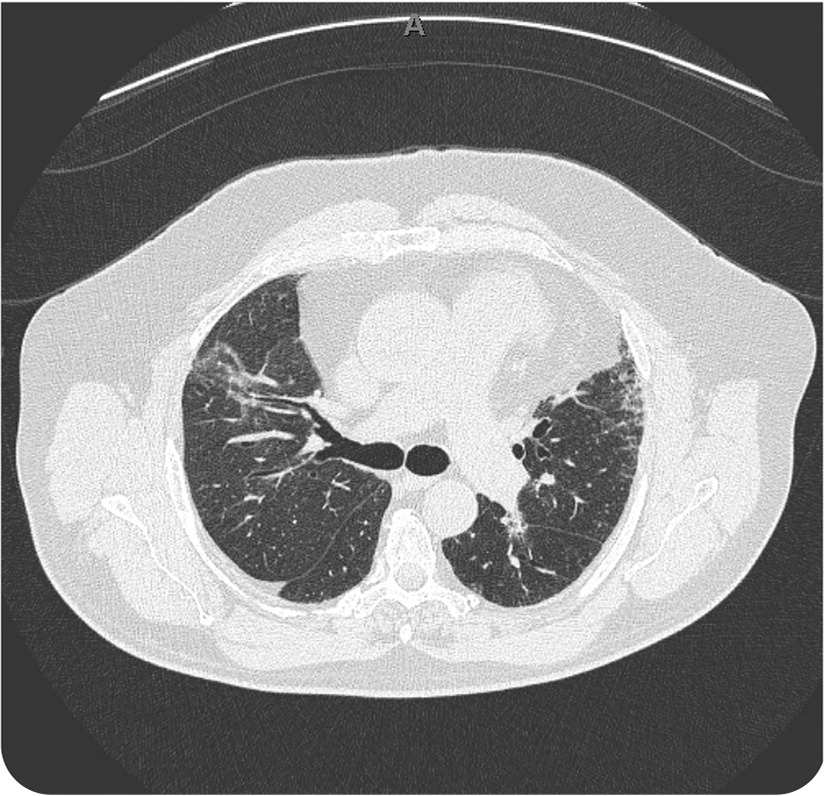
On examination, the patient was afebrile and normotensive. He had a body mass index of 38 kg per m2 (class 2 obesity) and an oxygen saturation of 92% on room air. He had normal respiratory effort but decreased aeration in the bilateral lung bases. The rest of the physical examination was unremarkable. Chest radiography and subsequent computed tomography (CT) were performed (Figure 1 and Figure 2).

FIGURE 1
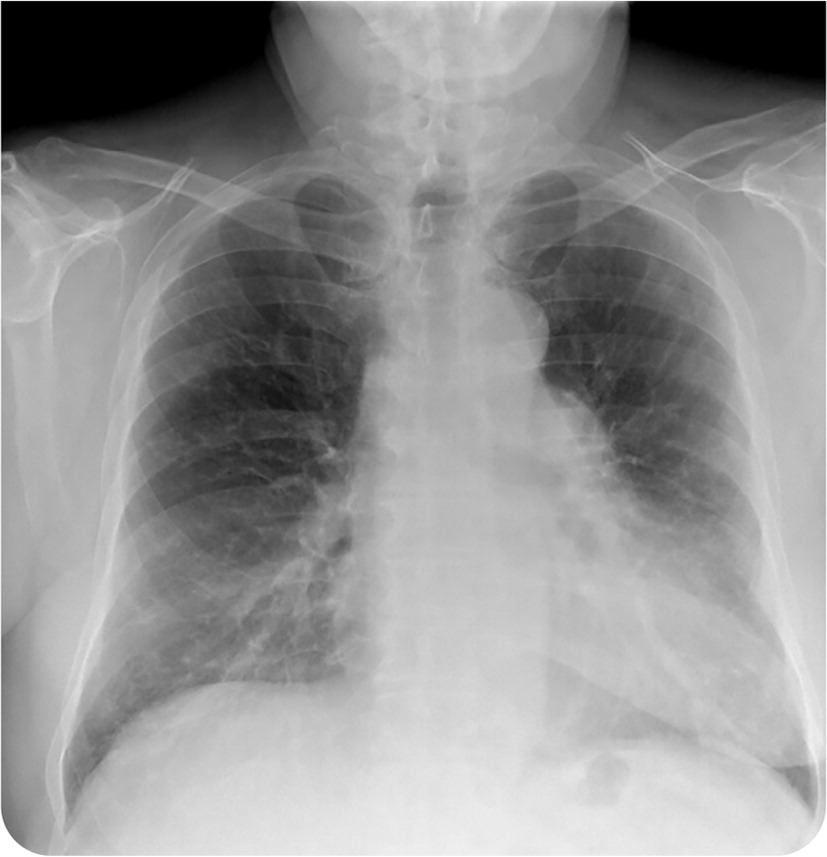
FIGURE 2
Question

Based on the patient’s history and physical examination findings, which one of the following is the most likely diagnosis?

  • A. Chronic obstructive pulmonary disease.
  • B. Desquamative interstitial pneumonia.
  • C. Idiopathic pulmonary fibrosis.
  • D. Sarcoidosis.

Discussion

The answer is C: idiopathic pulmonary fibrosis. The patient showed significant improvement after two weeks of treatment with a proton pump inhibitor. A correlation has been shown between GERD and the development of idiopathic pulmonary fibrosis. Idiopathic pulmonary fibrosis is a chronic, progressive disease characterized by the deposition of fibrotic tissue in the pulmonary interstitium, without a clear pathophysiologic mechanism. Animal studies have shown that chronic aspiration leads to pulmonary inflammation and fibrosis.13 Gastric contents, such as pepsin and bile acid, has been found on broncho-alveolar lavage in patients with idiopathic pulmonary fibrosis.4,5

Chest radiography of patients with pulmonary fibrosis shows reticular shadowing of the lung peripheries, predominantly in the lung bases (Figure 3A). High-resolution CT is needed for diagnosis, with findings typically characterized by bilateral reticular opacities, honeycombing, and architectural distortion of the subpleural lung regions and lower lobes6 (Figure 3B).

FIGURE 3.
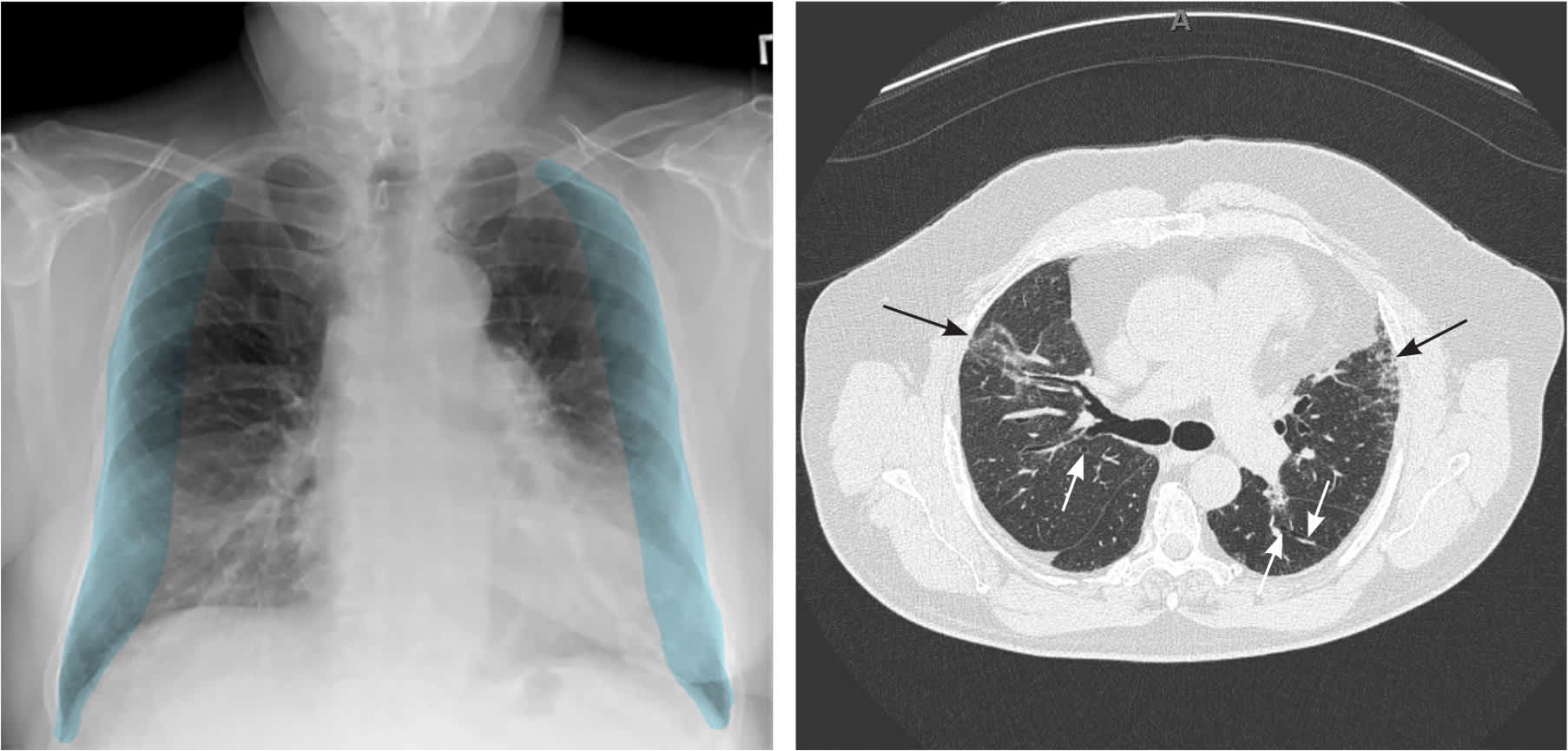
Imaging findings in a patient with idiopathic pulmonary fibrosis. (A) Chest radiography showing reticular and ground-glass opacities in both lungs, predominantly in the lower lungs (blue shading). (B) Computed tomography showing basilar subpleural reticulation (black arrows) with mild bronchiectasis (white arrows).

Chronic obstructive pulmonary disease (COPD) is an obstructive lung disease, unlike the other diagnoses, which are restrictive disorders. COPD is characterized by dyspnea, chronic cough, and sputum production. Chest radiography shows a flattened diaphragm, hyperexpanded lungs, decreased vasculature at the bases, and possible bullae associated with emphysema. CT can show the extent of emphysema. Spirometry is the diagnostic standard for COPD.

Desquamative interstitial pneumonia is a subtype of interstitial lung disease correlated with heavy smoking. It is characterized by macrophages accumulating in the alveolar spaces, leading to interstitial inflammation and fibrosis.7 Findings on chest radiography are normal in up to 20% of patients with this condition. Chest CT shows ground-glass opacities without the peripheral reticular opacities seen with typical interstitial pneumonia.8

Sarcoidosis, a subset of interstitial lung disease, is an inflammatory granulomatous disease of unknown etiology that can cause fibrocystic architectural distortion of the lungs. It is characterized by bilateral hilar adenopathy and pulmonary reticular opacities in the upper lung zone, and may involve the skin, joints, or eyes. The presence of small nodules in a perilymphatic distribution is the key finding on CT.9

SUMMARY TABLE

ConditionChest radiography findingsComputed tomography findings
Chronic obstructive pulmonary diseaseFlattened diaphragm, hyperexpanded lungs, decreased vasculature at the lung basesExtent of emphysema
Desquamative interstitial pneumoniaFindings are minimal or absentGround-glass opacities without peripheral reticular opacities
Idiopathic pulmonary fibrosisReticular shadowing of the lung peripheries, predominantly in the lung bases (Figure 3A)Bilateral reticular opacities, honeycombing, and architectural distortion of the subpleural lung regions and lower lobes (Figure 3B)
SarcoidosisBilateral hilar adenopathy and pulmonary reticular opacities in the upper lung zoneSmall nodules in a perilymphatic distribution

Address correspondence to Jennifer M. Corliss, MD, FAAFP, at jennifer.corliss@cuanschutz.edu. Reprints are not available from the authors.

Author disclosure: No relevant financial relationships.

  1. 1.Colombo JL, Hallberg TK. Airway reactivity following repeated milk aspiration in rabbits. Pediatr Pulmonol. 2000;29(2):113-119.
  2. 2.Lopes FD, Alvarenga GS, Quiles R, et al. Pulmonary responses to tracheal or esophageal acidification in guinea pigs with airway inflammation. J Appl Physiol (1985). 2002;93(3):842-847.
  3. 3.Appel JZ, Lee SM, Hartwig MG, et al. Characterization of the innate immune response to chronic aspiration in a novel rodent model. Respir Res. 2007;8(1):87.
  4. 4.Perng DW, Chang KT, Su KC, et al. Exposure of airway epithelium to bile acids associated with gastroesophageal reflux symptoms. Chest. 2007;132(5):1548-1556.
  5. 5.Davis CS, Mendez BM, Flint DV, et al. Pepsin concentrations are elevated in the bronchoalveolar lavage fluid of patients with idiopathic pulmonary fibrosis after lung transplantation. J Surg Res. 2013;185(2):e101-e108.
  6. 6.American Thoracic Society, European Respiratory Society. Idiopathic pulmonary fibrosis. Am J Respir Crit Care Med. 2000;161(2 pt 1):646-664.
  7. 7.Tazelaar HD, Wright JL, Churg A. Desquamative interstitial pneumonia. Histopathology. 2011;58(4):509-516.
  8. 8.Akira M, Yamamoto S, Hara H, et al. Serial computed tomographic evaluation in desquamative interstitial pneumonia. Thorax. 1997;52(4):333-337.
  9. 9.Ganeshan D, Menias CO, Lubner MG, et al. Sarcoidosis from head to toe: what the radiologist needs to know. Radiographics. 2018;38(4):1180-1200.

The editors of AFP welcome submissions for Photo Quiz. Guidelines for preparing and submitting a Photo Quiz manuscript can be found in the Authors' Guide at https://www.aafp.org/afp/photoquizinfo. To be considered for publication, submissions must meet these guidelines. Email submissions to afpphoto@aafp.org.

This series is coordinated by John E. Delzell Jr., MD, MSPH, associate medical editor.

A collection of Photo Quiz published in AFP is available at https://www.aafp.org/afp/photoquiz.

Copyright © 2026 by the American Academy of Family Physicians.

This content is owned by the AAFP. A person viewing it online may make one printout of the material and may use that printout only for his or her personal, non-commercial reference. This material may not otherwise be downloaded, copied, printed, stored, transmitted or reproduced in any medium, whether now known or later invented, except as authorized in writing by the AAFP. See permissions for copyright questions and/or permission requests.
