

A 73-year-old woman presented with a nail abnormality. She first noticed the condition several months earlier in her toenails, and then it also developed in her fingernails. The patient had no history of similar nail issues. She had previously seen a dermatologist for this condition, and a potassium hydroxide preparation showed no hyphae.
Her medical history was significant for gastroesophageal reflux disease with gastritis diagnosed by esophagogastroduodenoscopy. These symptoms were not well controlled despite treatment with proton pump inhibitors. She also had Graves disease, which was treated with radiofrequency ablation 40 years earlier. The patient was treated with amlodipine for Raynaud disease, but this was discontinued due to hypotension. She was a 90-pack-year smoker but had not smoked for 12 years.
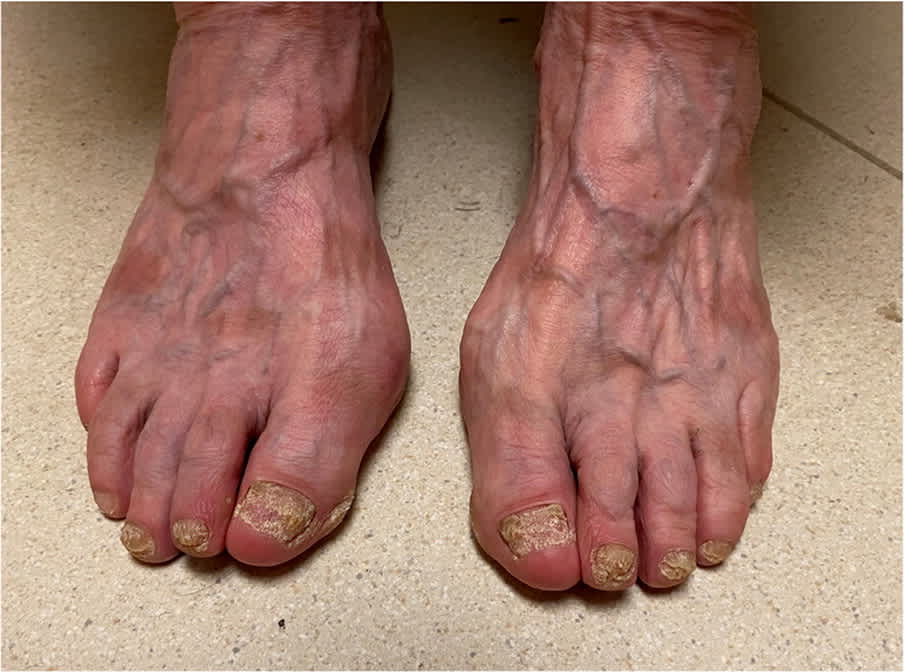
Examination revealed yellowed fingernails with longitudinal striations (Figure 1). The patient's toenails were thickened, brittle, and yellowed with a crumbled appearance (Figure 2).
FIGURE 1
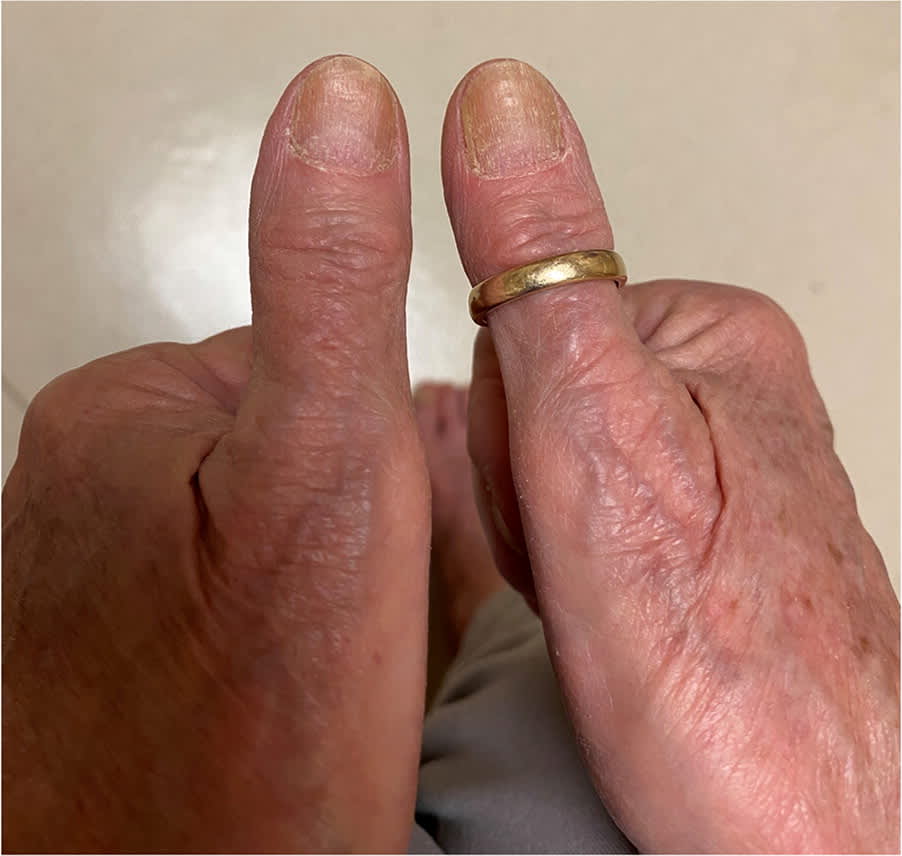
FIGURE 2
QUESTION
Based on the patient's history and physical examination, which one of the following is the most likely diagnosis?
- A. Chronic obstructive pulmonary disease.
- B. Endocarditis.
- C. Iron deficiency anemia.
- D. Onychomycosis.
- E. Scleroderma.
DISCUSSION
The answer is E: scleroderma, also known as systemic sclerosis. This is a chronic connective tissue disorder initially characterized by thickening of the skin. Its cause is unknown. Blood vessel damage and tissue injury result in scar tissue formation and the accumulation of excess collagen, particularly in the skin.1 Scleroderma is rare, with a prevalence of 4 to 250 cases per 1 million people.2 Raynaud phenomenon is the most common manifestation, occurring in more than 95% of patients with the condition. Due to the concern for systemic disease, this patient was tested for antinuclear antibodies; the screening result was positive.
The history of treatment-resistant gastritis and Graves disease also suggests an autoimmune condition. Involvement of all her fingernails is suggestive of a systemic process as opposed to a local condition, such as onychomycosis. Further rheumatologic workup detected Scl-70 antibody (anti-topoisomerase 1), which is a diagnostic criterion for scleroderma.
As with many autoimmune diseases of unknown etiology, management involves monitoring potentially affected organs and minimizing damage. Important sequelae of scleroderma include pulmonary fibrosis and pulmonary arterial hypertension.2 Treatment of scleroderma is complex and targets immunomodulation in affected organs.3
Patients with chronic obstructive pulmonary disease often develop nail clubbing. Clubbing is caused by thickening of the nail bed at the proximal end of the finger. This results in straightening of the angle between the nail bed and the nail. Clubbing is also associated with chronic heart disease.4
Approximately 15% of patients with endocarditis have splinter hemorrhages, which appear as thin, red-brown lines that run vertically under the fingernails. The hemorrhages are caused by small blood clots that occur due to damage to the capillaries. Other diseases associated with endocarditis include psoriasis and renal, pulmonary, endocrine, and systemic skin conditions.4
Iron deficiency anemia is associated with koilonychia (spoon-shaped, concave nails). The pathogenesis of koilonychia is unclear but may be related to reduced blood flow to the connective tissue underlying the nail bed.5
Onychomycosis is fungal infection of the nail. It can occur on fingernails but is more common on toenails. This patient was initially presumed to have onychomycosis due to the irregularity in the nails and the high prevalence of onychomycosis, but repeated potassium hydroxide examinations of nail scrapings provided no evidence of fungal infection. Furthermore, onychomycosis rarely affects all toenails and fingernails simultaneously. It is common in patients with diabetes mellitus.4
Read the full article
Get immediate access, anytime, anywhere.
Choose a single article, issue, or full-access subscription.
Earn up to 14 CME credits per issue.
