

Although most physicians are interested in the use of augmented or artificial intelligence (AI) in health care, only 38% are using AI in their practices.1 Initial results from AI integrated organizations show that AI scribe programs significantly decrease electronic health record workload, and as physician burnout rates remain high, there is greater interest in AI tools.2 , 3 The cautious approach to AI by physicians is due in part to the absence of necessary oversight and a limited regulatory framework.4 As AI changes health care delivery, primary care must be at the forefront to shape practice transformation.5
AI scribe services aim to reduce administrative burden, although the nuances of implementation vary between companies. Most tools feature customizable note templates, including national repositories used by other clinicians. Most available AI scribe tools offer medical code extraction, ranging from identifying key diagnoses and billable procedures to suggesting additional codes based on commonly co-occurring disorders, all with the hope of reducing the burden on doctors.
An environmental scan of the literature was used to identify evaluations of AI in practice. There are few studies on AI scribes, and none include direct comparative analytics of the various products. Several commentary and opinion pieces highlight the immense promise of AI scribes while remaining wary of the significant risks, including technical limitations and ethical concerns.6–8 One perspective piece illuminates particular concern about chart integrity degradation, biases, and “model collapse” where future AIs are trained on past data, ultimately leading to performance decline.9 Although these critiques are valid, they underestimate the dynamic nature of technologic evolution and health care’s capacity to refine these tools, ensuring they are tailored to meet the evolving needs of clinicians.
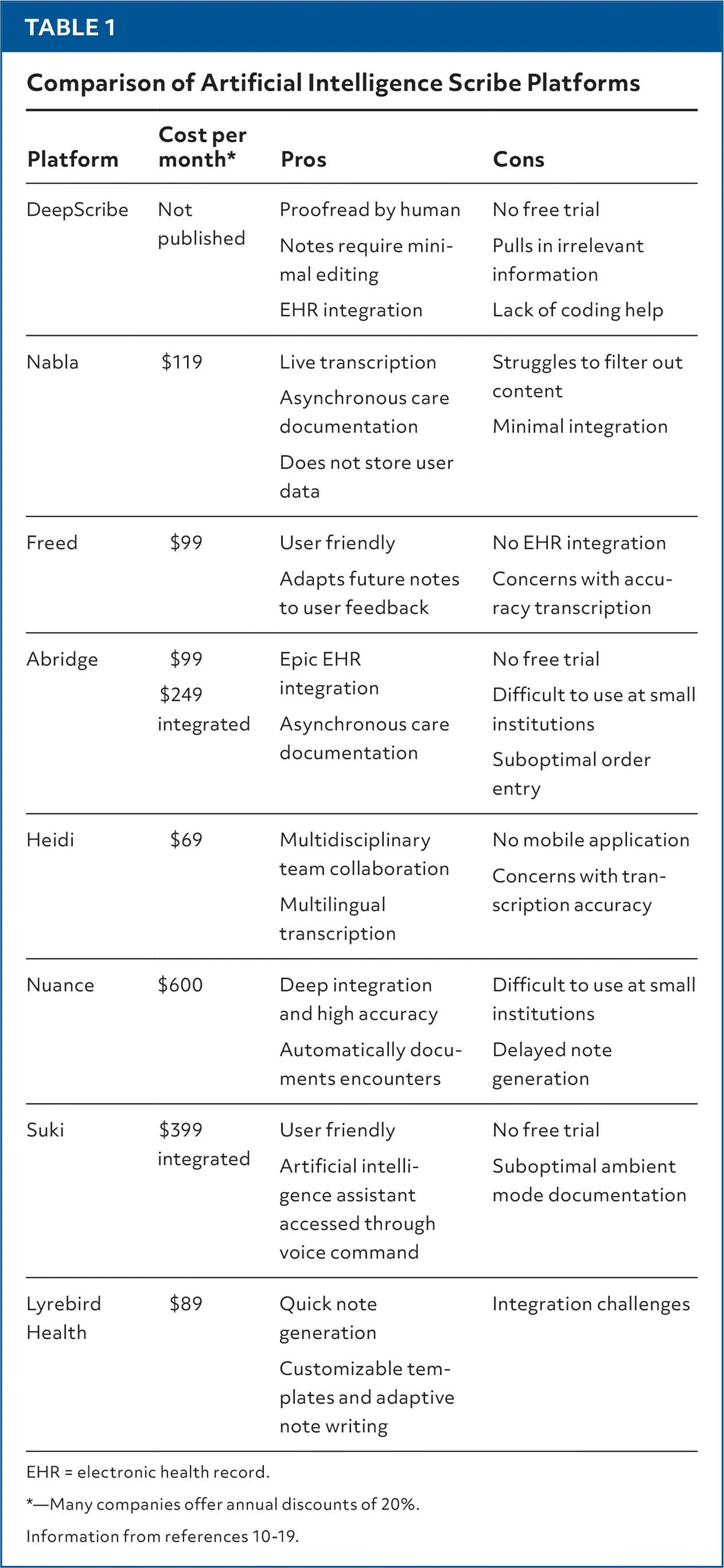
The authors also explored commercially available clinical AI scribes through reviews from peer forums and vendor marketplace sites. The list was compiled based on reputable reviews, popularity, and commercial availability. Platforms with insufficient online presence and those still in the beta testing stage, such as Doximity GPT, were eliminated from consideration. Eight companies were identified for review (Table 1).10–19 Services offered by companies included ambient listening, note generation (eg, history of present illness, review of systems, physical examination, assessment and planning), diagnosis coding, and order recommendations. The most cited concerns pertained to accuracy. Although some AI scribe services claim to have 90% to 99% accuracy, users have reported a different experience.10,12,14 AI hallucination, or false information produced by a generative AI model, ranges in severity from misleading to outright fabrication.6 This is a marked concern for clinicians who rely on accurate documentation to facilitate patient care and protect against litigation. Consequently, not all users believed that the scribe saved documentation time because of the need to review and edit the AI-generated notes.2,10
TABLE 1. Comparison of Artificial Intelligence Scribe Platforms
| Platform | Cost per month* | Pros | Cons |
|---|---|---|---|
| DeepScribe | Not published | Proofread by human Notes require minimal editing EHR integration | No free trial Pulls in irrelevant information Lack of coding help |
| Nabla | $119 | Live transcription Asynchronous care documentation Does not store user data | Struggles to filter out content Minimal integration |
| Freed | $99 | User friendly Adapts future notes to user feedback | No EHR integration Concerns with accuracy transcription |
| Abridge | $99 $249 integrated | Epic EHR integration Asynchronous care documentation | No free trial Difficult to use at small institutions Suboptimal order entry |
| Heidi | $69 | Multidisciplinary team collaboration Multilingual transcription | No mobile application Concerns with transcription accuracy |
| Nuance | $600 | Deep integration and high accuracy Automatically documents encounters | Difficult to use at small institutions Delayed note generation |
| Suki | $399 integrated | User friendly Artificial intelligence assistant accessed through voice command | No free trial Suboptimal ambient mode documentation |
| Lyrebird Health | $89 | Quick note generation Customizable templates and adaptive note writing | Integration challenges |
EHR = electronic health record.
*—Many companies offer annual discounts of 20%.
AI scribe services are promising for electronic health record interoperability and improved care delivery. However, the need for appropriate AI oversight is clear.20 Regulation and policies should promote patient safety and information security. The risk of biases perpetuated by AI algorithms and the threat of data breaches must be mitigated through ethical and accountable governance.21 The trustworthiness and acceptance of AI remains uncertain.
