

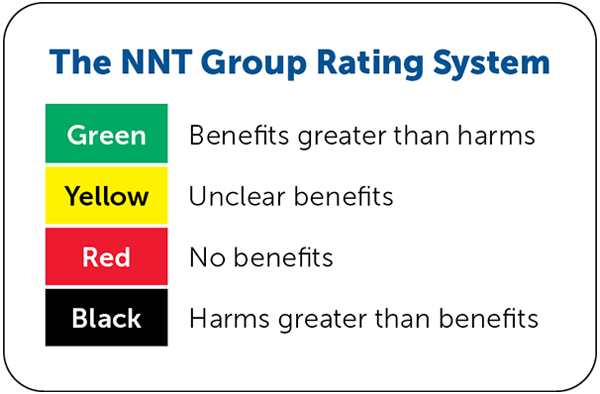
Parenteral Agents for Mitigating Migraine Relapse

Brit Long, MD
Michael Gottlieb, MD

American Family Physician. 2025;112(3):254-257.

Author disclosure: No relevant financial relationships.

DETAILS FOR THIS REVIEW

Study Population: 6,167 adults with acute migraine from 53 randomized controlled trials in an emergency setting comparing parenteral agents with placebo or other agents

Efficacy End Points: Migraine relapse reduction

Harm End Points: No comments about harms in the review

THE NUMBERS
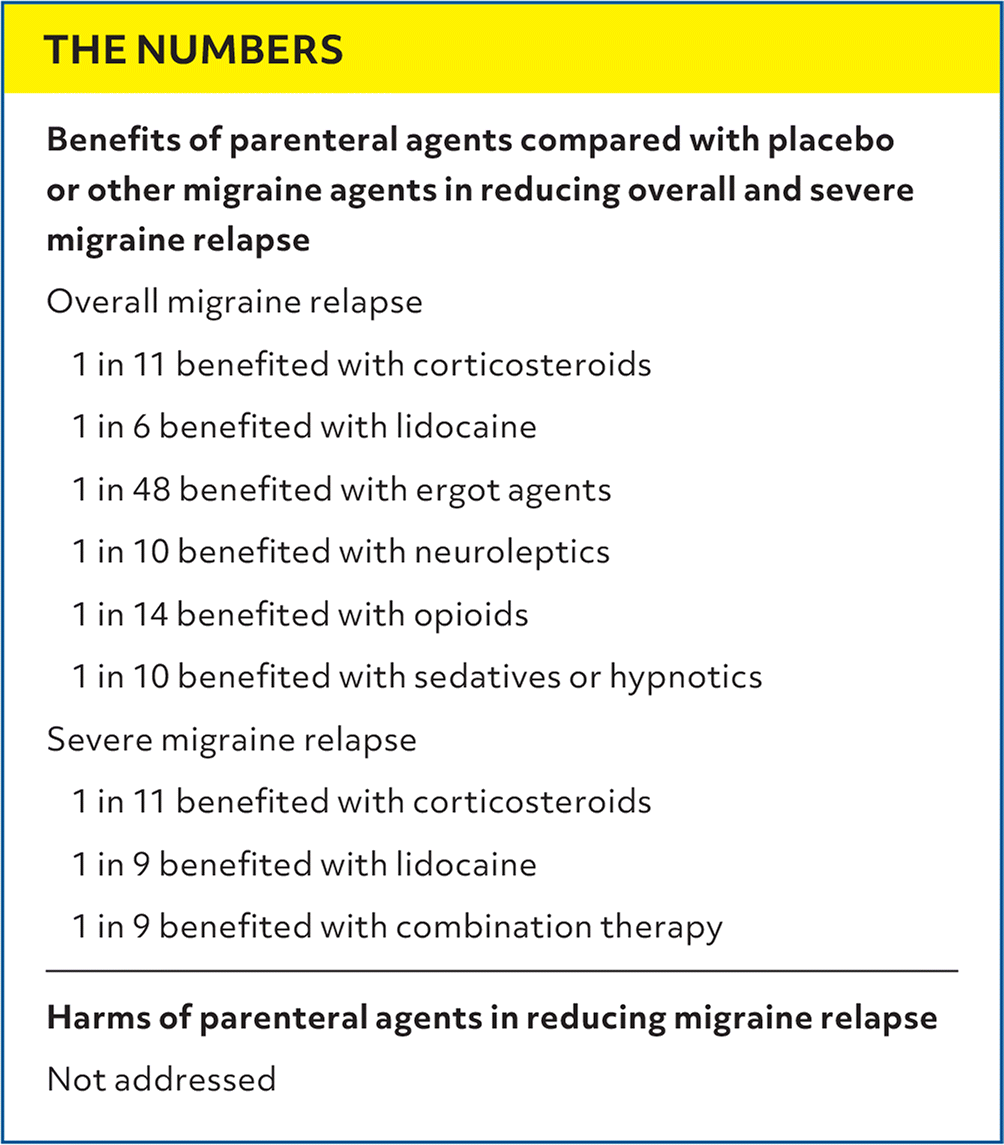
Benefits of parenteral agents compared with placebo or other migraine agents in reducing overall and severe migraine relapse
Overall migraine relapse
1 in 11 benefited with corticosteroids
1 in 6 benefited with lidocaine
1 in 48 benefited with ergot agents
1 in 10 benefited with neuroleptics
1 in 14 benefited with opioids
1 in 10 benefited with sedatives or hypnotics
Severe migraine relapse
1 in 11 benefited with corticosteroids
1 in 9 benefited with lidocaine
1 in 9 benefited with combination therapy
Harms of parenteral agents in reducing migraine relapse
Not addressed

Narrative: Acute migraine can be debilitating because of severe pain and symptoms such as nausea, vomiting, photophobia, and phonophobia.1 These episodic headaches often require care in an acute care setting when home-based therapies fail.2,3 American Headache Society and Canadian Headache Society guidelines recommend a variety of parenteral agents for the treatment of an acute migraine episode, including nonsteroidal anti-inflammatory drugs, metoclopramide, neuroleptics, and triptans.48 However, the risk of migraine persistence or relapse within 72 hours is significant despite treatment, often requiring a return visit.9,10 Corticosteroids have been shown to reduce migraine relapse frequency and severity, but repeated corticosteroid use can result in adverse effects, including hypertension, hyperglycemia, gastrointestinal bleeding, and osteoporosis.1113

Several pairwise and network meta-analyses have compared the relative effectiveness of two or more interventions for treating acute migraine pain. No systematic review, however, has evaluated the effectiveness of parenteral agents in reducing the risk of relapse with a network meta-analysis, which allows for simultaneous synthesis of direct and indirect evidence for two or more interventions.1419 The systematic review discussed here uses a frequentist network meta-analysis to assess the effectiveness of parenteral agents to reduce migraine relapse.20

The meta-analysis included 53 randomized controlled trials of 6,167 adults receiving treatment for acute migraine headache in an emergency setting.20 Studies including other headache types were eligible if they reported outcomes for migraine separately or if 80% or more of the study population had migraines.

Included studies evaluated the effectiveness of two or more eligible parenteral agents, including antiemetics, nonsteroidal anti-inflammatory drugs, ergot agents, anticonvulsants, neuroleptics, opioids, magnesium sulfate, lidocaine, sedatives or hypnotics (eg, ketamine, propofol), other analgesics (eg, acetaminophen, lysine-acetylsalicylic acid), combination therapy comprising two different parenteral agents provided simultaneously, or placebo. Studies evaluating agents targeting the calcitonin gene–related peptide pathway, greater occipital nerve blocks, or other emergency parenteral agents were excluded because these agents are not recommended or widely available in emergency settings.

The primary outcome was migraine relapse, defined as recurrent or worsening headache pain after discharge that may or may not result in a return to the emergency setting or other health care setting. Time of relapse assessment was classified as short term (72 hours or less) or long term (more than 72 hours). Severe relapse was defined as a return visit to an emergency or other health care setting due to migraine or recurring headache pain designated as severe using a pain score or relapse classification system.

BRIT LONG, MD, University of Virginia School of Medicine, Charlottesville

MICHAEL GOTTLIEB, MD, Rush University Medical Center, Chicago, Illinois

Address correspondence to Brit Long, MD, at brit.long@yahoo.com.

Author disclosure: No relevant financial relationships.

  1. 1.International Headache Society. International Classification of Headache Disorders 3rd Edition (ICHD-3). Accessed September 21, 2020. https://ichd-3.org/
  2. 2.Friedman BW. Migraine in the emergency department. Neurol Clin. 2019;37(4):743-752.
  3. 3.Wijeratne T, Kuan WS, Kelly AM, et al.; HEAD Study Group. Migraine in the emergency department. Neuroepidemiology. 2022;56(1):32-40.
  4. 4.American Headache Society. The American Headache Society position statement on integrating new migraine treatments into clinical practice. Headache. 2019;59(1):1-18.
  5. 5.Orr SL, Aubé M, Becker WJ, et al. Canadian Headache Society systematic review and recommendations on the treatment of migraine pain in emergency settings. Cephalalgia. 2015;35(3):271-284.
  6. 6.Vinson DR, Hurtado TR, Vandenberg JT, et al. Variations among emergency departments in the treatment of benign headache. Ann Emerg Med. 2003;41(1):90-97.
  7. 7.Friedman BW, West J, Vinson DR, et al. Current management of migraine in US emergency departments. Cephalalgia. 2015;35(4):301-309.
  8. 8.Yang S, Orlova Y, Lipe A, et al. Trends in the management of headache disorders in US emergency departments. J Clin Med. 2022;11(5):1401.
  9. 9.Ducharme J, Beveridge RC, Lee JS, et al. Emergency management of migraine: is the headache really over? Acad Emerg Med. 1998;5(9):899-905.
  10. 10.Friedman BW, Solorzano C, Esses D, et al. Treating headache recurrence after emergency department discharge. Ann Emerg Med. 2010;56(1):7-17.
  11. 11.Colman I, Friedman BW, Brown MD, et al. Parenteral dexamethasone for acute severe migraine headache. BMJ. 2008;336(7657):1359-1361.
  12. 12.Schellenberg ES, Dryden DM, Pasichnyk D, et al.; Agency for Healthcare Research and Quality. Acute migraine treatment in emergency settings. Comparative effectiveness review no 84. November 2012. Accessed July 21, 2025. https://effectivehealthcare.ahrq.gov/sites/default/files/pdf/migraine-emergency_research.pdf
  13. 13.Rice JB, White AG, Scarpati LM, et al. Long-term systemic corticosteroid exposure: a systematic literature review. Clin Ther. 2017;39(11):2216-2229.
  14. 14.Colman I, Brown MD, Innes GD, et al. Parenteral dihydroergotamine for acute migraine headache: a systematic review of the literature. Ann Emerg Med. 2005;45(4):393-401.
  15. 15.Colman I, Brown MD, Innes GD, et al. Parenteral metoclopramide for acute migraine: meta-analysis of randomised controlled trials. BMJ. 2004;329(7479):1369-1373.
  16. 16.Friedman BW, Kapoor A, Friedman MS, et al. The relative efficacy of meperidine for the treatment of acute migraine: a meta-analysis of randomized controlled trials. Ann Emerg Med. 2008;52(6):705-713.
  17. 17.Taggart E, Doran S, Kokotillo A, et al. Ketorolac in the treatment of acute migraine: a systematic review. Headache. 2013;53(2):277-287.
  18. 18.Chaimani A, Caldwell DM, Li T, et al. Undertaking network meta-analyses. In: Higgins JPT, Thomas J, Chandler J, et al., eds. Cochrane Handbook for Systematic Reviews of Interventions Version 6.5. Cochrane; 2024. Accessed August 2025. https://www.cochrane.org/authors/handbooks-and-manuals/handbook/current/chapter-11
  19. 19.Watt J, Tricco AC, Straus S, et al. Research techniques made simple: network meta-analysis. J Invest Dermatol. 2019;139(1):4-12.e1.
  20. 20.Kirkland S, Meyer J, Visser L, et al. The effectiveness of parenteral agents to mitigate relapses after severe acute migraine headache presentations: a systematic review and network analysis. Headache. 2024;64(10):1181-1199.
  21. 21.Loder E, Weizenbaum E, Frishberg B, et al.; American Headache Society Choosing Wisely Task Force. Choosing Wisely in headache medicine: the American Headache Society's list of five things physicians and patients should question. Headache. 2013;53(10):1651-1659.
  22. 22.Worthington I, Pringsheim T, Gawel MJ, et al.; Canadian Headache Society Acute Migraine Treatment Guideline Development Group. Canadian Headache Society guideline: acute drug therapy for migraine headache. Can J Neurol Sci. 2013;40(5 suppl 3):S1-S80.

Copyright ©2026 MD Aware, LLC (theNNT.com). Used with permission.

This series is coordinated by Christopher W. Bunt, MD, AFP assistant medical editor, and the NNT Group.

A collection of Medicine by the Numbers published in AFP is available at https:// www.aafp.org/afp/mbtn.

Copyright © 2026 by the American Academy of Family Physicians.

This content is owned by the AAFP. A person viewing it online may make one printout of the material and may use that printout only for his or her personal, non-commercial reference. This material may not otherwise be downloaded, copied, printed, stored, transmitted or reproduced in any medium, whether now known or later invented, except as authorized in writing by the AAFP. See permissions for copyright questions and/or permission requests.
