

Family physicians are inundated with guidelines, best practice alerts, value-based measurements, and local clinical pathways. These notifications are usually based on recommendations from experts in specialties other than family medicine. Providing primary care is our specialty. The best way to provide that care should not be mandated by specialists but instead arise from our own critique of the best available evidence.
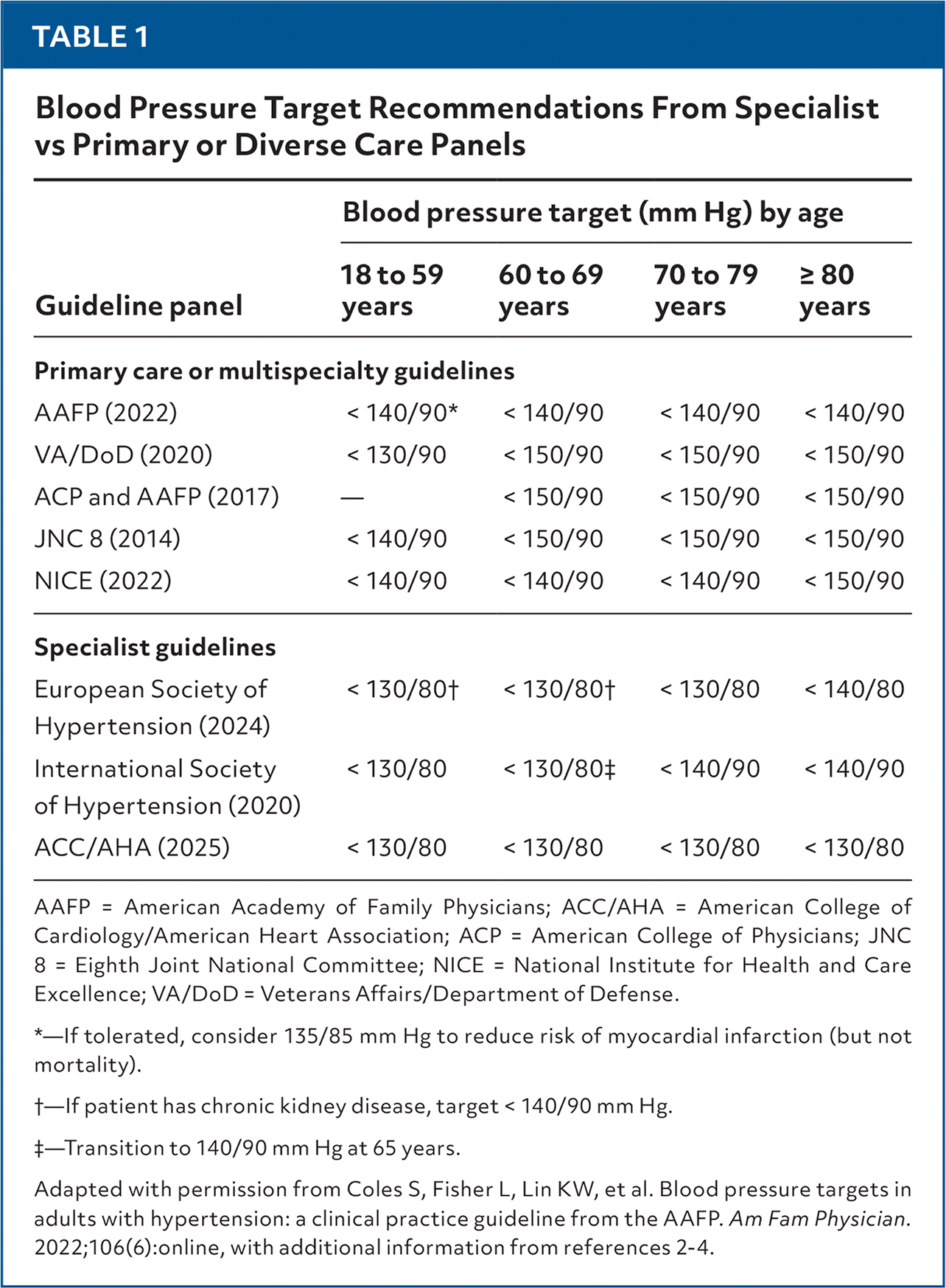
One especially pertinent issue addressed in primary care is the optimal management of hypertension. Table 1 summarizes blood pressure (BP) targets recommended by guidelines from different organizations.1–4 Guidelines from specialist groups clearly favor more intensive BP targets.
TABLE 1. Blood Pressure Target Recommendations From Specialist vs Primary or Diverse Care Panels
| Guideline panel | Blood pressure target (mm Hg) by age | |||
|---|---|---|---|---|
| 18 to 59 years | 60 to 69 years | 70 to 79 years | ≥ 80 years | |
| Primary care or multispecialty guidelines | ||||
| AAFP (2022) | < 140/90* | < 140/90 | < 140/90 | < 140/90 |
| VA/DoD (2020) | < 130/90 | < 150/90 | < 150/90 | < 150/90 |
| ACP and AAFP (2017) | — | < 150/90 | < 150/90 | < 150/90 |
| JNC 8 (2014) | < 140/90 | < 150/90 | < 150/90 | < 150/90 |
| NICE (2022) | < 140/90 | < 140/90 | < 140/90 | < 150/90 |
| Specialist guidelines | ||||
| European Society of Hypertension (2024) | < 130/80† | < 130/80† | < 130/80 | < 140/80 |
| International Society of Hypertension (2020) | < 130/80 | < 130/80‡ | < 140/90 | < 140/90 |
| ACC/AHA (2025) | < 130/80 | < 130/80 | < 130/80 | < 130/80 |
AAFP = American Academy of Family Physicians; ACC/AHA = American College of Cardiology/American Heart Association; ACP = American College of Physicians; JNC 8 = Eighth Joint National Committee; NICE = National Institute for Health and Care Excellence; VA/DoD = Veterans Affairs/Department of Defense.
*—If tolerated, consider 135/85 mm Hg to reduce risk of myocardial infarction (but not mortality).
†—If patient has chronic kidney disease, target < 140/90 mm Hg.
‡—Transition to 140/90 mm Hg at 65 years.
Adapted with permission from Coles S, Fisher L, Lin KW, et al. Blood pressure targets in adults with hypertension: a clinical practice guideline from the AAFP. Am Fam Physician. 2022;106(6):online, with additional information from references 2–4.
In 2015, the Systolic Blood Pressure Intervention Trial (SPRINT) reported results of a study that randomized 9,361 adults without diabetes to an intensive systolic BP target (achieving 121 mm Hg), compared with 136 mm Hg in the usual care group. The intensive treatment group was less likely to die from any cause (number needed to treat [NNT] = 83 over 3.3 years) and less likely to develop heart failure (NNT = 125 over 3.3 years). However, no significant differences in the likelihood of myocardial infarction, acute coronary syndrome, or stroke were found. This must be balanced against significantly more episodes of hypotension (number needed to harm [NNH] = 100), syncope (NNH = 200), electrolyte abnormalities (NNH = 142), and acute kidney injury or failure (NNH = 62) in the intensive therapy group.5
The 2024 published BPROAD study was nearly identical to SPRINT, except it included only patients with type 2 diabetes.6 The 12,281 patients were randomized, with the tight BP control group achieving a median systolic BP of 118 mm Hg and the usual control group achieving 135 mm Hg; average A1C was 7.6%. The study showed that a composite cardiovascular outcome was less likely with intensive BP control, although the magnitude was small (three fewer events per 1,000 person-years), with only stroke achieving statistical significance as an individual outcome. These results have led to calls from specialists to use a target of 130/80 mm Hg for all patients with hypertension.7
It is critical to note that BP in both studies was measured using a time-consuming protocol. The patient was seated alone in a quiet room for 5 minutes, then an automated cuff measured BP on a bare arm three times, separated by 1-minute intervals. The final BP was the average of those measurements. This protocol would take at least 8 to 10 minutes per patient to implement.
This protocol also results in significantly lower BPs than those measured in typical clinical practices. Using an arm that is not bare, using an incorrectly sized cuff, taking a single BP measurement, and improper arm position are common in the clinic, and each has been shown to increase systolic BP by 4 to 8 mm Hg.8–11 A study of 3,074 SPRINT participants compared research BPs with routine clinic BPs measured outside the study. More than 80% of routine clinic BPs were higher than those measured using the research protocol.12 In addition, a follow-up study found that the lower target was difficult to maintain, with the mean systolic blood pressure increasing by 7 mm Hg after 4.5 years.13
In a busy primary care clinic, the time-consuming SPRINT protocol is extremely difficult to implement. In one study, only 4% of practices reported using all the recommended elements for BP measurement.14 A BP of 140/90 mm Hg measured in a typical clinic may be 130/80 mm Hg if using the SPRINT protocol. Trying to achieve lower targets based on routine clinic BPs increases the risk of hypotension and adverse kidney events while also increasing cost and the possibility of polypharmacy and nonadherence.
The remarkably low rates of adverse events reported in the BPROAD study are another concern. It is difficult to believe that after 4.2 years, in a group of 6,414 adults with diabetes, a mean age of 64 years, and an intensive BP target, only eight (0.12%) had an episode of symptomatic hypotension. A 2020 Cochrane review of 11 randomized trials with 38,688 patients reported that 9.8% of participants assigned to an intensive BP target experienced an episode of symptomatic hypotension or syncope during 4 years of follow-up. This represents a 3% absolute increase over the number of events in patients assigned to a BP target of 140/90 mm Hg and 78-fold higher rate than reported in BPROAD.15 This suggests that the BPROAD study had notable methodological differences in capturing adverse events that resulted in undercounting.
The 2020 Cochrane review also found only small and mostly nonsignificant reductions in cardiovascular events and mortality for patients assigned to an intensive BP target. The only significant benefit identified was three fewer strokes per 1,000 patients treated to a more intensive BP target for 4 years.15 We agree with the Cochrane review authors, who state that “…the benefits of trying to achieve a lower blood pressure target rather than a standard target (≤ 140/90 mm Hg) do not outweigh the harms associated with that intervention.”
The decision to pursue a more intensive BP target should not be routine and, at best, should be a shared decision balancing benefits and harms. To avoid overtreatment, it is of paramount importance that patients who choose a BP target of less than 130/80 mm Hg always have their BP measured using the time-consuming SPRINT or BPROAD protocol.
Editor’s Note: Dr. Ebell is deputy editor for evidence-based medicine for AFP.
