

To the Editor: A 28-year-old woman presented to the emergency department with a 5-day history of fatigue, malaise, vomiting, and fever, and a 2-day history of worsening abdominal pain and periorbital edema. On examination, she had fever, tachycardia, and epigastric and right upper quadrant tenderness with a positive Murphy sign. Laboratory results showed elevated alanine transaminase at 437 U/L (7.30 μkat/L), aspartate transaminase at 275 U/L (4.59 μkat/L), and alkaline phosphatase at 234 U/L (3.91 μkat/L). Additional results included normal bilirubin, normal lipase, negative acute hepatitis panel, and no leukocytosis. Abdominal ultrasonography showed a severely edematous gallbladder without cholelithiasis, prompting concern for acute acalculous cholecystitis. She was admitted to the hospital, and intravenous ceftriaxone and metronidazole were initiated for sepsis from a presumed intra-abdominal source while further evaluation was completed.
Computed tomography of the abdomen and pelvis (Figure 1) found severe gallbladder edema without stones and diffuse retroperitoneal lymphadenopathy. A hepatobiliary iminodiacetic acid scan showed a normal gallbladder ejection fraction. A liver biopsy was scheduled due to persistently elevated liver enzymes and no clear diagnosis. Subsequent Epstein-Barr virus immunoglobulin M and viral load test results were positive, leading to the diagnosis of acute infectious mononucleosis. The biopsy was canceled, and the patient improved with supportive care alone. Results of the remaining extensive autoimmune and infectious workup were negative.
FIGURE 1.
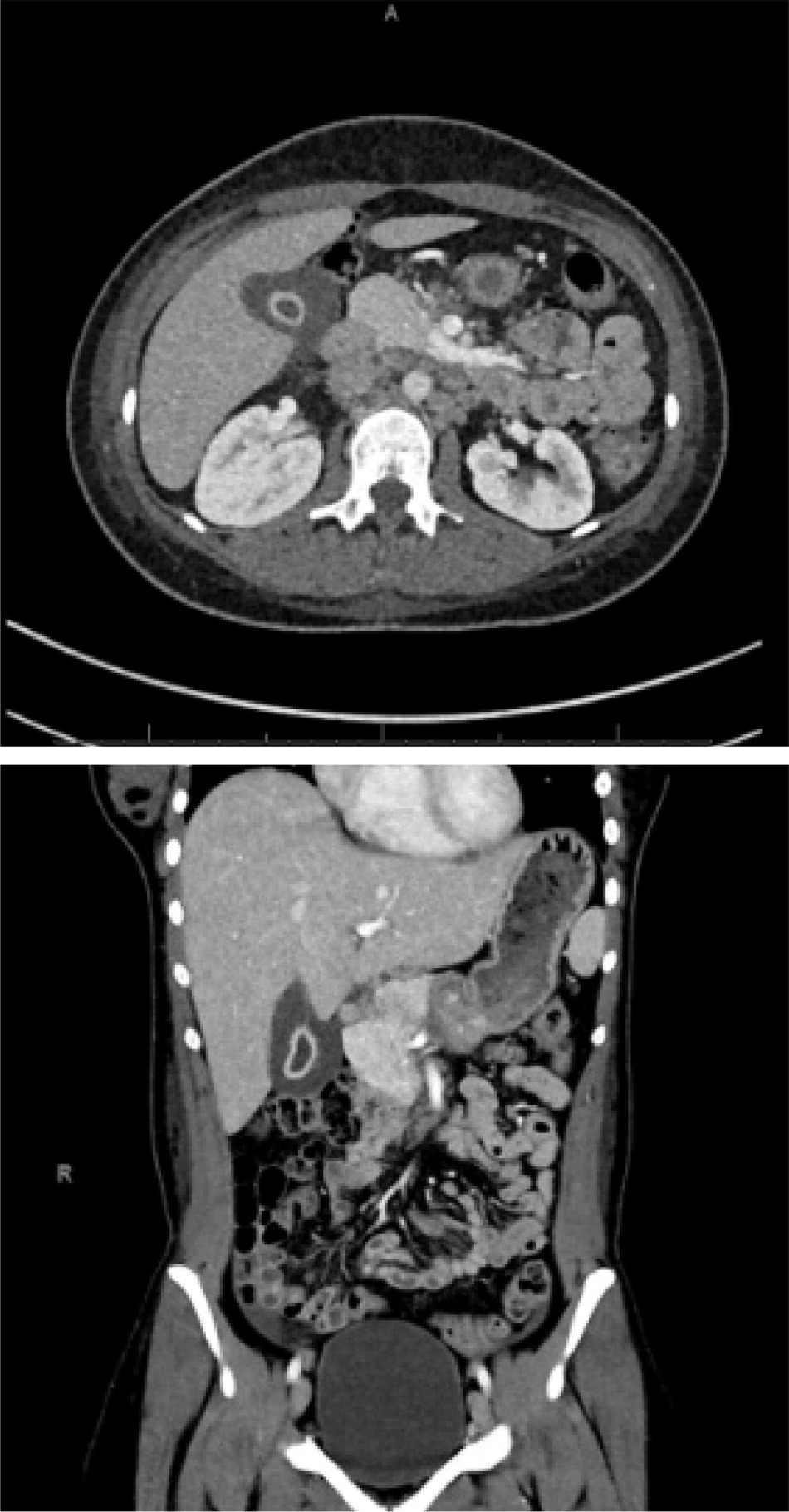
Axial and coronal computed tomography of the abdomen and pelvis showing edematous gallbladder without stones.
Epstein-Barr is a common virus, typically causing asymptomatic or mildly symptomatic infections in adolescents and young adults.1 Classic symptoms include fever, cervical lymphadenopathy, and pharyngitis, and subclinical and self-limited hepatic involvement is common.1,2 Although severe hepatobiliary complications are rare, a 2024 review found they are most common in young women.3
The case summarized here highlights a rare but clinically significant complication of acute Epstein-Barr virus infection in adults, manifesting as moderate liver enzyme elevations and radiologic features mimicking acute acalculous cholecystitis. This viral infection is an important differential diagnosis in patients with cholestatic liver injury and gallbladder edema, even without the classic symptoms of acute infectious mononucleosis.
Read the full article
Get immediate access, anytime, anywhere.
Choose a single article, issue, or full-access subscription.
Earn up to 14 CME credits per issue.
