

A 14-year-old girl presented with a painless swelling in her neck that had started 3 months prior. She did not have dysphagia or other compressive symptoms. The patient had no significant medical history.
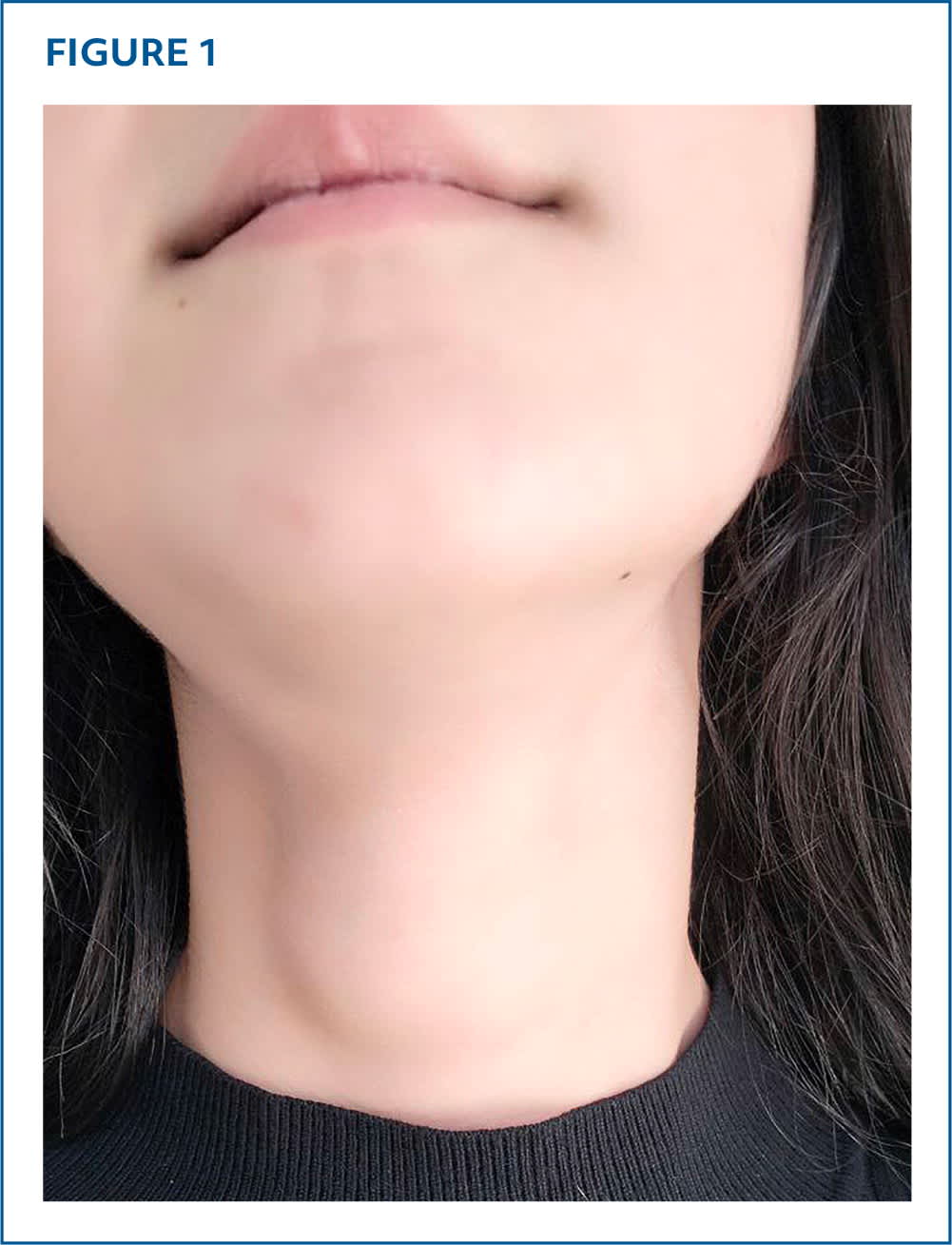
Physical examination revealed a well-defined, mobile, soft mass anterior to the laryngeal prominence (Figure 1). All laboratory findings, including assessment of thyroid function, were within normal ranges. Neck ultrasonography showed a single hypoechoic and fluid-filled lesion.
FIGURE 1
Question
Based on the patient's history and physical examination, which one of the following is the most likely diagnosis?
- A. Branchial cleft cyst.
- B. Cervical lymphadenopathy.
- C. Thyroglossal duct cyst.
- D. Thyroid tumor.
DISCUSSION
The answer is C: thyroglossal duct cyst. This is the most likely diagnosis due to the lesion's location and the patient's age.1 Thyroglossal duct cysts are classically found in the midline near the laryngeal prominence or hyoid bone. They most often present in children or adolescents but occasionally occur in adults.2 This diagnosis is strongly supported by the painless, fluctuant, and mobile nature of the mass; normal thyroid function of the patient; and a hypoechoic, thin-walled, fluid-filled lesion on ultrasonography.
Thyroglossal duct cysts have an estimated prevalence of 7%.3 The cysts arise from an embryological remnant that is present when the thyroglossal duct does not fully close. Most lesions are benign, although thorough evaluation is crucial to rule out other diagnoses, assess thyroid function, and determine the need for surgical intervention. Untreated thyroglossal cysts may lead to complications, such as infection or local inflammation that can result in pain, swelling, and fistula formation.1
Branchial cleft cysts are benign congenital cysts resulting from inadequate closure of a branchial cleft early in fetal development. They present in the lateral neck, most commonly anterior to the sternocleidomastoid muscle. Branchial cysts are often fluctuant and painless but may become infected.4
Cervical lymphadenopathy is typically associated with infection in the oropharyngeal area. Less commonly, lymphadenopathy is a presenting sign of malignancy. One or more lymph nodes may be affected. They are usually firm and can be tender to palpation. The underlying condition can usually be determined by history, clinical examination, and laboratory findings.5
Thyroid tumors tend to present in adults, and prevalence increases with age. They are usually located within the thyroid gland itself, not directly over the hyoid bone or laryngeal prominence. They may be associated with systemic symptoms or altered thyroid function.6
SUMMARY TABLE
| Condition | Characteristics |
|---|---|
| Branchial cleft cyst | Present in the lateral neck, most commonly anterior to the sternocleidomastoid muscle; fluctuant and painless; may become infected |
| Cervical lymphadenopathy | Firm, tender to palpation; typically associated with infection |
| Thyroglossal duct cyst | Typically occurs in children or adolescents; mobile, soft, painless mass at midline of upper neck; ultrasonography reveals a thin-walled, fluid-filled hypoechoic mass |
| Thyroid tumor | Typically occurs in adults and located within the thyroid gland itself |
Read the full article
Get immediate access, anytime, anywhere.
Choose a single article, issue, or full-access subscription.
Earn up to 14 CME credits per issue.
