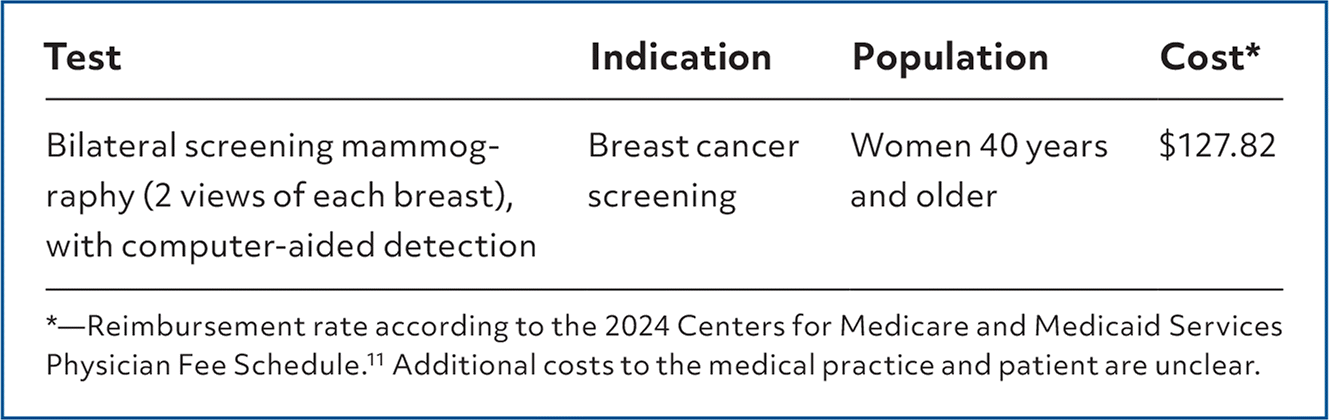
| Test | Indication | Population | Cost* |
|---|---|---|---|
| Bilateral screening mammography (2 views of each breast), with computer-aided detection | Breast cancer screening | Women 40 years and older | $127.82 |
*—Reimbursement rate according to the 2024 Centers for Medicare and Medicaid Services Physician Fee Schedule.11 Additional costs to the medical practice and patient are unclear.
Mammography is the recommended method of breast cancer screening, with an estimated sensitivity of 87% and specificity of 89% (positive likelihood ratio = 7.8; negative likelihood ratio = 0.15).1,2 Mammography screening supported by artificial intelligence (AI) is a rapidly growing field in clinical practice and presents an opportunity to increase sensitivity and efficiency of breast cancer detection.3,4
Neural networks using AI are trained to recognize complex patterns, learn iteratively, and make decisions based on large data sets. These AI image analysis tools can triage screening examinations according to the risk of malignancy, thereby enhancing efficiency by reducing the time radiologists spend on examinations.3,4 AI can also support radiologists by providing AI computer-aided detection (CAD) marks that highlight suspicious findings. Conventional CAD software first received US Food and Drug Administration (FDA) approval in 1998, and there are currently more than 20 approved proprietary AI applications for breast imaging.3–6
ACCURACY
A 2021 systematic review of 12 studies (n = 131,822 screened women) examined the accuracy of AI for breast cancer screening.7 The studies were generally of poor methodological quality, and none were prospective studies. The reference standard for validating AI accuracy was biopsy with histology for positive detections of invasive cancer, ductal carcinoma in situ, and follow-up for women with negative screening results. In two of the largest retrospective cohort studies involving 79,910 screened women, 34 out of 36 AI systems (94%) were found to be less accurate than a single radiologist, and all systems were less accurate than the consensus of two or more radiologists. Specifically, the top-performing AI system showed a lower specificity compared with a single radiologist (88% vs 96.7%) and the consensus of two radiologists (81% vs 98.5%) when sensitivity thresholds were matched.7
A 2023 randomized controlled population-based trial compared AI-supported mammography screening with standard screening (ie, double reading by two radiologists).8 A total of 80,033 women 40 to 80 years of age (median age = 54) were randomly assigned to AI-supported screening (Transpara version 1.7.0) or the control group without AI. The AI system provided malignancy risk scores ranging from 1 to 10, with scores of 1 to 7 considered low risk; 8 to 9, intermediate risk; and 10, high risk. In the intervention group, examinations with scores of 1 to 9 underwent single reading, whereas those with a score of 10 underwent double reading by two different radiologists.
The analysis revealed that AI-supported screening had a cancer detection rate comparable to standard screening. The AI-supported rate was 6.1 per 1,000 screened women (95% CI, 5.4–6.9), and the control group rate was 5.1 per 1,000 screened women (95% CI, 4.4–5.8) or a ratio of 1.2 (95% CI, 1–1.5).8 The AI-supported screening method reduced the radiologist workload by 44.3%, with 46,345 readings needed in the AI group and 83,231 in the control group.8 However, this study took place in Sweden, and the reduction may not be directly applicable to US practices, where mammograms are typically single-read by one radiologist without a consensus meeting, which is standard in Sweden.
Read the full article
Get immediate access, anytime, anywhere.
Choose a single article, issue, or full-access subscription.
Earn up to 14 CME credits per issue.