
Family physician returned to improve Hawaii’s rural primary care
May 27, 2026, David Mitchell—As a teenager growing up in Hawaii, Cynthia Ohata, MD, FAAFP, spent countless hours practicing, performing and competing as a hula dancer. The experience, she said, tied her to the land and its people while also teaching her valuable lessons about teamwork and leadership.
Though Ohata felt connected to the islands, her education and training led her away. It took decades to find her way back. Now director of the University of Hawaii’s new Kauai Family Medicine Residency program, Ohata is working to ensure that more physicians train, and stay, in the Aloha State.
Hawaii’s physician shortage crisis
“Hawaii needs rural primary care so badly,” Ohata said. “I was very aware of that because when I would visit, everywhere we traveled in the islands, people would say, ‘We need primary care. When are you coming back?’ I kept having to say, ‘I can’t right now, but I hear you.’ This was the time for me to come back, and the island of Kauai was ready, so ready, to build this program. This is what I love to do. I love to create things. I love to choreograph. I love to bring people together and make things happen.”
A recent University of Hawaii report to the state legislature found that the state, which has 1.4 million residents, would need more than 800 additional physicians to meet demand. The high cost of living is a challenge for many, and one-fourth of the state’s physicians are 65 are older.
The situation is especially dire in rural areas like Kauai.
“The issue is not necessarily recruiting; it’s retention,” said Ohata, who started the process of building the Kauai program in 2024 and matched her first class of four residents in March. “Every person on the island has a story about how many doctors they’ve had, if they’ve had any, in the last five years. The turnover is unbelievable. That’s where GME comes in.”
Training physicians locally to improve retention
Rather than relying solely on the recruitment of practicing physicians, Ohata is hoping her family medicine program can recruit residents who will train and practice in Hawaii.
Studies have shown that more than 60% of family physicians practice in the state where they completed residency. The state’s four family medicine programs take 20 new residents per year.
Ohata said people are signing up to be host families for the Kauai residents in the short term, and a long-term plan calls for a hospital to build housing for them.
“It’s on a beautiful piece of land that overlooks the ocean,” Ohata said. “It’s amazing. This program is being born from a beautiful partnership across the different entities on the island, which is really hard to do, but they all understand that this is what we need to do in order to make a difference.”
Ohata, who lives on Oahu, is faculty at the University of Hawaii’s Oahu Family Medicine Residency. Kauai residents will spend their first year on Oahu before spending their second and third years on Kauai, where Ohata also sees patients.
“To get onto the island of Kauai, it’s less than an hour,” said Ohata, who takes flights between the islands. “So, literally the same commute that I used to have in Chicago, but tropical and with a lot less concrete.”
The difference was family medicine
Ohata’s path to medical school, family medicine and, ultimately, home was a circuitous one.
A theater and literature major at Princeton University, Ohata spent a year teaching English in Japan, followed by another year teaching in Indonesia. She eventually went back to school at Seattle University to prepare for medical school and graduated from the University of Washington School of Medicine in 2002, more than a decade after graduating from Princeton.
Ohata, whose father and brother are internal medicine physicians, was a third-year medical student when she was first drawn to family medicine. She was on an inpatient rotation at a veteran’s hospital when she noticed that amongst a care team with three interns, one stood out.
“Every time we walked into the room, the patient looked at that intern and he was like, ‘Oh,’ she said. “They had this bond, and the patient knew exactly what was going on. He knew why he was getting specific treatments. There was great understanding and partnership between the physician and the patient. The way that they spoke to each other really resonated with me. The difference was that resident was in family medicine.”
A career dedicated to underserved populations
Ohata stayed at the University of Washington for family medicine residency and was an attending there before moving to Chicago. She initially taught students and residents at a federally qualified health center and later was an associate professor of family medicine at Rush Medical College for five years. She also held numerous roles during eight years at the Advocate Christ Family Medicine Residency, including faculty, associate program director and interim program director and department vice chair.
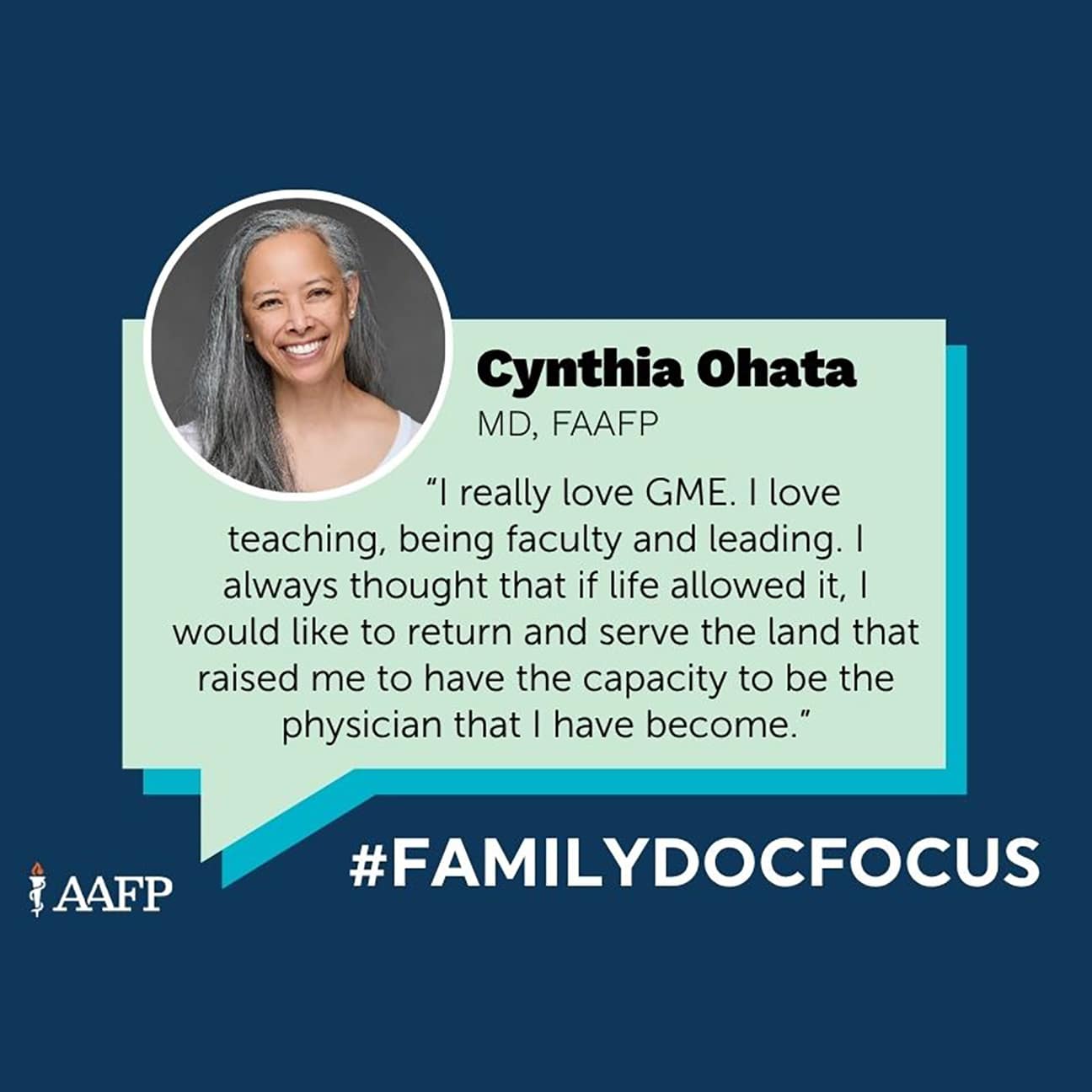
“I always took positions that served underserved communities, either underrepresented minorities or socioeconomically displaced peoples,” she said, “partly because I was very aware that my people were minorities and had been socioeconomically displaced in many ways. I really love GME. I love teaching, being faculty and leading. I always thought that if life allowed it, I would like to return and serve the land that raised me to have the capacity to be the physician that I have become.”