

Obsessive-compulsive disorder is an illness that can cause marked distress and disability. It often goes unrecognized and is undertreated. Primary care physicians should be familiar with the various ways obsessive-compulsive disorder can present and should be able to recognize clues to the presence of obsessions or compulsions. Proper diagnosis and education about the nature of the disorder are important first steps in recovery. Treatment is rarely curative, but patients can have significant improvement in symptoms. Recommended first-line therapy is cognitive behavior therapy with exposure and response prevention or a selective serotonin reuptake inhibitor. The medication doses required for treatment of obsessive-compulsive disorder are often higher than those for other indications, and the length of time to response is typically longer. There are a variety of options for treatment-resistant obsessive-compulsive disorder, including augmentation of a selective serotonin reuptake inhibitor with an atypical antipsychotic. Obsessive-compulsive disorder is a chronic condition with a high rate of relapse. Discontinuation of treatment should be undertaken with caution. Patients should be closely monitored for comorbid depression and suicidal ideation.
Obsessive-compulsive disorder (OCD) is a neuropsychiatric disorder characterized by recurrent distressing thoughts and repetitive behaviors or mental rituals performed to reduce anxiety. Symptoms are often accompanied by feelings of shame and secrecy because patients realize the thoughts and behaviors are excessive or unreasonable. This secrecy, along with a lack of recognition of OCD symptoms by health care professionals, often leads to a long delay in diagnosis and treatment. OCD has a reputation of being difficult to treat, but there are many effective treatments available.
SORT: KEY RECOMMENDATIONS FOR PRACTICE
| Clinical recommendation | Evidence rating | References |
|---|---|---|
| Patients with OCD should be monitored for psychiatric comorbidities and suicide risk. | C | 3, 19, 21 |
| Cognitive behavior therapy with exposure and response prevention is an effective treatment for OCD. | A | 21–23 |
| SSRIs are an effective treatment for OCD and are recommended as first-line pharmacologic therapy. | A | 21, 24, 25 |
| A trial of SSRI therapy should continue for eight to 12 weeks, with at least four to six weeks at the maximal tolerable dosage. | C | 21 |
| SSRIs should be taken for at least one to two years before attempting to discontinue. Exposure and response prevention “booster” sessions should be considered to prevent relapse. | C | 21 |
| Augmentation of SSRI therapy with atypical antipsychotic agents is effective in some patients with treatment-resistant OCD. | B | 16, 21, 30 |
OCD = obsessive-compulsive disorder; SSRI = selective serotonin reuptake inhibitor.
A = consistent, good-quality patient-oriented evidence; B = inconsistent or limited-quality patient-oriented evidence; C = consensus, disease-oriented evidence, usual practice, expert opinion, or case series. For information about the SORT evidence rating system, go to https://www.aafp.org/afpsort.xml.
Epidemiology
The lifetime prevalence of OCD is 1.6 percent.1 Symptoms usually begin during adolescence, and more than 50 percent of affected persons have symptom onset before their mid-20s.1 OCD has substantial adverse effects on well-being; more than one half of patients report moderate to severe distress from obsessions and compulsions.2 OCD interferes with work performance, social interactions, and family relationships. It is a chronic disorder and is likely to persist if not treated effectively. Nearly 70 percent of patients report a continuous course of symptoms, and 23 percent experience a waxing and waning course.3 The average time to treatment after meeting diagnostic criteria for OCD is 11 years.3 This delay is attributed to many factors, including reluctance of patients to report symptoms and under-recognition of OCD by physicians.
Pathogenesis
The current model for the pathogenesis of OCD is complex. Neuroimaging studies show involvement of the dorsolateral prefrontal cortex, basal ganglia, and thalamus.4 Because of the response to selective serotonin reuptake inhibitors (SSRIs), it is hypothesized that the serotonin system is heavily involved in the neurochemistry of OCD. Family studies have shown that genetics have a role in the etiology of OCD, particularly in the early-onset form of the disorder.5 An immunologic component has also been proposed, based on the association of OCD with pediatric autoimmune neuropsychiatric disorder associated with streptococcal infections (PANDAS), in which children develop an abrupt onset of OCD symptoms or tics after infection with group A Streptococcus.
Diagnosis
Obsessions are recurrent intrusive thoughts or images that cause marked distress. Patients usually recognize that the thoughts are self-generated and inappropriate. Some common obsessions involve contamination, doubts about whether an important task has been performed, or worries that an action will harm another person (Table 1). Compulsions are repetitive activities or mental rituals designed to counteract the anxiety caused by obsessions. Common compulsions include handwashing, checking, ordering, praying, counting, and seeking reassurance (Table 1). The Diagnostic and Statistical Manual of Mental Disorders, 4th ed., states that to meet the criteria for OCD, the obsessions cannot be excessive worries about everyday problems, and they must cause marked distress (Table 2).6
Table 1 Common Obsessions and Compulsions
| Type | Examples |
|---|---|
| Obsessions | |
| Aggressive impulses | Images of hurting a child or parent |
| Contamination | Becoming contaminated by shaking hands with another person |
| Need for order | Intense distress when objects are disordered or asymmetric |
| Religious | Blasphemous thoughts, concerns about unknowingly sinning |
| Repeated doubts | Wondering if a door was left unlocked |
| Sexual imagery | Recurrent pornographic images |
| Compulsions | |
| Checking | Repeatedly checking locks, alarms, appliances |
| Cleaning | Handwashing |
| Hoarding | Saving trash or unnecessary items |
| Mental acts | Praying, counting, repeating words silently |
| Ordering | Reordering objects to achieve symmetry |
| Reassurance-seeking | Asking others for reassurance |
| Repetitive actions | Walking in and out of a doorway multiple times |
Table 2 Diagnostic Criteria for Obsessive-Compulsive Disorder
| Recurrent obsessions or compulsions |
| Obsessions and compulsions are severe enough to be time consuming (more than one hour daily) or to cause marked distress or significant impairment |
| At some point during the course of the disorder, the person has recognized that the obsessions or compulsions are excessive or unreasonable |
| If another axis I disorder is present, the content of the obsessions or compulsions is not restricted to it |
| The disturbance is not a result of physiologic effects of a substance or medical condition |
Information from reference 6.
OCD is a heterogeneous disorder with several subtypes and a multitude of manifestations (Table 3).7–15 There are several associated disorders (often referred to as OCD spectrum disorders), such as body dysmorphic disorder, trichotillomania, hypochondriasis, and eating disorders. These disorders have similar features and respond to the same therapies used to treat OCD.
Table 3 Subtypes of Obsessive-Compulsive Disorder
| Subtype | Features |
|---|---|
| Early-onset7,8 | Symptom onset before puberty |
| Higher frequency of tics and other psychiatric comorbidities | |
| Onset of compulsions often predates obsessions | |
| Compulsions often severe and frequent | |
| Less responsive to first-line treatments | |
| Strong familial link (17 percent among first-degree relatives) | |
| Hoarding9 | Less insight than in other OCD subtypes |
| Symptoms often more severe | |
| Higher rates of psychiatric comorbidities, especially social phobia | |
| Greater degree of global impairment | |
| May be less responsive to psychological treatment | |
| “Just right”10,11 | Patients wish to have things “perfect,” “certain,” or “under control” |
| Results in a need to repeat certain actions until the uncomfortable feeling subsides | |
| “Not-just-right” experiences are common in all forms of OCD, but for some patients it is the primary manifestation | |
| Primary obsessional12 | 25 percent of patients with OCD lack overt compulsions |
| Patients are not free from rituals, which may be mental (e.g., praying, counting, reciting “good words”) | |
| Common themes of obsessions are sex, violence, religion | |
| Historically thought to be less responsive to treatment, but does respond to medication and exposure and response prevention | |
| Scrupulosity13 | Religious or moral obsessions |
| Devastating form of OCD for patients to whom faith or religious affiliation is important | |
| Obsessions focus on whether one has committed a sin, or involve blasphemous thoughts | |
| Compulsions include prayer, reassurance-seeking from clergy, excessive confession | |
| Tic-related14,15 | Significant overlap with early-onset OCD |
| Many patients meet criteria for Tourette syndrome | |
| High rate of comorbid conditions (e.g., attention-deficit/hyperactivity disorder, body dysmorphic disorder, trichotillomania, social anxiety, mood disorders) | |
| Hoarding and somatic obsessions are common | |
| Often requires combination treatment with a selective serotonin reuptake inhibitor and an atypical antipsychotic |
OCD = obsessive-compulsive disorder.
Patients are often reluctant to report symptoms of OCD, which they may find embarrassing. Physicians should maintain a high awareness for the possibility of OCD in patients with general complaints of anxiety or depression. Patients may offer clues by alluding to intrusive thoughts or repetitive behaviors. Avoidance of particular locations or objects, excessive concerns about illness or injury, and repetitive reassurance-seeking are common. Chapped hands may signal excessive handwashing. If OCD is suspected, the use of a few simple screening questions can be helpful (Table 4).16 Standardized diagnostic tools are available, but most are not practical for use in primary care. There are some brief patient self-report inventories that may be useful; two commonly used tools are the Obsessive-Compulsive Inventory–Revised17 and the Florida Obsessive-Compulsive Inventory18. Psychiatric referral is indicated if there is diagnostic uncertainty.
Table 4 Screening Questions for Obsessive-Compulsive Disorder
| Do you have thoughts or images that keep coming back to you and are difficult to put out of your head? For example, being contaminated by something, having something terrible happen to you or someone you care about, or doing something terrible? |
| Do you ever feel the need to perform certain actions that don't make sense or that you don't want to do, such as washing, cleaning, counting, or checking things over and over? |
Adapted with permission from Canadian Psychiatric Association. Clinical practice guidelines. Management of anxiety disorders [published correction appears in Can J Psychiatry. 2006;51(10):623]. Can J Psychiatry. 2006;51(8 suppl 2):44S.
Comorbidities
The rate of psychiatric comorbidity in patients with OCD is high, particularly in those with severe OCD. In one longitudinal study, more than 90 percent of patients with OCD met the criteria for at least one other axis I diagnosis in their lifetime.3 The most common comorbid diagnosis is major depressive disorder, which affects two thirds of persons with OCD at some point in life.3 Panic disorder, social phobia, specific phobias, and substance abuse are also common. The risk of suicide in persons with OCD is high; more than 50 percent experience suicidal ideation, and 15 percent have attempted suicide.3 Depression and hopelessness are major correlates of suicidal behavior in persons with OCD.19 Patients with OCD should be carefully monitored for suicide risk and symptoms of depression.
Treatment
Once a diagnosis of OCD has been established, it is important to provide education and support. Although full remission is rare in patients with OCD, significant improvement is common. Evidence-based medical and behavioral therapies are available to reduce the severity and frequency of obsessions and compulsions. However, it may take weeks to months for these therapies to become effective. Physicians should inform patients about this delay in treatment response, provide support, and encourage adherence during the early phase of treatment.
It is helpful to quantify the severity of symptoms and impairment before and during treatment for OCD. This may be done with standardized rating scales or by a patient estimate of the time spent each day engaging in obsessive-compulsive thoughts or behaviors. The Yale-Brown Obsessive Compulsive Scale (Y-BOCS) is a reliable tool for measuring OCD symptom severity.20 It is also important to monitor the effect of OCD symptoms on relationships, work, self-care, and recreational time.
Treatment is indicated when OCD symptoms cause impairment in functioning or significant distress for the patient. Reasonable treatment goals would be spending less than one hour per day on obsessive-compulsive behaviors, with minimal interference with daily tasks.21 A treatment strategy algorithm is provided in Figure 1.16,21
Figure 1. Treatment of Obsessive-Compulsive Disorder
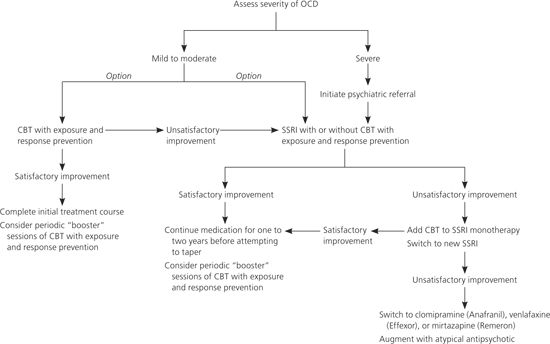
Treatment algorithm for patients with obsessive-compulsive disorder. (CBT = cognitive behavior therapy; OCD = obsessive-compulsive disorder; SSRI = selective serotonin reuptake inhibitor.)
Information from references 16 and 21.
Psychiatric consultation is recommended for patients with severe OCD, as measured by the Y-BOCS. For patients with mild or subclinical symptoms, education and support may be sufficient. High-quality self-help materials are available that explain the nature of the disorder, its manifestations, and available treatments.
PSYCHOLOGICAL TREATMENTS
Psychological treatments are effective for OCD.22 These treatments should be administered by a properly trained health care professional, most commonly a psychologist or social worker. Cognitive behavior therapy (CBT) is the method of psychotherapy most often used; there is no evidence for the use of psychodynamic psychotherapy or “talk therapy” for treatment of OCD. Exposure and response prevention is a key element of CBT that has been proven effective in the treatment of OCD.23 Patients are taught to confront situations that create fear related to their obsessions, and to avoid performing compulsive behaviors in response. The feared situations may be confronted directly (e.g., touching objects in a public restroom), or through imagined encounters (e.g., imagining shaking hands with another person). Patients refrain from performing rituals until the level of anxiety dissipates. Exposure and response prevention is usually performed in 13 to 20 weekly sessions, with each session lasting one to two hours.21
PHARMACOTHERAPY
OCD exhibits a highly selective response to serotonergic medications. Clomipramine (Anafranil), a tricyclic antidepressant with a strong serotonergic effect, was historically the first-line pharmacologic treatment for OCD. However, because of concerns about the safety and adverse effects of tricyclic agents, SSRIs have become first-line pharmacologic treatments for OCD. Fluoxetine (Prozac), fluvoxamine, paroxetine (Paxil), and sertraline (Zoloft) have been approved by the U.S. Food and Drug Administration for the treatment of OCD. Citalopram (Celexa) and escitalopram (Lexapro) are also commonly used. Approximately 60 to 70 percent of patients experience some degree of improvement in OCD symptoms with SSRI treatment.24 A recent Cochrane review confirmed the effectiveness of SSRIs for the treatment of OCD (absolute risk reduction = 8 to 17 percent; number needed to treat = 6 to 12).25
The dosage of SSRI required to achieve treatment effect for OCD is often higher than the recommended dosages for other indications (Table 5).21 The dosage should be increased over four to six weeks until the maximal dosage is achieved, or until further increase is limited by adverse effects.21 Higher-than-maximal dosages are sometimes used, with careful monitoring for serotonin syndrome. Early signs of serotonin syndrome include anxiety, tremor, tachycardia, and sweating.26 The patient should continue taking the SSRI for eight to 12 weeks, with at least four to six weeks at the maximal tolerable dosage.21 It usually takes at least four to six weeks for patients to note any significant improvement in symptoms; for some, it may take 10 to 12 weeks or longer.
Table 5 Typical SSRI Dosages in Patients with Obsessive-Compulsive Disorder
| SSRI | Starting dosage (mg per day) | Target dosage (mg per day) | Maximal dosage (mg per day) |
|---|---|---|---|
| Citalopram (Celexa) | 20 | 40 to 60 | 80 |
| Escitalopram (Lexapro) | 10 | 20 | 40 |
| Fluoxetine (Prozac)* | 20 | 40 to 60 | 80 |
| Fluvoxamine* | 50 | 200 | 300 |
| Paroxetine (Paxil)* | 20 | 40 to 60 | 60 |
| Sertraline (Zoloft)* | 50 | 200 | 200 |
SSRI = selective serotonin reuptake inhibitor.
*— Approved by the U.S. Food and Drug Administration for treatment of obsessive-compulsive disorder.
Adapted with permission from Koran LM, Hanna GL, Hollander E, Nestadt G, Simpson HB, for the American Psychiatric Association. Practice guideline for the treatment of patients with obsessive-compulsive disorder. Am J Psychiatry. 2007;164(7 suppl):22.
If medical therapy is successful, it should be continued for at least one to two years.21 If the patient chooses to discontinue pharmacotherapy, the dosage should be gradually tapered over several months. If symptoms worsen during this time, the original dosage should be resumed, and further attempts at discontinuing medication should be approached with reservation. Some patients require lifelong medical therapy.
Initial data suggest that the response to psychological treatments may be more durable than medication.27 Periodic exposure and response prevention “booster” sessions are recommended to lower the risk of relapse when psychological therapy is discontinued.21 Initiating psychological treatments before a trial of medication discontinuation may also be an effective strategy to lower the risk of relapse.
If an adequate trial of an SSRI or psychological therapy does not result in a satisfactory response, one option is to initiate combined treatment. If the patient prefers to continue with medical therapy alone, a trial of a different SSRI is indicated.21 If there is no response to trials of at least two SSRIs, clomipramine may be considered.21 Clomipramine can cause anticholinergic adverse effects and, rarely, arrhythmia or seizures. It should be started at a low dose (25 mg) with gradual titration to minimize adverse reactions. Venlafaxine (Effexor) is another option for second-line treatment; the extended-release form was shown in a randomized controlled trial to be equivalent to paroxetine.28 A small preliminary study suggested that mirtazapine (Remeron) may also be an effective treatment for OCD.29
Another option for patients with OCD who have partially responded to SSRI therapy is the addition of an atypical antipsychotic. Antipsychotic augmentation is indicated only after a three-month trial of an SSRI at the maximal tolerated dosage.30 Risperidone (Risperdal) has the strongest evidence base for use as an adjunctive agent; however, quetiapine (Seroquel) and olanzapine (Zyprexa) are also used.16 Antipsychotic augmentation is particularly beneficial in patients with comorbid tics. An SSRI in combination with risperidone or haloperidol (formerly Haldol) is the preferred treatment in these patients.30
Patients with treatment-resistant OCD should be referred to a subspecialist. There are a variety of treatment options for these patients, but the evidence for most therapies is based on small preliminary studies or expert opinion.16,21 Partial hospitalization and residential treatment facilities are options for patients with severe, treatment-resistant OCD.
COMPLEMENTARY AND ALTERNATIVE MEDICINE
There are limited trials of complementary and alternative medicine approaches for the treatment of OCD. Initial studies have suggested beneficial effects for moderate-intensity aerobic exercise and mindfulness interventions (e.g., meditative breathing).31,32 There has long been interest in the use of St. John's wort for treatment of OCD. A recent double-blind study did not support the effectiveness of this treatment, although further study has been recommended.33
Special Considerations for Childhood OCD
Although OCD in childhood can occur in isolation, there is a high rate of comorbidity with mood disorders, tic disorders, attention-deficit/hyperactivity disorder, and developmental abnormalities. Children with abrupt onset of obsessive-compulsive symptoms or tics should be evaluated for group A Streptococcus infection, with possible PANDAS. Children with OCD should be referred to a subspecialist. CBT with exposure and response prevention is the preferred initial treatment modality. SSRI treatment may be indicated in patients with severe symptoms, or when there is lack of improvement with CBT alone.21
