Diagnosis and Management of Obsessive-Compulsive Disorder in the Primary Care Setting

Afi M. Semenya, MD, MPH
Prakhya Bhatnagar, MD

American Family Physician. 2024;110(4):385-392.

Author disclosure: No relevant financial relationships.

This clinical content conforms to AAFP criteria for CME.

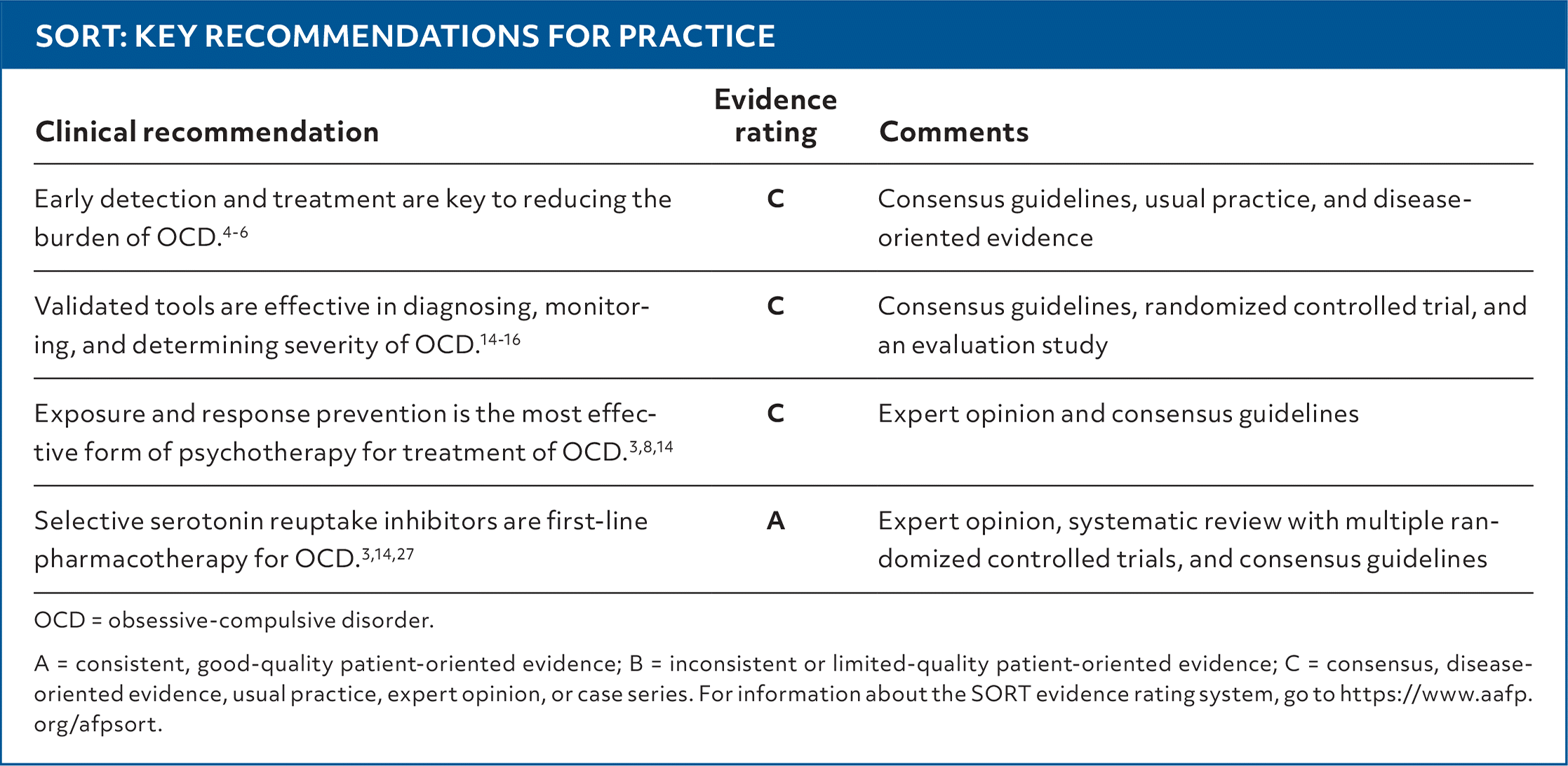
Obsessive-compulsive disorder is a common neuropsychiatric disorder that is often underdiagnosed or misdiagnosed. It is characterized by obsessions, which are intrusive and include unwanted thoughts, images, or urges that cause marked anxiety or distress. Obsessions also drive patients to engage in repetitive actions or thoughts, known as compulsions. The condition has a high prevalence of comorbid disorders and can be associated with functional impairment. Early recognition and treatment can lead to improved outcomes, and complete remission is possible. Validated tools, such as the Yale-Brown Obsessive-Compulsive Scale, are effective in diagnosing and monitoring obsessive-compulsive disorder and determining the severity of the condition. Severity varies among cases, and proper diagnosis and education about this condition are important for determining a treatment plan, which can include psychotherapy, pharmacotherapy, or both. Exposure and response prevention is the most effective form of psychotherapy, and selective serotonin reuptake inhibitors are the most effective pharmacotherapy. If monotherapy is not effective, psychotherapy and pharmacotherapy can be combined. Treatment of obsessive-compulsive disorder is typically recommended for at least 12 months for maintenance and prevention of relapse. In patients requiring augmentation, higher-risk or novel adjunctive treatments or investigational therapies should be managed by an experienced multidisciplinary team.

AFI M. SEMENYA, MD, MPH, is core faculty at the Tristar Nashville (Tenn.) Family Medicine Residency Program and an assistant professor in the Department of Family Medicine at Boston (Mass.) University Chobanian and Avedisian School of Medicine.

PRAKHYA BHATNAGAR, MD, is core faculty at the Tristar Nashville Family Medicine Residency Program.

Address correspondence to Afi M. Semenya, MD, MPH, at afi.semenya@hcahealthcare.com.

Author disclosure: No relevant financial relationships.

  1. 1.Williams MT, Mugno B, Franklin M, et al. Symptom dimensions in obsessive-compulsive disorder: phenomenology and treatment outcomes with exposure and ritual prevention. Psychopathology. 2013;46(6):365-376.
  2. 2.Williams MT, Taylor RJ, Mouzon DM, et al. Discrimination and symptoms of obsessive-compulsive disorder among African Americans. Am J Orthopsychiatry. 2017;87(6):636-645.
  3. 3.Grant JE. Clinical practice: obsessive-compulsive disorder. N Engl J Med. 2014;371(7):646-653.
  4. 4.Pampaloni I, Marriott S, Pessina E, et al. The global assessment of OCD. Compr Psychiatry. 2022;118:152342.
  5. 5.Eisen JL, Sibrava NJ, Boisseau CL, et al. Five-year course of obsessive-compulsive disorder: predictors of remission and relapse. J Clin Psychiatry. 2013;74(3):233-239.
  6. 6.Fineberg NA, Krishnaiah RB, Moberg J, et al. Clinical screening for obsessive-compulsive and related disorders. Isr J Psychiatry Relat Sci. 2008;45(3):151-163.
  7. 7.Veale D, Roberts A. Obsessive-compulsive disorder. BMJ. 2014;348 : g2183.
  8. 8.Hirschtritt ME, Bloch MH, Mathews CA. Obsessive-compulsive disorder: advances in diagnosis and treatment. JAMA. 2017;317(13):1358-1367.
  9. 9.Ruscio AM, Stein DJ, Chiu WT, et al. The epidemiology of obsessive-compulsive disorder in the National Comorbidity Survey Replication. Mol Psychiatry. 2010;15(1):53-63.
  10. 10.Ziegler S, Bednasch K, Baldofski S, et al. Long durations from symptom onset to diagnosis and from diagnosis to treatment in obsessive-compulsive disorder: a retrospective self-report study. PLoS One. 2021;16(12):e0261169.
  11. 11.Fenske JN, Petersen K. Obsessive-compulsive disorder: diagnosis and management. Am Fam Physician. 2015;92(10):896-903.
  12. 12.Diagnostic and Statistical Manual of Mental Disorders. 5th ed., text revision. American Psychiatric Association; 2022: 266–267.
  13. 13.Diedrich A, Voderholzer U. Obsessive-compulsive personality disorder: a current review. Curr Psychiatry Rep. 2015;17(2):2.
  14. 14.Koran LM, Hanna GL, Hollander E, et al.; American Psychiatric Association. Practice guideline for the treatment of patients with obsessive-compulsive disorder. Am J Psychiatry. 2007;164(7 suppl):5-53.
  15. 15.Storch EA, Rasmussen SA, Price LH, et al. Development and psychometric evaluation of the Yale-Brown Obsessive-Compulsive Scale—Second Edition. Psychol Assess. 2010;22(2):223-232.
  16. 16.National Institute for Health and Care Excellence. Obsessive-compulsive disorder and body dysmorphic disorder. November 29, 2005. Accessed April 23, 2024. https://www.nice.org.uk/guidance/cg31
  17. 17.Stanford Medicine. Obsessive-compulsive and related disorders. Accessed April 23, 2024. https://med.stanford.edu/ocd/about/diagnosis.html
  18. 18.Foa EB, Huppert JD, Leiberg S, et al. The Obsessive-Compulsive Inventory: development and validation of a short version. Psychol Assess. 2002;14(4):485-496.
  19. 19.Storch EA, Kaufman DAS, Bagner D, et al. Florida Obsessive-Compulsive Inventory: development, reliability, and validity [published correction appears in J Clin Psychol. 2007; 63(12): 1265]. J Clin Psychol. 2007;63(9):851-859.
  20. 20.Pellegrini L, Maietti E, Rucci P, et al. Suicide attempts and suicidal ideation in patients with obsessive-compulsive disorder: a systematic review and meta-analysis. J Affect Disord. 2020;276:1001-1021.
  21. 21.Katzman MA, Bleau P, Blier P, et al.; Canadian Anxiety Guidelines Initiative Group on behalf of the Anxiety Disorders Association of Canada/Association Canadienne des troubles anxieux and McGill University. Canadian clinical practice guidelines for the management of anxiety, posttraumatic stress and obsessive-compulsive disorders. BMC Psychiatry. 2014;14(suppl 1):S1.
  22. 22.Jónsson H, Hougaard E, Bennedsen BE. Randomized comparative study of group versus individual cognitive behavioural therapy for obsessive compulsive disorder. Acta Psychiatr Scand. 2011;123(5):387-397.
  23. 23.Lovell K, Cox D, Haddock G, et al. Telephone administered cognitive behaviour therapy for treatment of obsessive compulsive disorder: randomised controlled non-inferiority trial. BMJ. 2006;333(7574):883.
  24. 24.Rees CS, Anderson RA, Kane RT, et al. Online obsessive-compulsive disorder treatment: preliminary results of the “OCD? Not Me!” self-guided internet-based cognitive behavioral therapy program for young people. JMIR Ment Health. 2016;3(3):e29.
  25. 25.Ponniah K, Magiati I, Hollon SD. An update on the efficacy of psychological therapies in the treatment of obsessive-compulsive disorder in adults. J Obsessive Compuls Relat Disord. 2013;2(2):207-218.
  26. 26.Evey KJ, Steinman SA. A systematic review of the use of acceptance and commitment therapy to treat adult obsessive-compulsive disorder. Behav Ther. 2023;54(6):1006-1019.
  27. 27.Skapinakis P, Caldwell DM, Hollingworth W, et al. Pharmacological and psychotherapeutic interventions for management of obsessive-compulsive disorder in adults: a systematic review and network meta-analysis. Lancet Psychiatry. 2016;3(8):730-739.
  28. 28.Obsessive compulsive disorder. Evidence update September 2013. A summary of selected new evidence relevant to NICE clinical guideline 31 ‘Obsessive-compulsive disorder: core interventions in the treatment of obsessive-compulsive disorder and body dysmorphic disorder.' September 2013. Accessed April 23, 2024. https://www.ncbi.nlm.nih.gov/books/NBK552052/
  29. 29.Gosmann NP, Costa MA, Jaeger MB, et al. Selective serotonin reuptake inhibitors, and serotonin and norepinephrine reuptake inhibitors for anxiety, obsessive-compulsive, and stress disorders: a 3-level network meta-analysis. PLoS Med. 2021;18(6):e1003664.
  30. 30.Simpson HB, Huppert JD, Petkova E, et al. Response versus remission in obsessive-compulsive disorder. J Clin Psychiatry. 2006;67(2):269-276.
  31. 31.Foa EB, Simpson HB, Gallagher T, et al. Maintenance of wellness in patients with obsessive-compulsive disorder who discontinue medication after exposure/response prevention augmentation: a randomized clinical trial. JAMA Psychiatry. 2022;79(3):193-200.
  32. 32.Chien WT, Tse M, Chan HYL, et al. Is mindfulness-based intervention an effective treatment for people with obsessive-compulsive disorder? A systematic review and meta-analysis. J Obsessive Compuls Relat Disord. 2022;32:100712.
  33. 33.Bloch MH, Wasylink S, Landeros-Weisenberger A, et al. Effects of ketamine in treatment-refractory obsessive-compulsive disorder. Biol Psychiatry. 2012;72(11):964-970.
  34. 34.Rodriguez CI, Kegeles LS, Levinson A, et al. Randomized controlled crossover trial of ketamine in obsessive-compulsive disorder: proof-of-concept. Neuropsychopharmacology. 2013;38(12):2475-2483.
  35. 35.Pittenger C, Bloch MH, Wasylink S, et al. Riluzole augmentation in treatment-refractory obsessive-compulsive disorder: a pilot randomized placebo-controlled trial. J Clin Psychiatry. 2015;76(8):1075-1084.
  36. 36.Emamzadehfard S, Kamaloo A, Paydary K, et al. Riluzole in augmentation of fluvoxamine for moderate to severe obsessive-compulsive disorder: randomized, double-blind, placebo-controlled study. Psychiatry Clin Neurosci. 2016;70(8):332-341.
  37. 37.Paydary K, Akamaloo A, Ahmadipour A, et al. N-acetylcysteine augmentation therapy for moderate-to-severe obsessive-compulsive disorder: randomized, double-blind, placebo-controlled trial. J Clin Pharm Ther. 2016;41(2):214-219.
  38. 38.Ghaleiha A, Entezari N, Modabbernia A, et al. Memantine add-on in moderate to severe obsessive-compulsive disorder: randomized double-blind placebo-controlled study. J Psychiatr Res. 2013;47(2):175-180.
  39. 39.Bruno A, Micò U, Pandolfo G, et al. Lamotrigine augmentation of serotonin reuptake inhibitors in treatment-resistant obsessive-compulsive disorder: a double-blind, placebo-controlled study. J Psychopharmacol. 2012;26(11):1456-1462.
  40. 40.Sayyah M, Boostani H, Pakseresht S, et al. A preliminary randomized double-blind clinical trial on the efficacy of celecoxib as an adjunct in the treatment of obsessive-compulsive disorder. Psychiatry Res. 2011;189(3):403-406.
  41. 41.Heidari M, Zarei M, Hosseini SMR, et al. Ondansetron or placebo in the augmentation of fluvoxamine response over 8 weeks in obsessive-compulsive disorder. Int Clin Psychopharmacol. 2014;29(6):344-350.
  42. 42.Kumar KK, Appelboom G, Lamsam L, et al. Comparative effectiveness of neuroablation and deep brain stimulation for treatment-resistant obsessive-compulsive disorder: a meta-analytic study. J Neurol Neurosurg Psychiatry. 2019;90(4):469-473.
  43. 43.National Institute for Health and Care Excellence. Deep brain stimulation for chronic, severe, treatment-resistant obsessive-compulsive disorder in adults. April 28, 2021. Accessed April 23, 2024. https://www.nice.org.uk/guidance/ipg693/resources/deep-brain-stimulation-for-chronic-severe-treatmentresistantobsessivecompulsive-disorder-in-adults-pdf-1899874404226501
  44. 44.Alonso P, Cuadras D, Gabriëls L, et al. Deep brain stimulation for obsessive-compulsive disorder: a meta-analysis of treatment outcome and predictors of response. PLoS One. 2015;10(7):e0133591.
  45. 45.Hudepohl N, MacLean JV, Osborne LM. Perinatal obsessive-compulsive disorder: epidemiology, phenomenology, etiology, and treatment. Curr Psychiatry Rep. 2022;24(4):229-237.
  46. 46.Rowe H, Baker T, Hale TW. Maternal medication, drug use, and breastfeeding. Child Adolesc Psychiatr Clin N Am. 2015;24(1):1-20.
  47. 47.Practice parameter for the assessment and treatment of children and adolescents with obsessive-compulsive disorder. J Am Acad Child Adolesc Psychiatry. 2012;51(1):98-113.
  48. 48.Bandelow B, Allgulander C, Baldwin DS, et al. World Federation of Societies of Biological Psychiatry (WFSBP) guidelines for treatment of anxiety, obsessive-compulsive and posttraumatic stress disorders - version 3. Part II: OCD and PTSD. World J Biol Psychiatry. 2023;24(2):118-134.
  49. 49.Piacentini J, Bergman RL, Chang S, et al. Controlled comparison of family cognitive behavioral therapy and psychoeducation/relaxation training for child obsessive-compulsive disorder. J Am Acad Child Adolesc Psychiatry. 2011;50(11):1149-1161.
  50. 50.Prato A, Gulisano M, Scerbo M, et al. Diagnostic approach to pediatric autoimmune neuropsychiatric disorders associated with streptococcal infections (PANDAS): a narrative review of literature data. Front Pediatr. 2021;9:746639.
  51. 51.Zibordi F, Zorzi G, Carecchio M, et al. CANS: childhood acute neuropsychiatric syndromes. Eur J Paediatr Neurol. 2018;22(2):316-320.
  52. 52.Fenske JN, Schwenk TL. Obsessive-compulsive disorder: diagnosis and management. Am Fam Physician. 2009;80(3):239-245.
  53. 53.Eddy MF, Walbroehl GS. Recognition and treatment of obsessive-compulsive disorder. Am Fam Physician. 1998;57(7):1623-1628.

Copyright © 2026 by the American Academy of Family Physicians.

This content is owned by the AAFP. A person viewing it online may make one printout of the material and may use that printout only for his or her personal, non-commercial reference. This material may not otherwise be downloaded, copied, printed, stored, transmitted or reproduced in any medium, whether now known or later invented, except as authorized in writing by the AAFP. See permissions for copyright questions and/or permission requests.