

Title VII Is Critical to the Community Health Center and National Health Service Corps Workforce

BRIDGET HARRISON, MD, MPH
DIANE R. RITTENHOUSE, MD, MPH
ROBERT L. PHILLIPS, JR., MD, MSPH
KEVIN GRUMBACH, MD
ANDREW W. BAZEMORE, MD, MPH
MARTEY S. DODOO, PhD

American Family Physician. 2010;81(2):132.

Author disclosure: Drs. Rittenhouse and Grumbach hold an academic appointment in a department that receives Title VII training funds.

Community health centers (CHCs) and the National Health Service Corps (NHSC) are essential to a functioning health care safety net, but they struggle to recruit physicians. Compared with physicians trained in residency programs without Title VII funding, those trained in Title VII-funded programs are more likely to work in CHCs and the NHSC. Title VII funding cuts threaten efforts to improve access to care for the underserved.

Since 1972, federal Title VII, Section 747 primary care training grants to medical schools and residency programs have aimed to increase the number of physicians who select primary care specialties and work in underserved areas. These grants help establish and maintain departments of family medicine, general internal medicine, and general pediatrics; strengthen primary care curriculum; and offer incentives for training in underserved areas. Previous analyses have shown that the grants are fulfilling their objectives.1,2 A recent study found that physicians who work with the underserved in CHCs and NHSC sites are more likely to have trained in Title VII-funded programs (Figure 1).3

Figure 1. Effect of Title VII Residency Funding on CHC and NHSC Physician Staffing
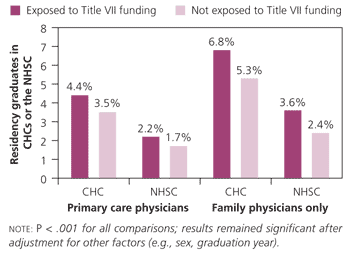
Percentage of primary care physicians who attended Title VII-funded versus non-Title VII-funded residency programs and then went on to work in a community health center (CHC) between 2001 and 2003, or the National Health Service Corps (NHSC) between 1975 and 2004.

Information from reference 3.

If physicians from Title VII-funded residencies had chosen practices similar to those from nonfunded programs, CHCs would have had as many as 648 additional primary care physician vacancies from 2001 to 2003, doubling CHC vacancy rates. In 2004, there were 644 full-time equivalent vacancies for primary care physicians in CHCs.4 In 2009, more than 3,400 NHSC primary care physician positions were unfilled.5 CHC capacity has expanded rapidly, yet Title VII funding has declined dramatically.6,7 Federal efforts to enhance access to care may fail without better funding of the primary care pipeline through programs such as Title VII.

Author disclosure: Drs. Rittenhouse and Grumbach hold an academic appointment in a department that receives Title VII training funds.

  1. 1.Fryer GE, et al. The association of Title VII funding to departments of family medicine with choice of physician specialty and practice location. Fam Med. 2002;34(6):436-440.
  2. 2.Politzer RM, et al. The impact of Title VII departmental and predoctoral support on the production of generalist physicians in private medical schools. Arch Fam Med. 1997;6(6):531-535.
  3. 3.Rittenhouse DR, et al. Impact of Title VII training programs on community health center staffing and national health service corps participation. Ann Fam Med. 2008;6(5):397-405.
  4. 4.Rosenblatt RA, et al. Shortages of medical personnel at community health centers: implications for planned expansion. JAMA. 2006;295(9):1062-1064.
  5. 5.NHSC job opportunities. http://datawarehouse.hrsa.gov/HGDWReports/RT_App.aspx?rpt=JO. Accessed December 3, 2009.
  6. 6.NACHC, Robert Graham Center, George Washington University School of Public Health and Health Services. Access transformed: building a primary care workforce for the 21st century. 2008
  7. 7.Harrison B, et al. Title VII's decline: shrinking investment in the primary care training pipeline. Am Fam Physician. 2009;80(8):872.

The information and opinions contained in research from the Graham Center do not necessarily reflect the views or the policy of the AAFP.

This series is coordinated by Kenny Lin, MD, MPH, deputy editor.

A collection of Graham Center Policy One-Pagers published in AFP is available at https://www.aafp.org/afp/graham. One-Pagers are also available at https://www.graham-center.org.

Copyright © 2026 by the American Academy of Family Physicians.

This content is owned by the AAFP. A person viewing it online may make one printout of the material and may use that printout only for his or her personal, non-commercial reference. This material may not otherwise be downloaded, copied, printed, stored, transmitted or reproduced in any medium, whether now known or later invented, except as authorized in writing by the AAFP. See permissions for copyright questions and/or permission requests.