

Newborn Skin: Part II. Birthmarks

Katherine A. M. Snyder, MD
Adam D. Voelckers, MD

American Family Physician. 2024;109(3):217-221.

Author disclosure: No relevant financial relationships.

This is part II of a two-part article on newborn skin. “Newborn Skin: Part I. Common Rashes and Skin Changes,” appears in this issue of AFP.

Birthmarks in newborns can be classified as vascular, melanocytic or pigmented, or markers of underlying developmental abnormalities of the nervous system. A nevus simplex is a benign capillary malformation. Newborns with a nevus flammeus can be safely treated before one year of age with a pulsed dye laser to reduce the visibility of lesions. Infantile hemangiomas should be treated with systemic beta blockers if there is a risk of life-threatening complications, functional impairment, ulceration, underlying abnormalities, permanent scarring, or alteration of anatomic landmarks. Dermal melanocytosis is a benign finding that is easily recognized and does not warrant further evaluation. A solitary congenital melanocytic nevus that is less than 20 cm in diameter may be observed in primary care; children with larger or multiple nevi should be referred to pediatric dermatology due to the risk of melanoma. Newborns with skin markers of occult spinal dysraphism (other than a simple, solitary dimple) should have lumbar spine imaging using ultrasonography or magnetic resonance imaging.

Birthmarks are common sources of parental concern, and some require evaluation and treatment. Birthmarks can be classified as vascular, as melanocytic or pigmented, or as markers of underlying developmental abnormalities of the nervous system. Part II of this article reviews the identification and management of birthmarks that appear in the neonatal period, with an emphasis on prognosis and appropriate counseling for parents. Part I of this article, which also appears in this issue of American Family Physician, discusses the presentation, prognosis, and treatment of common rashes and skin changes that may present during an infant's first four weeks of life.1

SORT: KEY RECOMMENDATIONS FOR PRACTICE
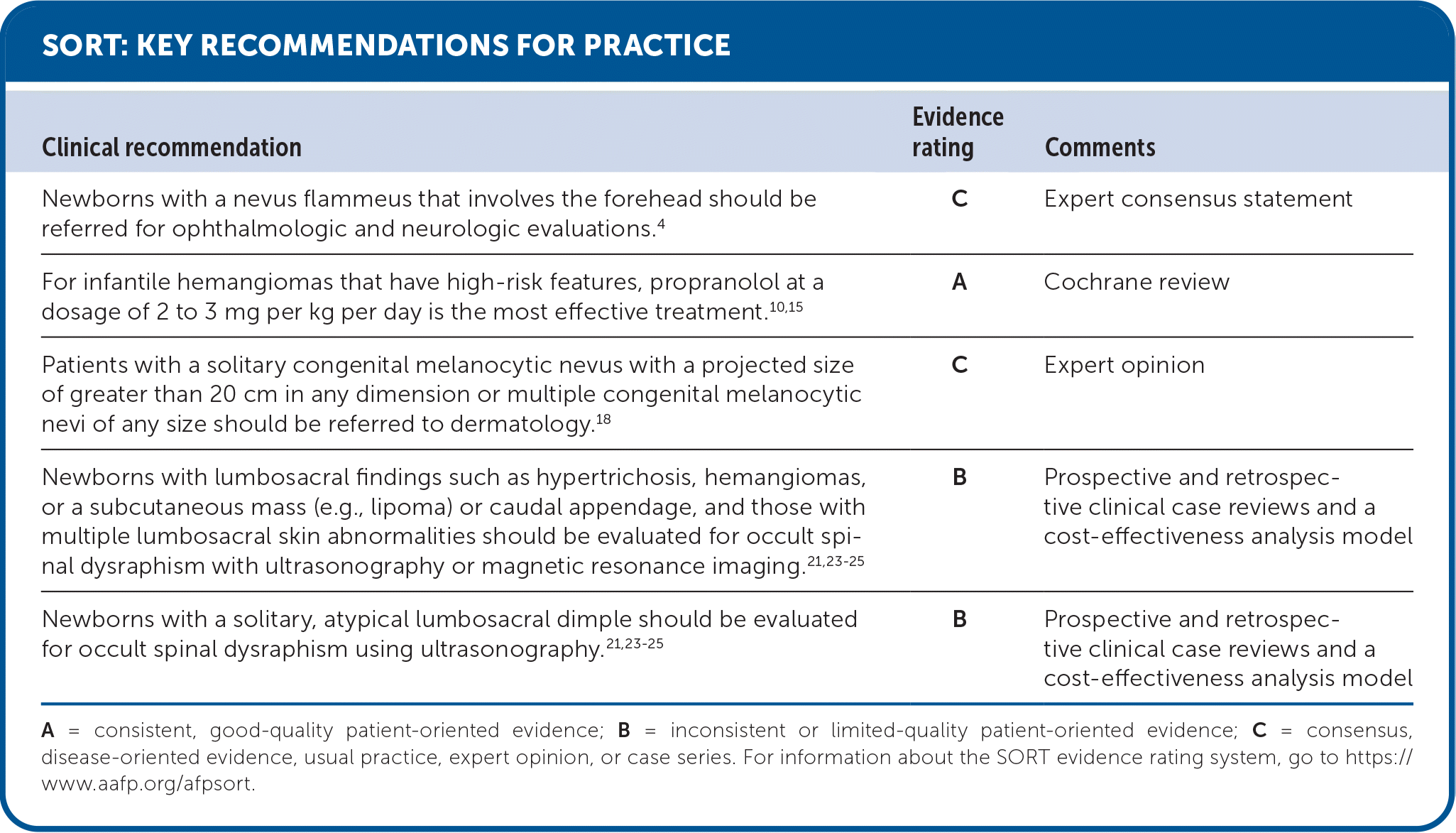
A = consistent, good-quality patient-oriented evidence; B = inconsistent or limited-quality patient-oriented evidence; C = consensus, disease-oriented evidence, usual practice, expert opinion, or case series. For information about the SORT evidence rating system, go to https://www.aafp.org/afpsort.

Vascular Lesions

Vascular lesions result from abnormally formed blood vessels. Capillary malformations, such as a nevus simplex and nevus flammeus, are the most common presentations. Cutaneous vascular lesions can be associated with genetic syndromes or extracutaneous malformations. Early recognition, diagnosis, and treatment of syndromes associated with vascular lesions in infants can significantly impact quality of life.

NEVUS SIMPLEX

A nevus simplex is colloquially known as a stork bite, angel kiss, or salmon patch, and is present in 82% of newborns. These lesions present as pale pink to bright red or violet macules with indistinct borders that can be partially blanched with pressure on the skin (Figure 1). Most are benign and spontaneously regress by one year of age. Rarely, a nevus simplex can be associated with genetic syndromes including Beckwith-Wiedemann syndrome, port-wine nevi-mega cisterna magna-hydrocephalus syndrome (Nova syndrome), odontodysplasia, macrocephaly-capillary malformation syndrome, and Roberts-SC phocomelia syndrome.2 Neurologic symptoms, seizures, large head size, and limb malformations should prompt consideration of referral for genetic evaluation.

FIGURE 1.

A nevus simplex is a transient capillary malformation.

NEVUS FLAMMEUS

A nevus flammeus, colloquially known as a port-wine stain, occurs in 3 to 5 per 1,000 live births and is most commonly present on the limbs or face. These lesions are well-demarcated, pink or red lesions composed of abnormally dilated capillaries and venules.3 Lesions on the limbs or trunk remain stable or lighten over time, whereas facial lesions tend to become darker, taking on the port-wine color.2 A nevus flammeus that involves the forehead may indicate Sturge-Weber syndrome, a congenital neurocutaneous syndrome characterized by vascular malformations in the brain or eyes; therefore, ophthalmologic and neurologic evaluations are recommended.4 Nevi flammeus can progress to include nodules, pyogenic granulomas, and soft tissue hypertrophy that involves underlying structures, such as gingiva. Treatment can reduce the visibility of lesions and associated psychological morbidity. A pulsed dye laser selectively destructs the involved capillaries. Treatment with pulsed dye laser is typically more effective in children than adults due to differences in skin thickness and capillary size.5 Treatment in infants younger than one year is effective and avoids the need for general anesthesia that is needed for treatment in older children.6,7 The most common adverse effects of treatment are transient purpura, localized edema, crusting, and blistering, but long-term complications such as pigmentary changes and scarring are rare.8

INFANTILE HEMANGIOMAS

Infantile hemangiomas are the most common benign vascular tumor in children, occurring in up to 5% of infants and 10% of premature infants. They are more common in infants with low birth weight, female sex, twin gestation, and premature birth.9,10 Clinical presentation at birth varies from bright strawberry-red lesions to pale patches or telangiectasias surrounded by pallor 11 (Figure 2). Hemangiomas proliferate rapidly between one and three months of age and typically stop growing by five months of age. Involution starts by 12 months of age and lesions disappear by four years of age in 80% of children.10

FIGURE 2.

Infantile hemangioma presenting as telangiectasias surrounded by skin pallor.

Most hemangiomas are benign and do not require treatment. High-risk features are those that increase potential for life-threatening complications, functional impairment, ulceration, underlying abnormalities, permanent scarring, or alteration of anatomic landmarks. Hemangiomas on the face or anterior neck can be associated with functional impairment of feeding or vision or, if they are associated with airway hemangiomas, life-threatening complications. The presence of five or more hemangiomas increases the likelihood of hepatic hemangioma, which rarely can lead to high-output heart failure. Hemangiomas in the perineum, gluteal cleft, or lumbosacral area can be associated with occult spinal dysraphism or LUMBAR (lower body hemangioma, urogenital abnormalities/ulceration, myelopathy, bony deformities, anorectal malformations/arterial anomalies, and rectal anomalies) syndrome. Hemangiomas with a diameter greater than 5 cm that involve the face or scalp can be an indicator of PHACE (posterior fossa anomalies, hemangioma, arterial anomalies, cardiac anomalies, and eye anomalies) syndrome. Hemangiomas located over the axilla, much of the face, or diaper area have the potential for permanent scarring or alteration of key anatomic landmarks. Urgent referral to a hemangioma specialist is recommended if any high-risk features are present.10 The Infantile Hemangioma Referral Score screening tool (https://www.ihscoring.com) reliably identifies infantile hemangiomas that require referral, can be used quickly by primary care physicians, and has good interrater reliability between expert and nonexpert users.12,13

Imaging should be performed if there is concern for associated anatomic abnormalities. Abdominal Doppler ultrasonography is indicated in children with five or more cutaneous hemangiomas or if there is concern for LUMBAR syndrome. Infants should be evaluated for occult spinal dysraphism if hemangiomas are present in the perineum, gluteal cleft, or lumbosacral area. Magnetic resonance angiography of the head and neck should be performed if there is concern for PHACE syndrome.10

Success rates are significantly higher if treatment is started before 10 weeks of age, and current guidelines recommend starting by one month of age.10,14 Systemic beta blockers are the treatment of choice, specifically propranolol, 2 to 3 mg per kg per day.10 This is supported by moderate-quality evidence, with a number needed to treat of 2 vs. placebo for clearance of hemangiomas.15 Propranolol is superior to systemic atenolol in the rate of complete response; however, propranolol is associated with significantly more adverse effects.16 Treatment should be initiated in the inpatient setting for infants younger than five weeks' corrected gestational age or in older infants with poor social support or cardiovascular or respiratory comorbidities.10 Adverse effects of propranolol include changes in sleep, acrocyanosis, bronchial irritation, gastrointestinal symptoms, hypotension, bradycardia, or hypoglycemia.9,10 Propranolol administration with or after feeding and withholding the medication during times of reduced intake or vomiting can lower the risk of treatment-associated hypoglycemia. Systemic or intralesional corticosteroids and topical timolol are alternatives to propranolol.10

Melanocytic Lesions

Melanocytic or pigmented lesions are caused by displaced melanocytes, such as those in dermal melanocytosis, or atypical growth of melanocytes, such as those in congenital melanocytic nevi.

DERMAL MELANOCYTOSIS

Dermal melanocytosis is a benign, hyperpigmented macule primarily found in the lumbosacral and gluteal regions (Figure 3). Single or multiple macules that are blueish gray in color may be present and should be documented during physical examination. No treatment is required. Parents can be reassured that dermal melanocytosis will fade by two years of age and may disappear by puberty.17

FIGURE 3.

Dermal melanocytosis is characterized by benign, hyperpigmented macules primarily found in the lumbosacral and gluteal regions.

CONGENITAL MELANOCYTIC NEVI

Congenital melanocytic nevi are pigmented lesions that affect up to 1 out of 17 newborns. Lesions vary in size from a few millimeters to several centimeters, may be flat or palpable, and most commonly occur on the trunk, extremities, or face. The most common locations are the lower back and thigh area. Color may be uniform or variable within the same lesion but is predominantly shades of black or brown18 (Figure 4). Locations and sizes of congenital melanocytic nevi should be clearly documented during physical examination. Lesions tend to increase in size as the child ages, and the rate of increase depends on the location. Lesions on the head will likely double in size, whereas those on the trunk and extremities will likely triple in size.19

FIGURE 4.

Congenital melanocytic nevus on the lower extremity.

The primary concern with a congenital melanocytic nevus is the risk of melanoma. Lifetime risk of melanoma in any congenital melanocytic nevus is up to 2.2%; however, risk increases with projected adult size. Solitary lesions with a projected size of less than 20 cm may be observed, with referral for any change in color, texture, size, bleeding, or pain. Immediate dermatologist referral is recommended for a projected size of greater than 20 cm or with multiple congenital melanocytic nevi.18 Historically, surgical removal has been recommended; however, removal does not eliminate the risk of melanoma.1820

Markers of Spinal Dysraphism

Occult spinal dysraphisms are skin-covered developmental abnormalities of the nervous system. Early recognition of skin markers of occult spinal dysraphisms and evaluation and surgical correction in affected newborns can prevent irreversible neurologic damage before neurologic impairment is clinically apparent.21 Most cases of occult spinal dysraphisms are associated with midline lumbosacral skin abnormalities such as atypical dimples, hypertrichosis, capillary hemangiomas, subcutaneous masses, including lipoma, or a caudal appendage21 (Figure 5). Features of atypical sacral dimples include dimples that are larger than 5 mm, located more than 25 mm from the anus or off the midline, or with no visible skin at the base.21,22 A solitary dimple is a low-risk finding.22 Lumbosacral skin findings other than simple, solitary dimples, especially two or more skin findings, suggest an increased risk of occult spinal dysraphisms.20,22,23

FIGURE 5.

Cutaneous stigmata of occult spinal dysraphism. This newborn has two simple dimples and a small, palpable, subcutaneous mass below the more caudal dimple. There is also an unrelated dermal melanocytosis.

Ultrasonography and magnetic resonance imaging (MRI) can be used to evaluate newborns with markers of occult spinal dysraphisms (Table 1).20,21,2325 Although ultrasonography is more difficult to obtain in newborns after three months of age due to ossification of the vertebral bodies, MRI requires the use of sedation.21,22 Ultrasonography is cost-effective for initial evaluation in patients with a solitary atypical dimple, has good diagnostic agreement with MRI, and appropriately identifies patients with spinal lesions that may require intervention.2325 In patients with multiple dimples or cutaneous findings other than dimples that infer a higher risk of a surgical lesion, evaluation with MRI may be a more time efficient and cost-effective approach; however, in resource-limited settings, ultrasonography is appropriate as initial imaging.21,23,25 Newborns should be referred to neurosurgery for any abnormal imaging findings or before imaging if there is discharge from any dimple.21

TABLE 1. Evaluation of Cutaneous Markers of Occult Spinal Dysraphism

Lumbosacral skin lesionSuggested evaluation
Atypical dimple* Ultrasonography
Any one of the following:Ultrasonography or magnetic resonance imaging
Caudal appendage
Hemangioma
Hypertrichosis
Subcutaneous mass (e.g., lipoma)
Any two skin findingsUltrasonography or magnetic resonance imaging

*—An atypical dimple is larger than 5 mm or located more than 25 mm from the anus. Deep dimples, multiple dimples, or those that are located cranially to the gluteal crease or outside the mid-line would also be included in this category.

Information from references 20, 21, and 2325.

This article updates a previous article on this topic by McLaughlin, et al.20

Data Sources: A PubMed search was completed using the terms nevus simplex, nevus flammeus, infantile hemangiomas, dermal melanocytosis, congenital melanocytic nevi, markers of spinal dysraphism, and key terms for diagnosis and management. The search included meta-analyses, randomized controlled trials, clinical trials, and reviews. The Cochrane database, UpToDate, Essential Evidence Plus, and the TRIP database were also searched. Search dates: November 2022 to February 2023, May to June 2023, and January 2024.

The authors thank the patients’ families who allowed their newborns to be photographed for this article.

KATHERINE A. M. SNYDER, MD, is a staff physician and the clinical medical director at Mosaic Community Health–Madras (Ore.) Health Center.

ADAM D. VOELCKERS, MD, is a faculty physician at the University of Pittsburgh Medical Center, Lititz (Pa.) Family Medicine Residency Program.

Address correspondence to Katherine A. M. Snyder, MD, Mosaic Community Health, 500 NE A St. Ste. 100, Madras, OR 97741 (katie.snyder@mosaicmedical.org). Reprints are not available from the authors.

Author disclosure: No relevant financial relationships.

  1. 1.Snyder KAM, Voelckers AD. Newborn skin: part I. Common rashes and skin changes. Am Fam Physician. 2024;109(3):212-216.
  2. 2.Rozas-Muñoz E, Frieden IJ, Roé E, et al. Vascular stains: proposal for a clinical classification to improve diagnosis and management. Pediatr Dermatol. 2016;33(6):570-584.
  3. 3.McCuaig CC. Update on classification and diagnosis of vascular malformations. Curr Opin Pediatr. 2017;29(4):448-454.
  4. 4.Sabeti S, Ball KL, Burkhart C, et al. Consensus statement for the management and treatment of port-wine birthmarks in Sturge-Weber syndrome. JAMA Dermatol. 2021;157(1):98-104.
  5. 5.Tran JM, Kelly KM, Drolet BA, et al. Light-based treatment of pediatric port-wine birthmarks. Pediatr Dermatol. 2021;38(2):351-358.
  6. 6.Chapas AM, Eickhorst K, Geronemus RG. Efficacy of early treatment of facial port wine stains in newborns: a review of 49 cases. Lasers Surg Med. 2007;39(7):563-568.
  7. 7.Jeon H, Bernstein LJ, Belkin DA, et al. Pulsed dye laser treatment of port-wine stains in infancy without the need for general anesthesia [published correction appears in JAMA Dermatol. 2019; 155(4): 504]. JAMA Dermatol. 2019;155(4):435-441.
  8. 8.Shi MD, Yang K, Li SB, et al. Complication rates and safety of pulsed dye laser treatment for port-wine stain: a systematic review and meta-analysis. Lasers Med Sci. 2023;39(1):16.
  9. 9.Püttgen KB. Diagnosis and management of infantile hemangiomas. Pediatr Clin North Am. 2014;61(2):383-402.
  10. 10.Krowchuk DP, Frieden IJ, Mancini AJ, et al.; Subcommittee on the Management of Infantile Hemangiomas. Clinical practice guideline for the management of infantile hemangiomas. Pediatrics. 2019;143(1):e20183475.
  11. 11.Fimiani M, Bilenchi R, Mandato F, et al. Neonatal skin disorders. In: Buonocore G, Bracci R, Weindling M, eds. Neonatology. A Practical Approach to Neonatal Diseases. 2nd ed. Springer International; 2018: 2391–2425.
  12. 12.Léauté-Labrèze C, Baselga Torres E, Weibel L, et al. The Infantile Hemangioma Referral Score: a validated tool for physicians. Pediatrics. 2020;145(4):e20191628.
  13. 13.Qiu T, Yang K, Dai S, et al. Analysis of therapeutic decisions for infantile hemangiomas: a prospective study comparing the Hemangioma Severity Scale with the Infantile Hemangioma Referral Score. Children (Basel). 2022;9(12):1851.
  14. 14.Léauté-Labrèze C, Frieden I, Delarue A. Early initiation of treatment with oral propranolol for infantile hemangioma improves success rate. Pediatr Dermatol. 2023;40(2):261-264.
  15. 15.Novoa M, Baselga E, Beltran S, et al. Interventions for infantile haemangiomas of the skin. Cochrane Database Syst Rev. 2018(4):CD006545.
  16. 16.Chen T, Gudipudi R, Nguyen SA, et al. Should propranolol remain the gold standard for treatment of infantile hemangioma? A systematic review and meta-analysis of propranolol versus atenolol. Ann Otol Rhinol Laryngol. 2023;132(3):332-340.
  17. 17.Dinulos JG, Graham EA. Influence of culture and pigment on skin conditions in children. Pediatr Rev. 1998;19(8):268-275.
  18. 18.Jahnke MN, O’Haver J, Gupta D, et al. Care of congenital melanocytic nevi in newborns and infants: review and management recommendations. Pediatrics. 2021;148(6):e2021051536.
  19. 19.Dinulos JGH. Habif’s Clinical Dermatology: A Color Guide to Diagnosis and Therapy. 7th ed. Elsevier; 2021.
  20. 20.McLaughlin MR, O’Connor NR, Ham P. Newborn skin: part II. Birthmarks. Am Fam Physician. 2008;77(1):56-60.
  21. 21.Zywicke HA, Rozzelle CJ. Sacral dimples [published corrections appear in Pediatr Rev. 2011; 32(4): 151 and Pediatr Rev. 2011; 32(5): 207]. Pediatr Rev. 2011;32(3):109-113.
  22. 22.Choi SJ, Yoon HM, Hwang JS, et al. Incidence of occult spinal dysraphism among infants with cutaneous stigmata and proportion managed with neurosurgery: a systematic review and meta-analysis. JAMA Netw Open. 2020;3(7):e207221.
  23. 23.Medina LS, Crone K, Kuntz KM. Newborns with suspected occult spinal dysraphism: a cost-effectiveness analysis of diagnostic strategies. Pediatrics. 2001;108(6):E101.
  24. 24.Ausili E, Maresca G, Massimi L, et al. Occult spinal dysraphisms in newborns with skin markers: role of ultrasonography and magnetic resonance imaging. Childs Nerv Syst. 2018;34(2):285-291.
  25. 25.Hughes JA, De Bruyn R, Patel K, et al. Evaluation of spinal ultrasound in spinal dysraphism. Clin Radiol. 2003;58(3):227-233.

Copyright © 2026 by the American Academy of Family Physicians.

This content is owned by the AAFP. A person viewing it online may make one printout of the material and may use that printout only for his or her personal, non-commercial reference. This material may not otherwise be downloaded, copied, printed, stored, transmitted or reproduced in any medium, whether now known or later invented, except as authorized in writing by the AAFP. See permissions for copyright questions and/or permission requests.
