

ASCCP Management Guidelines for Abnormal Cervical Cancer Screening

Kiana Espinosa, MD,
University of Arizona College of Medicine, Phoenix, Arizona

American Family Physician. 2024;109(3):275-276.

Author disclosure: No relevant financial relationships.

Clinical Question

How should abnormal test results be managed in patients who have had cervical cancer screening?

Evidence Summary

Cervical cancer incidence and mortality have decreased significantly in the United States since the introduction of cervical cancer screening.1 In 2019, the American Society for Colposcopy and Cervical Pathology (ASCCP) published updated consensus guidelines for the management of abnormal cervical cancer screening results in asymptomatic patients. These guidelines provided recommendations that attempted to maximize cervical cancer prevention and limit harms from overtesting and overtreatment.2

The ASCCP guidelines help determine the risk of developing cervical intraepithelial neoplasia grade 3 or worse (CIN3+), including CIN3, adenocarcinoma in situ, and invasive cervical cancer, and recommend management based on the guiding principle that equal risk should receive equal management. Risk estimates were based on a prospective longitudinal cohort of more than 1.5 million patients followed for more than 10 years at Kaiser Permanente–Northern California3 and were validated in several databases that represent patients of diverse racial, ethnic, and socioeconomic backgrounds.49

The recommendations can be implemented in five common clinical scenarios: (1) initial management of an abnormal cervical cancer screening result; (2) return visit for surveillance of a previous abnormal cervical cancer screening result that did not require colposcopy; (3) evaluation of a colposcopic biopsy result; (4) management of test results at a surveillance visit after a colposcopic biopsy that shows less than CIN grade 2 (CIN2); and (5) follow-up after treatment for CIN2 or CIN3.2

Individualized risk of developing CIN3+ can be determined by combining the patient's age, current screening results (from primary human papillomavirus [HPV] screening, cotesting with HPV and cervical cytology, or cervical cytology alone), prior screening and biopsy results, and history of precancer treatment.2 In most cases, a persistent HPV infection is necessary for developing cervical precancer or cancer; therefore, HPV type and duration of infection strongly impact the risk for CIN3+.1013 In an observational cohort of 990,013 women in the Kaiser Permanente–Northern California health care system, a negative HPV test or co-test in the past five years has been shown to correlate with a 50% decrease in the risk of CIN3+.14 Incorporating prior screening and biopsy results allows for the detection and treatment of CIN3+ and avoids unnecessary interventions for patients who are at lower risk.

When a patient's risk has been identified, appropriate management can be determined by referencing the clinical action thresholds that correspond to specific risk levels. Colposcopy and treatment recommendations are based on the immediate risk of CIN3+, whereas longer-term surveillance recommendations are based on the five-year risk of CIN3+. Risk estimates and management plans can be determined using the ASCCP decision aid, available via a smartphone application (ASCCP Management Guidelines; $9.99 in the Apple App Store and Google Play) and at no cost on their website (https://app.asccp.org).2 Figure 1 provides management recommendations based on immediate and five-year risk of CIN3+.

FIGURE 1. Management recommendations based on immediate and five-year risk of CIN grade 3 or worse.
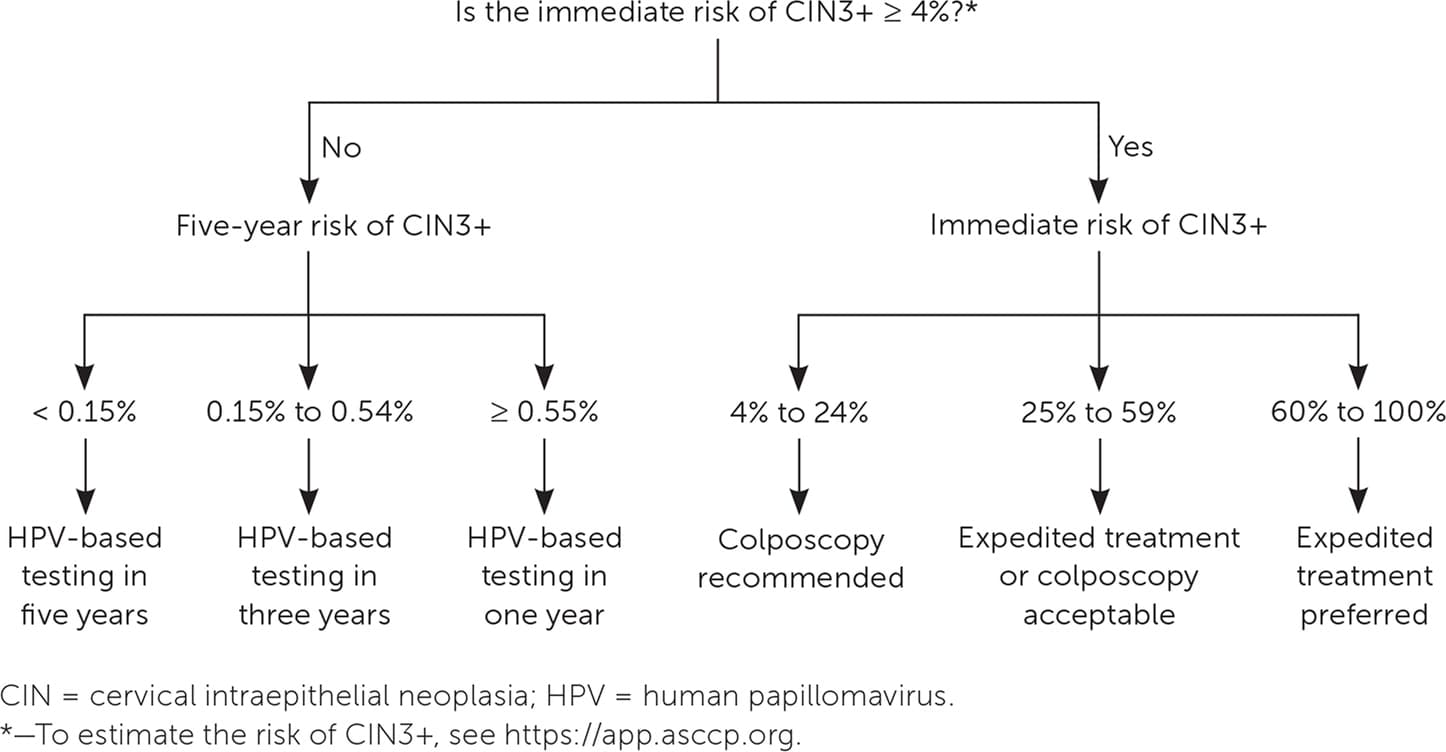
There are specific considerations for patients who are pregnant, immunosuppressed, posthysterectomy, and younger than 25 years; therefore, it is important to include these patient characteristics when determining risk. There are also special guidelines for atypical glandular cells, adenocarcinoma in situ, atypical squamous cells–cannot rule out high-grade squamous intraepithelial lesions, HPV-16 and HPV-18 with normal cytology, and two consecutive unsatisfactory cervical cancer screening tests. Management of these cases does not follow the risk algorithm outlined in Figure 1 because of limited data or a disproportionately high risk of cancer.2

Applying the Evidence

A 30-year-old woman with no prior cervical cancer screening has a co-test result that is positive for HPV and atypical squamous cells of undetermined significance.Using the ASCCP decision aid, you enter herage, current test result, and lack of prior testing. It determines that shehas an immediate risk of CIN3+ of 4.4%. Becauseher immediate risk is 4% or greater, colposcopy is recommended. Her colposcopic biopsy result isCIN grade 1, and repeat HPV screening is recommended in one year. At follow-up, her cotestresult is still positive forHPV and atypical squamous cells of undeter-mined significance. You include her prior screening and current testresults using the decision aid and determine that her immediate risk of CIN3+ is 3.1%, and her five-year risk of CIN3+ is 6.0%. Because her immediate risk is below the clinical action threshold of 4%, she does not need to repeat colposcopy. It is recommended that HPV screening be repeated in one year based on her five-year risk of CIN3+.

Address correspondence to Kiana Espinosa, MD, at kiana.espinosa@bannerhealth.com. Reprints are not available from the author.

Author disclosure: No relevant financial relationships.

  1. 1.Adegoke O, Kulasingam S, Virnig B. Cervical cancer trends in the United States: a 35-year population-based analysis. J Womens Health (Larchmt). 2012;21(10):1031-1037.
  2. 2.Perkins RB, Guido RS, Castle PE, et al. 2019 ASCCP risk-based management consensus guidelines for abnormal cervical cancer screening tests and cancer precursors [published correction appears in J Low Genit Tract Dis. 2020;24(4):427]. J Low Genit Tract Dis. 2020;24(2):102-131.
  3. 3.Egemen D, Cheung LC, Chen X, et al. Risk estimates supporting the 2019 ASCCP risk-based management consensus guidelines. J Low Genit Tract Dis. 2020;24(2):132-143.
  4. 4.Cheung LC, Egemen D, Chen X, et al. 2019 ASCCP risk-based management consensus guidelines: methods for risk estimation, recommended management, and validation. J Low Genit Tract Dis. 2020;24(2):90-101.
  5. 5.Wright TC, Stoler MH, Behrens CM, et al. The ATHENA human papillomavirus study: design, methods, and baseline results. Am J Obstet Gynecol. 2012;206(1):46.e1-46.e11.
  6. 6.Stoler MH, Wright TC, Parvu V, et al. The Onclarity Human Papillomavirus Trial: design, methods, and baseline results. Gynecol Oncol. 2018;149(3):498-505.
  7. 7.Gage JC, Schiffman M, Hunt WC, et al.; New Mexico HPV Pap Registry Steering Committee. Cervical histopathology variability among laboratories: a population-based state wide investigation. Am J Clin Pathol. 2013;139(3):330-335.
  8. 8.Wheeler CM, Hunt WC, Cuzick J, et al.; New Mexico HPV Pap Registry Steering Committee. A population-based study of human papillomavirus genotype prevalence in the United States: baseline measures prior to mass human papillomavirus vaccination. Int J Cancer. 2013;132(1):198-207.
  9. 9.Ekwueme DU, Uzunangelov VJ, Hoerger TJ, et al. Impact of the National Breast and Cervical Cancer Early Detection Program on cervical cancer mortality among uninsured low-income women in the U.S., 1991–2007. Am J Prev Med. 2014;47(3):300-308.
  10. 10.Elfgren K, Elfström KM, Naucler P, et al. Management of women with human papillomavirus persistence: long-term follow-up of a randomized clinical trial. Am J Obstet Gynecol. 2017;216(3):264.e1-264.e7.
  11. 11.Aro K, Nieminen P, Louvanto K, et al. Age-specific HPV type distribution in high-grade cervical disease in screened and unvaccinated women. Gynecol Oncol. 2019;154(2):354-359.
  12. 12.Wentzensen N, Schiffman M, Dunn T, et al. Multiple human papillomavirus genotype infections in cervical cancer progression in the study to understand cervical cancer early end points and determinants. Int J Cancer. 2009;125(9):2151-2158.
  13. 13.Wentzensen N, Schiffman M, Dunn ST, et al. Grading the severity of cervical neoplasia based on combined histopathology, cytopathology, and HPV genotype distribution among 1,700 women referred to colposcopy in Oklahoma. Int J Cancer. 2009;124(4):964-969.
  14. 14.Castle PE, Kinney WK, Xue X, et al. Effect of several negative rounds of human papillomavirus and cytologyco-testing on safety against cervical cancer: an observational cohort study. Ann Intern Med. 2018;168(1):20-29.

This guide is one in a series that offers evidence-based tools to assist family physicians in improving their decision-making at the point of care.

This series is coordinated by Mark H. Ebell, MD, MS, deputy editor for evidence-based medicine.

A collection of Point-of-Care Guides published in AFP is available at https://www.aafp.org/afp/poc.

Copyright © 2026 by the American Academy of Family Physicians.

This content is owned by the AAFP. A person viewing it online may make one printout of the material and may use that printout only for his or her personal, non-commercial reference. This material may not otherwise be downloaded, copied, printed, stored, transmitted or reproduced in any medium, whether now known or later invented, except as authorized in writing by the AAFP. See permissions for copyright questions and/or permission requests.
