Salivary Gland Disorders: Rapid Evidence Review

Michael J. Kim, MD
Anna Milliren, DO
Dennis J. Gerold, Jr., MD

American Family Physician. 2024;109(6):550-559.

Author disclosure: No relevant financial relationships.

This clinical content conforms to AAFP criteria for CME.

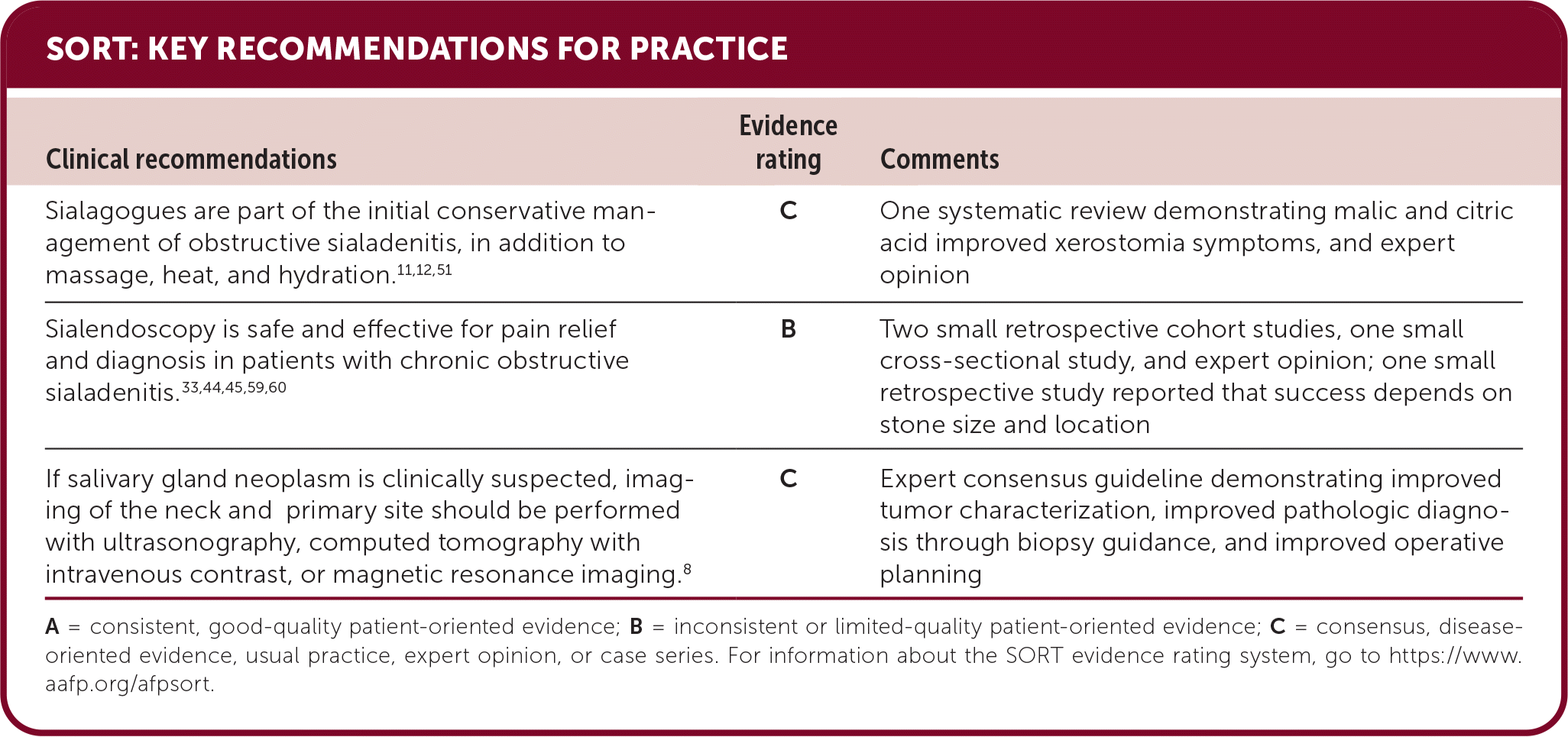
The major salivary glands are the paired parotid, submandibular, and sublingual glands. Salivary gland disorders can affect the glandular tissue or its excretory system. The parotid glands are the largest and produce aqueous serous secretions that are less immunogenic. They are more susceptible to infections and neoplasms. The submandibular glands produce mucinous secretions that are high in calcium and phosphate salts through a long submandibular duct that flows against gravity. The submandibular glands are responsible for more than 80% of salivary stones. Sialadenitis can be acute or chronic and caused by bacterial, viral, and obstructive etiologies; the most common bacteria is Staphylococcus aureus. The most common viral etiologies in children are mumps (globally) and juvenile recurrent parotitis (in vaccinated populations). Sialadenosis is a chronic asymptomatic enlargement of the salivary glands due to systemic disease. Sialolithiasis causes up to 50% of salivary gland disorders. It is associated with salivary stasis and inflammation caused by dehydration, malnutrition, medications, or chronic illness. Obstruction is also caused by trauma, stenosis, and mucoceles. Neoplasms are rare and typically benign, but they warrant referral and imaging with ultrasonography, computed tomography, or magnetic resonance sialography. Most disorders are managed with conservative measures by treating the underlying etiology, optimizing predisposing factors, controlling pain, and increasing salivary flow with sialagogues, hydration, massage, warm compresses, oral hygiene, and medication adjustment. Sialendoscopy is a gland-sparing technique that can treat obstructive and nonobstructive disorders. (Am Fam Physician. 2024;109(6):550-559. Copyright © 2024 American Academy of Family Physicians.)

MICHAEL J. KIM, MD, FAAFP, is an assistant professor in the Department of Family Medicine at the Uniformed Services University of the Health Sciences, Bethesda, Md., and associate program director of the Travis Air Force Base (Calif.) Family Medicine Residency, David Grant Medical Center, Travis Air Force Base.

ANNA MILLIREN, DO, is an assistant professor in the Department of Family Medicine at the Uniformed Services University of the Health Sciences and core faculty at the Travis Air Force Base Family Medicine Residency, David Grant Medical Center.

DENNIS J. GEROLD Jr., MD, is core faculty at the Travis Air Force Base Family Medicine Residency, David Grant Medical Center.

Address correspondence to Michael J. Kim, MD, 101 Bodin Cir., 60 HCOS/SGGF, Travis Air Force Base, CA 94535 (drmichaeljkim@gmail.com). Reprints are not available from the authors.

Author disclosure: No relevant financial relationships.

  1. 1.Mehanna H, McQueen A, Robinson M, et al. Salivary gland swellings. Clin Otolaryngol. 2013;38(1):58-65.
  2. 2.Kraaij S, Karagozoglu KH, Forouzanfar T, et al. Salivary stones: symptoms, aetiology, biochemical composition and treatment. Br Dent J. 2014;217(11):E23-E23.
  3. 3.Hammett JT, Walker C. Sialolithiasis. StatPearls. Updated September 26, 2022. Accessed August 13, 2023. http://www.ncbi.nlm.nih.gov/books/NBK549845/
  4. 4.Fattahi TT, Lyu PE, Van Sickels JE. Management of acute suppurative parotitis. J Oral Maxillofac Surg. 2002;60(4):446-448.
  5. 5.Ugga L, Ravanelli M, Pallottino AA, et al. Diagnostic work-up in obstructive and inflammatory salivary gland disorders. Acta Otorhinolaryngol Ital. 2017;37(2):83-93.
  6. 6.Wood J, Toll EC, Hall F, et al. Juvenile recurrent parotitis: review and proposed management algorithm. Int J Pediatr Otorhinolaryngol. 2021;142:110617.
  7. 7.Mandel L. Salivary gland disorders. Med Clin North Am. 2014;98(6):1407-1449.
  8. 8.Geiger JL, Ismaila N, Beadle B, et al. Management of salivary gland malignancy: ASCO guideline. J Clin Oncol. 2021;39(17):1909-1941.
  9. 9.Peraza A, Gómez R, Beltran J, et al. Mucoepidermoid carcinoma. An update and review of the literature. J Stomatol Oral Maxillofac Surg. 2020;121(6):713-720.
  10. 10.Alves LDB, de Melo AC, Farinha TA, et al. A systematic review of secretory carcinoma of the salivary gland: where are we?. Oral Surg Oral Med Oral Pathol Oral Radiol. 2021;132(4):e143-e152.
  11. 11.Ogle OE. Salivary gland diseases. Dent Clin North Am. 2020;64(1):87-104.
  12. 12.Armstrong MA, Turturro MA. Salivary gland emergencies. Emerg Med Clin North Am. 2013;31(2):481-499.
  13. 13.Wilson KF, Meier JD, Ward PD. Salivary gland disorders. Am Fam Physician. 2014;89(11):882-888.
  14. 14.Lau RK, Turner MD. Viral mumps: increasing occurrences in the vaccinated population. Oral Surg Oral Med Oral Pathol Oral Radiol. 2019;128(4):386-392.
  15. 15.Riley P, Glenny AM, Hua F, et al. Pharmacological interventions for preventing dry mouth and salivary gland dysfunction following radiotherapy. Cochrane Database Syst Rev. 2017(7):CD012744.
  16. 16.Sánchez Barrueco A, González Galán F, Alcalá Rueda I, et al. Incidence and risk factors for radioactive iodine-induced sialadenitis. Acta Otolaryngol. 2020;140(11):959-962.
  17. 17.Negrini S, Emmi G, Greco M, et al. Sjögren's syndrome: a systemic auto-immune disease. Clin Exp Med. 2022;22(1):9-25.
  18. 18.Puxeddu I, Capecchi R, Carta F, et al. Salivary gland pathology in IgG4-related disease: a comprehensive review. J Immunol Res. 2018;2018:6936727.
  19. 19.Bowers EMR, Schaitkin B. Management of mucoceles, sialoceles, and ranulas. Otolaryngol Clin North Am. 2021;54(3):543-551.
  20. 20.Key S, Chia C, Hasan Z, et al. Systematic review of prognostic factors in carcinoma ex pleomorphic adenoma. Oral Oncol. 2022;133:106052.
  21. 21.Abdel Razek AAK, Mukherji S. Imaging of sialadenitis. Neuroradiol J. 2017;30(3):205-215.
  22. 22.Skálová A, Hyrcza MD, Leivo I. Update from the 5th edition of the World Health Organization classification of head and neck tumors: salivary glands. Head Neck Pathol. 2022;16(1):40-53.
  23. 23.Wolff A, Joshi RK, Ekström J, et al. A guide to medications inducing salivary gland dysfunction, xerostomia, and subjective sialorrhea: a systematic review sponsored by the World Workshop on Oral Medicine VI. Drugs R D. 2017;17(1):1-28.
  24. 24.Friedman E, Cai Y, Chen B. Imaging of major salivary gland lesions and disease. Oral Maxillofac Surg Clin North Am. 2023;35(3):435-449.
  25. 25.Haran S, Kazi S, Caldera S. Presentation is key to diagnosing salivary gland disorders. J Fam Pract. 2019;68(8):E1-E7.
  26. 26.Fisher J, Monette DL, Patel KR, et al. COVID-19 associated parotitis. Am J Emerg Med. 2021;39:254.e1-254.e3.
  27. 27.Stafford JA, Moore CA, Mark JR. Acute sialadenitis associated with 2017–2018 influenza A infection: a case series. Laryngoscope. 2018;128(11):2500-2502.
  28. 28.Lim ZY, Ang AXY, Cross GB. COVID-19 associated parotitis. IDCases. 2021;24:e01122.
  29. 29.Nkuna T, Maharaj S, Hari K. Benign lymphoepithelial cyst of parotid glands in HIV infected patients on anti-retroviral therapy: a narrative review. Indian J Otolaryngol Head Neck Surg. 2023;75(2):547-556.
  30. 30.Lee E, Badger C, Thakkar PG. Otorhinolaryngology manifestations of systemic illness. Med Clin North Am. 2021;105(5):871-883.
  31. 31.Davis AB, Hoffman HT. Management options for sialadenosis. Otolaryngol Clin North Am. 2021;54(3):605-611.
  32. 32.Troeltzsch M, Pache C, Probst FA, et al. Antibiotic concentrations in saliva: a systematic review of the literature, with clinical implications for the treatment of sialadenitis. J Oral Maxillofac Surg. 2014;72(1):67-75.
  33. 33.Erkul E, Gillespie MB. Sialendoscopy for non-stone disorders: the current evidence. Laryngoscope Investig Otolaryngol. 2016;1(5):140-145.
  34. 34.Prasad RS. Parotid gland imaging. Otolaryngol Clin North Am. 2016;49(2):285-312.
  35. 35.Diebold S, Overbeck M. Soft tissue disorders of the mouth. Emerg Med Clin North Am. 2019;37(1):55-68.
  36. 36.Thomas WW, Douglas JE, Rassekh CH. Accuracy of ultrasonography and computed tomography in the evaluation of patients undergoing sialendoscopy for sialolithiasis. Otolaryngol Head Neck Surg. 2017;156(5):834-839.
  37. 37.Goncalves M, Schapher M, Iro H, et al. Value of sonography in the diagnosis of sialolithiasis: comparison with the reference standard of direct stone identification. J Ultrasound Med. 2017;36(11):2227-2235.
  38. 38.Kim DH, Kang JM, Kim SW, et al. Utility of ultrasonography for diagnosis of salivary gland sialolithiasis: a meta-analysis. Laryngoscope. 2022;132(9):1785-1791.
  39. 39.Purcell YM, Kavanagh RG, Cahalane AM, et al. The diagnostic accuracy of contrast-enhanced CT of the neck for the investigation of sialolithiasis. AJNR Am J Neuroradiol. 2017;38(11):2161-2166.
  40. 40.Bachesk AB, Bin LR, Iwaki IV, et al. Ranula in children: retrospective study of 25 years and literature review of the plunging variable. Int J Pediatr Otorhinolaryngol. 2021;148:110810.
  41. 41.Jain P, Jain R, Morton RP, et al. Plunging ranulas: high-resolution ultrasound for diagnosis and surgical management. Eur Radiol. 2010;20(6):1442-1449.
  42. 42.Isa AY, Hilmi OJ. An evidence based approach to the management of salivary masses. Clin Otolaryngol. 2009;34(5):470-473.
  43. 43.Strychowsky JE, Sommer DD, Gupta MK, et al. Sialendoscopy for the management of obstructive salivary gland disease: a systematic review and meta-analysis. Arch Otolaryngol Head Neck Surg. 2012;138(6):541-547.
  44. 44.Gillespie MB, O'Connell BP, Rawl JW, et al. Clinical and quality-of-life outcomes following gland-preserving surgery for chronic sialadenitis. Laryngoscope. 2015;125(6):1340-1344.
  45. 45.Fabie JE, Kompelli AR, Naylor TM, et al. Gland-preserving surgery for salivary stones and the utility of sialendoscopes. Head Neck. 2019;41(5):1320-1327.
  46. 46.Ramsha A, Keskool P, Ongard S, et al. Outcome of the management of salivary gland diseases by sialendoscopy: a university hospital's experience. J Oral Maxillofac Surg. 2023;81(3):344-349.
  47. 47.Agarwal AK, Kanekar SG. Imaging of submandibular and sublingual salivary glands. Neuroimaging Clin N Am. 2018;28(2):227-243.
  48. 48.Afzelius P, Nielsen MY, Ewertsen C, et al. Imaging of the major salivary glands. Clin Physiol Funct Imaging. 2016;36(1):1-10.
  49. 49.Schmidt RL, Hall BJ, Wilson AR, et al. A systematic review and meta-analysis of the diagnostic accuracy of fine-needle aspiration cytology for parotid gland lesions. Am J Clin Pathol. 2011;136(1):45-59.
  50. 50.McQuone SJ. Acute viral and bacterial infections of the salivary glands. Otolaryngol Clin North Am. 1999;32(5):793-811.
  51. 51.Salum FG, Medella-Junior FAC, Figueiredo MAZ, et al. Salivary hypofunction: an update on therapeutic strategies. Gerodontology. 2018;35(4):305-316.
  52. 52.Brook I. Acute bacterial suppurative parotitis: microbiology and management. J Craniofac Surg. 2003;14(1):37-40.
  53. 53.Di Pietrantonj C, Rivetti A, Marchione P, et al. Vaccines for measles, mumps, rubella, and varicella in children. Cochrane Database Syst Rev. 2021(11):CD004407.
  54. 54.Marlow MA, Marin M, Moore K, et al. CDC guidance for use of a third dose of MMR vaccine during mumps outbreaks. J Public Health Manag Pract. 2020;26(2):109-115.
  55. 55.Su SB, Chang HL, Chen KT. Current status of mumps virus infection: epidemiology, pathogenesis, and vaccine. Int J Environ Res Public Health. 2020;17(5):1686.
  56. 56.Nouraei SAR, Ismail Y, Ferguson MS, et al. Analysis of complications following surgical treatment of benign parotid disease. ANZ J Surg. 2008;78(3):134-138.
  57. 57.Benaim E, Fan T, Dash A, et al. Common characteristics and clinical management recommendations for juvenile recurrent parotitis: a 10-year tertiary center experience. OTO Open. 2022;6(1) ): 2473974X221077874.
  58. 58.Garcia Garcia B, Dean Ferrer A, Diaz Jimenez N, et al. Bilateral parotid sialadenosis associated with long-standing bulimia: a case report and literature review. J Maxillofac Oral Surg. 2018;17(2):117-121.
  59. 59.Moorthy A, Bachalli PS, Krishna S, et al. Sialendoscopic management of obstructive salivary gland pathology: a retrospective analysis of 236 cases. J Oral Maxillofac Surg. 2021;79(7):1474-1481.
  60. 60.Van Cleemput T, Vanpoecke J, Coropciuc R, et al. Sialendoscopy: a four-year single center experience. J Oral Maxillofac Surg. 2021;79(11):2285-2291.
  61. 61.Badash I, Raskin J, Pei M, et al. Contemporary review of submandibular gland sialolithiasis and surgical management options. Cureus. 2022;14(8):e28147.
  62. 62.Kolomvos N, Kalfarentzos E, Papadogeorgakis N. Surgical treatment of plunging ranula: report of three cases and review of literature. Oral Maxillofac Surg Cases. 2019;5(1):100098.

Copyright © 2026 by the American Academy of Family Physicians.

This content is owned by the AAFP. A person viewing it online may make one printout of the material and may use that printout only for his or her personal, non-commercial reference. This material may not otherwise be downloaded, copied, printed, stored, transmitted or reproduced in any medium, whether now known or later invented, except as authorized in writing by the AAFP. See permissions for copyright questions and/or permission requests.