

Modified Two-Tiered Serodiagnostic Testing Algorithms for Acute Phase or Early Disseminated Lyme Disease

Haroon Samar, MD, MPH, FAAFP
Matthew J. Kenney, DO

American Family Physician. 2024;110(1):85-86.

Author disclosure: No relevant financial relationships.

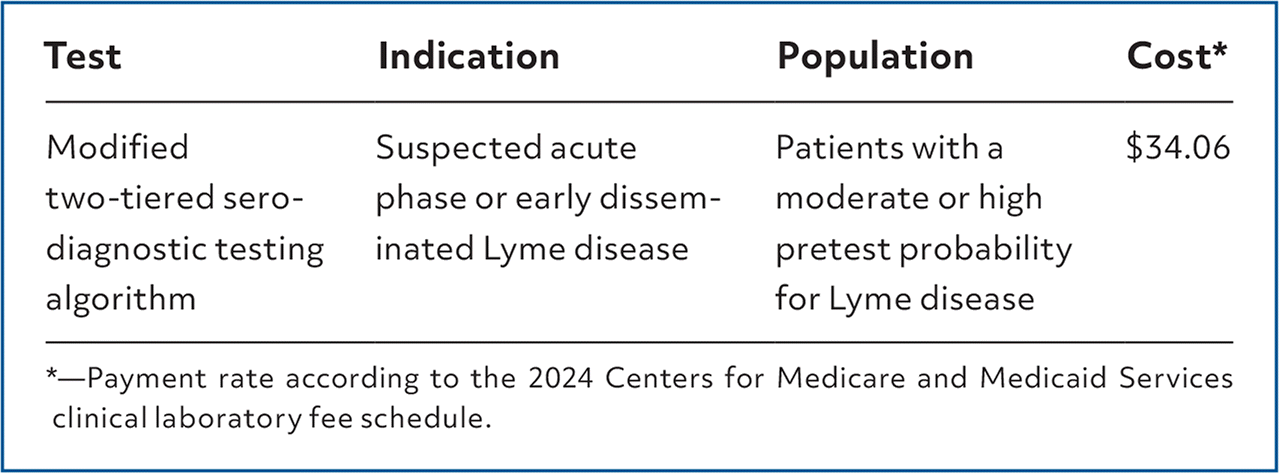
TestIndicationPopulationCost*
Modified two-tiered serodiagnostic testing algorithmSuspected acute phase or early disseminated Lyme diseasePatients with a moderate or high pretest probability for Lyme disease$34.06

*—Payment rate according to the 2024 Centers for Medicare and Medicaid Services clinical laboratory fee schedule.

Lyme disease is the most common vector-borne illness, with more than 476,000 cases annually in the United States and can be challenging to diagnose.1 The presence of erythema migrans is considered diagnostic in patients who live in or have recently traveled to an endemic area. However, serologic testing is recommended if the cause of the skin lesion is unknown and antibiotics have not been administered. Serologic testing is also recommended for early disseminated and late-stage Lyme disease.2

Traditional serologic two-tiered testing for Lyme disease involves initially obtaining an enzyme immunoassay (EIA) or immunofluorescence assay, followed by confirmatory immunoglobulin M (IgM) and IgG Western blot tests if the initial test result is positive or equivocal.3 The U.S. Food and Drug Administration approved modified two-tiered testing in 2019 by replacing the confirmatory Western blot test with another enzyme immunoassay.4 Since then, the Centers for Disease Control and Prevention has recommended modified two-tiered testing as the method of choice, especially in the acute phase or early disseminated Lyme disease, when slow humoral response may lead to false negatives.4

ACCURACY

A multicenter prospective clinical trial of three separate modified two-tiered testing protocols was conducted to determine sensitivity and specificity for early Lyme disease detection (30 days or less of symptoms). Fifty-five patients with erythema migrans (considered a true positive) were examined to assess sensitivity. Specificity was determined using 50 patients with other illnesses and 1,227 healthy patients.3 This type of diagnostic case-control design has the potential to inflate specificity compared with evaluation in patients who have clinically suspected Lyme disease. All testing methods were compared with the conventional two-tiered testing protocol of whole-cell sonicate EIA and follow-up IgM and IgG Western blot tests if needed. Sensitivity for patients with acute erythema migrans was higher in all three modified two-tiered testing groups (35% to 54%) compared with the control group (25%); however, this reached statistical significance for only one protocol (variable major protein-like sequence, expressed [VlsE] chemiluminescence immunoassay [CLIA] with C6 EIA; P = .03). The three modified two-tiered testing protocols were similarly specific when compared with each other. The specificity was not statistically significant when compared with the control group.3

The positive and negative likelihood ratios for sensitivity of 54% and specificity of 99% are 54 and 0.46, respectively. Therefore, a negative test provides only weak evidence against the diagnosis. For a patient with a 50% pretest probability of having Lyme disease, a positive VlsE CLIA with C6 EIA test result increases the likelihood to 98%, whereas a negative result reduces it to only 32%.

BENEFIT

Conventional Lyme disease testing protocols involving Western blots are expensive, require subjective interpretation of data, and have demonstrated poor sensitivity in patients with early symptoms. Many laboratories send out Western blot assays to other laboratories for testing, which further delays results.5 Modified two-tiered tests are more cost-effective, are less objective, and can be completed in-house by most laboratories.6

HARMS

Because antibodies can persist after the resolution of an acute infection, standard and modified two-tiered testing protocols cannot distinguish between active and past infections.5 As a stand-alone test, EIAs for Borrelia burgdorferi infection have poor specificity and are recommended only in a two-tiered testing protocol with Western blot (standard testing) or the modified algorithm.3 Modified two-tiered testing protocols do not allow for the characterization of antibody classes and have limited use in staging the duration of disease and assessing late-stage Lyme disease compared with the IgM and IgG Western blot analysis. The modified two-tiered testing protocol may be limited in the clinical setting and not widely available.

COST

The overall cost of a two-EIA algorithm is less expensive than standard two-tiered testing with Western blot as a confirmatory test.7 Using data from six commercial diagnostic laboratories, the median cost of a single whole-cell sonicate enzyme-linked immunosorbent assay and C6 enzyme-linked immunosorbent assay were $127 and $180, respectively, whereas the median cost of IgM and IgG immunoblots was $264. The 2024 Medicare reimbursement for a single EIA test for Lyme disease antibody is $17.03, and confirmatory Western blot is $15.49.8

BOTTOM LINE

The modified two-tiered protocol offers greater or similar sensitivity compared with the traditional testing protocol for acute phase or early disseminated Lyme disease, although it is still only 35% to 54%. The modified two-tiered testing is less expensive than traditional testing, but it may not be widely available. Because the negative likelihood ratio and negative predictive value for a normal or negative result are poor, the modified two-tiered protocol can be repeated 4 to 6 weeks after a negative initial screen if Lyme disease is still suspected.9

The opinions and assertions contained herein are the private views of the author and are not to be construed as official or as reflecting the views of the U.S. Army Medical Department or the U.S. Army at large.

HAROON SAMAR, MD, MPH, and MATTHEW J. KENNEY, DO, Carl R. Darnall Army Medical Center, Fort Cavazos, Texas.

Author disclosure: No relevant financial relationships.

  1. 1.Kugeler KJ, Schwartz AM, Delorey MJ, et al. Estimating the frequency of Lyme disease diagnoses, United States, 2010–2018. Emerg Infect Dis. 2021;27(2):616-619.
  2. 2.Centers for Disease Control and Prevention. Lyme disease. Accessed January 9, 2024. https://www.cdc.gov/lyme
  3. 3.Branda JA, Strle K, Nigrovic LE, et al. Evaluation of modified 2-tiered serodiagnostic testing algorithms for early Lyme disease. Clin Infect Dis. 2017;64(8):1074-1080.
  4. 4.Mead P, Petersen J, Hinckley A. Updated CDC recommendation for serologic diagnosis of Lyme disease. MMWR Morb Mortal Wkly Rep. 2019;68(32):703.
  5. 5.Kobayashi T, Auwaerter PG. Diagnostic testing for Lyme disease. Infect Dis Clin North Am. 2022;36(3):605-620.
  6. 6.Branda JA, Linskey K, Kim YA, et al. Two-tiered antibody testing for Lyme disease with use of 2 enzyme immunoassays, a whole-cell sonicate enzyme immunoassay followed by a VlsE C6 peptide enzyme immunoassay. Clin Infect Dis. 2011;53(6):541-547.
  7. 7.Wormser GP, Levin A, Soman S, et al. Comparative cost-effectiveness of two-tiered testing strategies for serodiagnosis of Lyme disease with noncutaneous manifestations. J Clin Microbiol. 2013;51(12):4045-4049.
  8. 8.Centers for Medicare & Medicaid Services. Clinical laboratory fee schedule. Accessed January 17, 2024. https://www.cms.gov/medicare/payment/fee-schedules/clinical-laboratory-fee-schedule-clfs/files/24clabq1
  9. 9.National Institute for Health and Care Excellence (NICE). Lyme disease: diagnosis and management. Updated October 17, 2018. Accessed May 29, 2024. https://www.nice.org.uk/guidance/ng95

This series is coordinated by Natasha Pyzocha, DO, contributing editor.

A collection of Diagnostic Tests published in AFP is available at https://www.aafp.org/afp/diagnostic.

Copyright © 2026 by the American Academy of Family Physicians.

This content is owned by the AAFP. A person viewing it online may make one printout of the material and may use that printout only for his or her personal, non-commercial reference. This material may not otherwise be downloaded, copied, printed, stored, transmitted or reproduced in any medium, whether now known or later invented, except as authorized in writing by the AAFP. See permissions for copyright questions and/or permission requests.
