Pulmonary Hypertension

Kelly Latimer, MD, MPH
Michael Layne, MD
Maya Payne, MD

American Family Physician. 2024;110(2):183-191.

Author disclosure: No relevant financial relationships.

This clinical content conforms to AAFP criteria for CME.

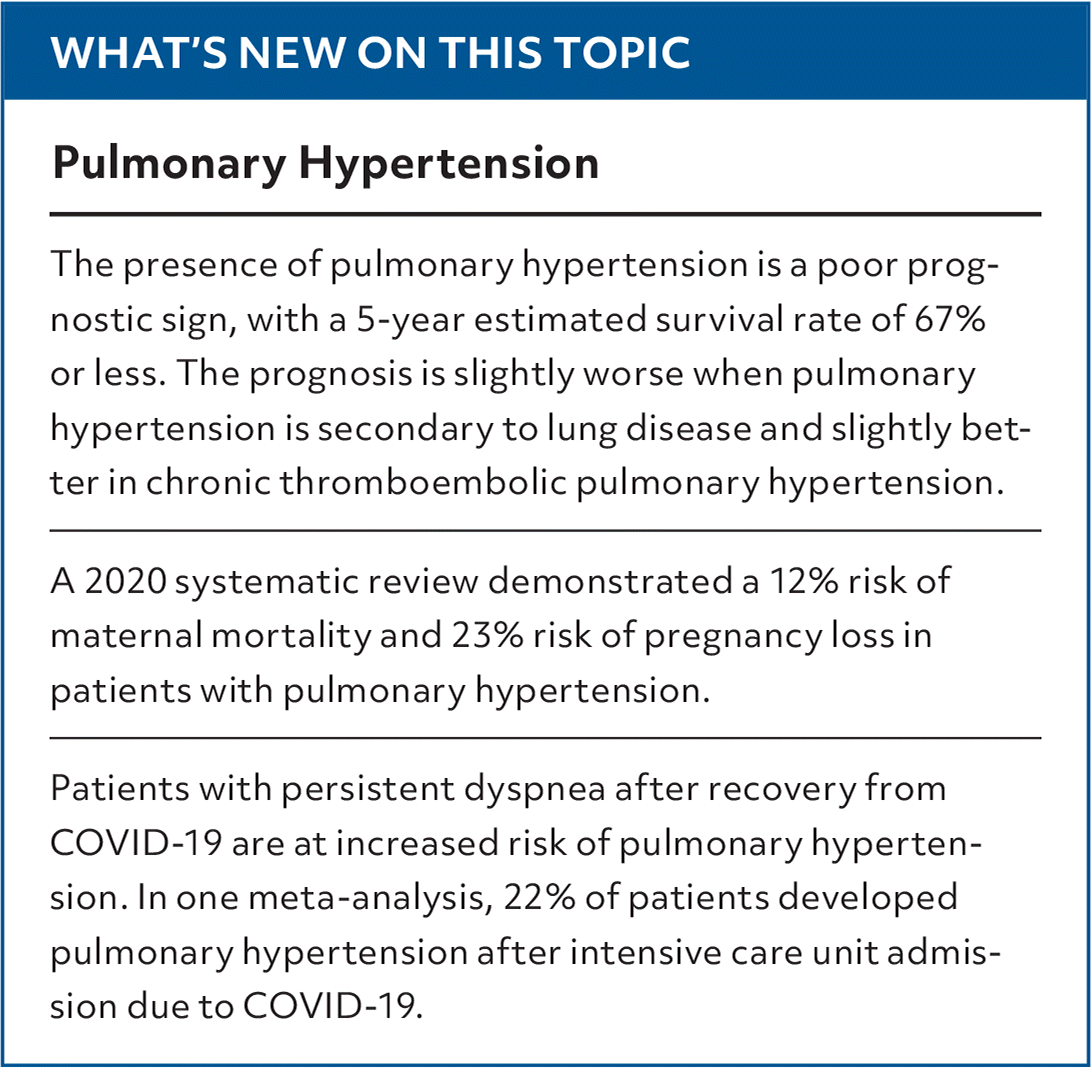
Pulmonary hypertension includes a diverse set of conditions defined by a mean pulmonary artery pressure greater than 20 mm Hg found during right heart catheterization that can lead to right-sided heart failure and death if untreated. The most common cause of pulmonary hypertension is left-sided heart failure, followed by chronic obstructive lung disease. Pulmonary hypertension presents as unexplained dyspnea on exertion and possible findings of right-sided heart failure. The diagnosis is commonly delayed because the symptoms are often attributed to underlying heart or lung disease. Echocardiography is the initial study of choice, and findings can suggest a low, intermediate, or high risk of pulmonary hypertension. Right heart catheterization is the standard of care for diagnosing and classifying pulmonary hypertension, and the results may inform treatment. Patients with pulmonary hypertension should be referred to a center specializing in treatment. Patients with pulmonary hypertension have a high risk of perioperative complications, and detailed specialty preoperative evaluation is recommended. Physicians should counsel patients of childbearing age with pulmonary hypertension to prevent pregnancy to avoid worsening the severity of pulmonary hypertension and fetal loss. Pulmonary hypertension is severe, chronic, progressive, and challenging to treat; therefore, family physicians should update the patient’s immunization status, screen for and address mental health conditions, and discuss goals of care and advance directives with patients.

KELLY LATIMER, MD, MPH, is an associate professor of family and community medicine at Eastern Virginia Medical School, Norfolk, Va.

MICHAEL LAYNE, MD, is an assistant professor of family and community medicine at Eastern Virginia Medical School.

MAYA PAYNE, MD, is a physician at MidAtlantic Long Term Care, Norfolk, Va. At the time this article was written, she was the ship physician for the USS John C. Stennis (CVN 74).

Address correspondence to Kelly Latimer, MD, MPH, at latimekm@evms.edu.

Author disclosure: No relevant financial relationships.

  1. 1.Humbert M, Kovacs G, Hoeper MM, et al.; ESC/ERS Scientific Document Group. 2022 ESC/ERS guidelines for the diagnosis and treatment of pulmonary hypertension [published correction appears in Eur Heart J. 2023; 44(15): 1312]. Eur Heart J. 2022;43(38):3618-3731.
  2. 2.Hoeper MM, Humbert M, Souza R, et al. A global view of pulmonary hypertension. Lancet Respir Med. 2016;4(4):306-322.
  3. 3.Sysol JR, Machado RF. Classification and pathophysiology of pulmonary hypertension. Continuing Cardiology Education. 2018;4(1):1-12.
  4. 4.Rich S, Dantzker DR, Ayres SM, et al. Primary pulmonary hypertension. A national prospective study. Ann Intern Med. 1987;107(2):216-223.
  5. 5.Khou V, Anderson JJ, Strange G, et al. Diagnostic delay in pulmonary arterial hypertension: insights from the Australian and New Zealand pulmonary hypertension registry. Respirology. 2020;25(8):863-871.
  6. 6.Bonderman D, Wexberg P, Martischnig AM, et al. A noninvasive algorithm to exclude pre-capillary pulmonary hypertension. Eur Respir J. 2011;37(5):1096-1103.
  7. 7.Ascha M, Renapurkar RD, Tonelli AR. A review of imaging modalities in pulmonary hypertension. Ann Thorac Med. 2017;12(2):61-73.
  8. 8.Sun XG, Hansen JE, Oudiz RJ, et al. Pulmonary function in primary pulmonary hypertension. J Am Coll Cardiol. 2003;41(6):1028-1035.
  9. 9.Sirajuddin A, Mirmomen SM, Henry TS, et al.; Expert Panel on Thoracic Imaging. ACR appropriateness criteria suspected pulmonary hypertension: 2022 update. J Am Coll Radiol. 2022;19(11S):S502-S512.
  10. 10.Frost A, Badesch D, Gibbs JSR, et al. Diagnosis of pulmonary hypertension. Eur Respir J. 2019;53(1):1801904.
  11. 11.Hirani N, Brunner NW, Kapasi A, et al. Canadian Cardiovascular Society/Canadian Thoracic Society position statement on pulmonary hypertension. Can J Cardiol. 2020;36(7):977-992.
  12. 12.Stewart S, Chan YK, Playford D, et al. Incident pulmonary hypertension in 13,488 cases investigated with repeat echocardiography: a clinical cohort study. ERJ Open Res. 2023;9(5):00082-2023.
  13. 13.Simonneau G, Montani D, Celermajer DS, et al. Haemodynamic definitions and updated clinical classification of pulmonary hypertension. Eur Respir J. 2019;53(1):1801913.
  14. 14.Highland KB, Crawford R, Classi P, et al. Development of the Pulmonary Hypertension Functional Classification Self-Report: a patient version adapted from the World Health Organization Functional Classification measure. Health Qual Life Outcomes. 2021;19(1):202.
  15. 15.Gall H, Felix JF, Schneck FK, et al. The Giessen Pulmonary Hypertension Registry: survival in pulmonary hypertension subgroups. J Heart Lung Transplant. 2017;36(9):957-967.
  16. 16.Guazzi M, Ghio S, Adir Y. Pulmonary hypertension in HFpEF and HFrEF: JACC review topic of the week. J Am Coll Cardiol. 2020;76(9):1102-1111.
  17. 17.Shah FA, Moronta S, Braford M, et al. Obstructive sleep apnea and pulmonary hypertension: a review of literature. Cureus. 2021;13(4):e14575.
  18. 18.Fonseca GHH, Souza R, Salemi VMC, et al. Pulmonary hypertension diagnosed by right heart catheterisation in sickle cell disease. Eur Respir J. 2012;39(1):112-118.
  19. 19.Klinger JR, Elliott CG, Levine DJ, et al. Therapy for pulmonary arterial hypertension in adults: update of the CHEST guideline and expert panel report [published correction appears in Chest. 2021; 159(1): 457]. Chest. 2019;155(3):565-586.
  20. 20.McLaughlin VV, Archer SL, Badesch DB, et al.; ACCF/AHA. ACCF/AHA 2009 expert consensus document on pulmonary hypertension: a report of the American College of Cardiology Foundation Task Force on Expert Consensus Documents and the American Heart Association: developed in collaboration with the American College of Chest Physicians, American Thoracic Society, Inc., and the Pulmonary Hypertension Association [published correction appears in Circulation. 2009; 120(2): e13]. Circulation. 2009;119(16):2250-2294.
  21. 21.Guérin L, Couturaud F, Parent F, et al. Prevalence of chronic thromboembolic pulmonary hypertension after acute pulmonary embolism. Thromb Haemost. 2014;112(3):598-605.
  22. 22.Kim NH, Delcroix M, Jais X, et al. Chronic thromboembolic pulmonary hypertension. Eur Respir J. 2019;53(1):1801915.
  23. 23.Herve P, Lau EM, Sitbon O, et al. Criteria for diagnosis of exercise pulmonary hypertension. Eur Respir J. 2015;46(3):728-737.
  24. 24.Naeije R, Saggar R, Badesch D, et al. Exercise-induced pulmonary hypertension: translating pathophysiological concepts into clinical practice. Chest. 2018;154(1):10-15.
  25. 25.Kagioglou O, Mouratoglou SA, Giannakoulas G, et al. Long-term effect of an exercise training program on physical functioning and quality of life in pulmonary hypertension: a randomized controlled trial. Biomed Res Int. 2021;2021:8870615.
  26. 26.Grünig E, MacKenzie A, Peacock AJ, et al. Standardized exercise training is feasible, safe, and effective in pulmonary arterial and chronic thromboembolic pulmonary hypertension: results from a large European multicentre randomized controlled trial. Eur Heart J. 2021;42(23):2284-2295.
  27. 27.Jha N, Jha AK, Mishra SK, et al. Pulmonary hypertension and pregnancy outcomes: systematic review and meta-analysis. Eur J Obstet Gynecol Reprod Biol. 2020;253:108-116.
  28. 28.Franco V, Ryan JJ, McLaughlin VV. Pulmonary hypertension in women. Heart Fail Clin. 2019;15(1):137-145.
  29. 29.Oktaviono YH, Mulia EPB, Luke K, et al. Right ventricular dysfunction and pulmonary hypertension in COVID-19: a meta-analysis of prevalence and its association with clinical outcome. Arch Med Sci. 2021;18(5):1169-1180.
  30. 30.Eroume À Egom E, Shiwani HA, Nouthe B. From acute SARS-CoV-2 infection to pulmonary hypertension. Front Physiol. 2022;13:1023758.
  31. 31.Olsson KM, Meltendorf T, Fuge J, et al. Prevalence of mental disorders and impact on quality of life in patients with pulmonary arterial hypertension. Front Psychiatry. 2021;12:667602.
  32. 32.Rajagopal S, Ruetzler K, Ghadimi K, ; American Heart Association Council on C, Critical C, Perioperative and R; Council on Cardiovascular and Stroke Nursing. Evaluation and management of pulmonary hypertension in noncardiac surgery: a scientific statement for the American Heart Association. Circulation. 2023;147(17):1317-1343.
  33. 33.Health Information Associates. Coding changes for pulmonary hypertension. August 13, 2022. Accessed January 22, 2024. https://hiacode.com/blog/education/pulmonary-hypertension
  34. 34.Dunlap B, Weyer G. Pulmonary hypertension: diagnosis and treatment. Am Fam Physician. 2016;94(6):463-469.
  35. 35.Stringham R, Shah NR. Pulmonary arterial hypertension: an update on diagnosis and treatment. Am Fam Physician. 2010;82(4):370-377.
  36. 36.Nauser TD, Stites SW. Diagnosis and treatment of pulmonary hypertension. Am Fam Physician. 2001;63(9):1789-1798.

Copyright © 2026 by the American Academy of Family Physicians.

This content is owned by the AAFP. A person viewing it online may make one printout of the material and may use that printout only for his or her personal, non-commercial reference. This material may not otherwise be downloaded, copied, printed, stored, transmitted or reproduced in any medium, whether now known or later invented, except as authorized in writing by the AAFP. See permissions for copyright questions and/or permission requests.