Hair Loss: Diagnosis and Treatment

MaryAnn Dakkak, MD, MPH
Klive M. Forde, MB, BS
Howard Lanney, MD, MS

American Family Physician. 2024;110(3):243-250.

Author disclosure: No relevant financial relationships.

This clinical content conforms to AAFP criteria for CME.

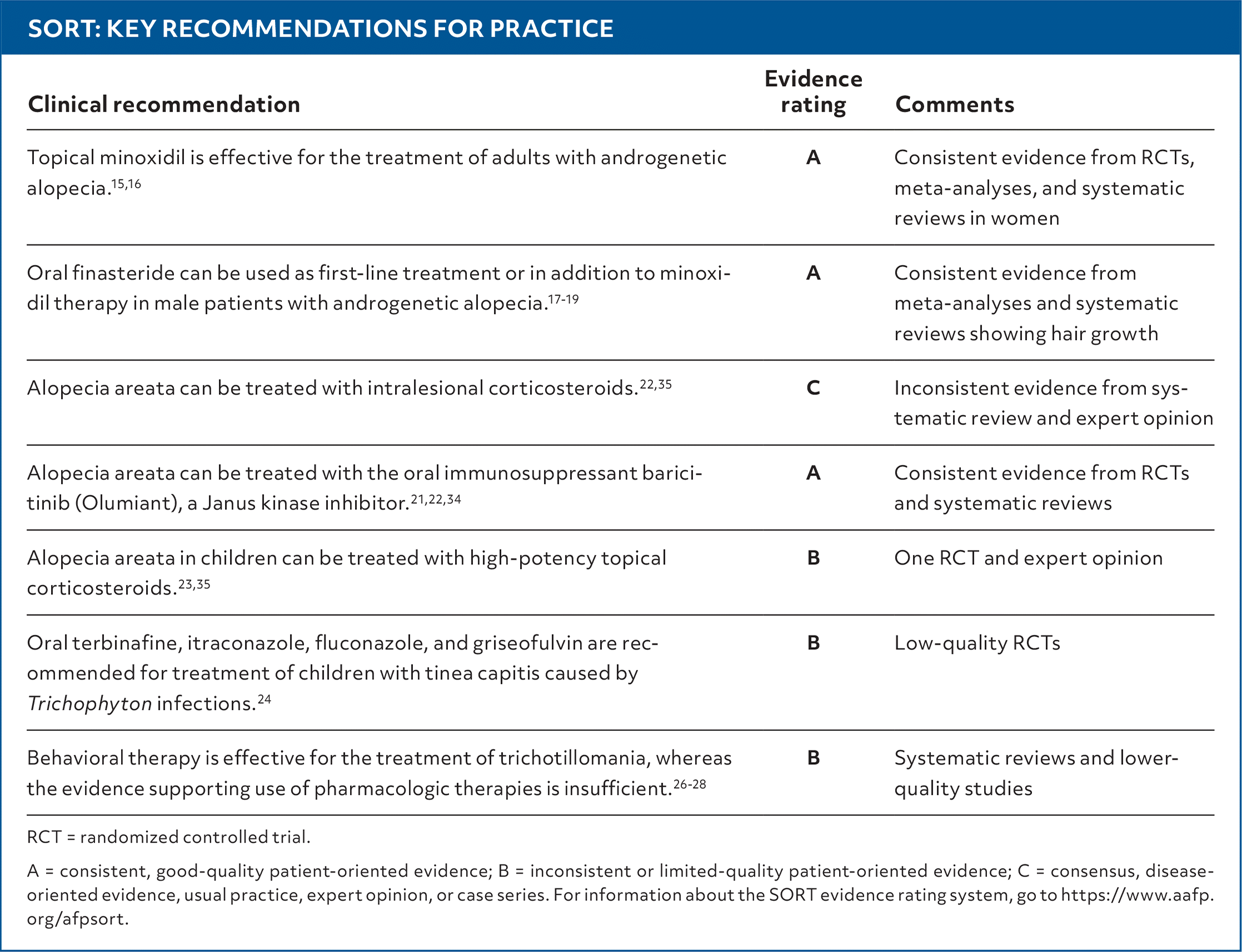
More than 80 million people in the United States are affected by hair loss, also known as alopecia. Nonscarring alopecias are categorized as diffuse, patterned, or focal. Diffuse alopecias include telogen and anagen effluvium, are usually self-limited, and depend on stopping the underlying cause (e.g., stress). Patterned hair loss, specifically androgenetic alopecia, is the most common form of alopecia; it is typically genetic, and first-line treatment is minoxidil. Oral finasteride is another treatment available for male patients. Focal hair loss includes alopecia areata, which is typically self-limited and treated with intralesional corticosteroid or oral immunosuppressant therapy; tinea capitis, which is treated with oral antifungals; and traction alopecia, which is treated by decreasing tension on the hair. Hair loss can be caused by several systemic diseases. A comprehensive history and physical examination, with targeted laboratory testing, may elucidate malnutrition, autoimmune diseases, and endocrine disease. Patients with moderate to severe hair loss are more likely to have accompanying anxiety, depression, and lower work productivity and quality-of-life scores. Educating patients about expected hair changes, treatment options, and realistic outcomes can help patients feel that they are being listened to and that their hair loss is being taken seriously.

MARYANN DAKKAK, MD, MPH, is the associate program director of the Department of Family Medicine Residency Program at Boston (Mass.) University Chobanian & Avedisian School of Medicine.

KLIVE M. FORDE, MB, BS, is an assistant professor in the Department of Family Medicine at Boston University Chobanian & Avedisian School of Medicine.

HOWARD LANNEY, MD, MS, is an assistant professor in the Department of Family Medicine at Boston University Chobanian & Avedisian School of Medicine.

Address correspondence to MaryAnn Dakkak, MD, MPH, at maryann.dakkak@bmc.org.

Author disclosure: No relevant financial relationships.

  1. 1.Grand View Research. Alopecia market size, share and trends analysis report by disease type (alopecia areata, cicatricial, traction, androgenetic alopecia), by treatment, by gender, by sales channel, by end-use, by region, and segment forecasts, 2024–2030. Accessed September 13, 2023. https://www.grandviewresearch.com/industry-analysis/alopecia-market
  2. 2.Edson-Heredia E, Aranishi T, Isaka Y, et al. Patient and physician perspectives on alopecia areata: a real-world assessment of severity and burden in Japan. J Dermatol. 2022;49(6):575-583.
  3. 3.Aukerman EL, Jafferany M. The psychological consequences of androgenetic alopecia: a systematic review. J Cosmet Dermatol. 2023;22(1):89-95.
  4. 4.Price VH. Treatment of hair loss. N Engl J Med. 1999;341(13):964-973.
  5. 5.Trüeb RM, Rezende HD, Dias MFRG. A comment on the science of hair aging. Int J Trichology. 2018;10(6):245-254.
  6. 6.Mirmirani P, Fu J. Diagnosis and treatment of nonscarring hair loss in primary care in 2021. JAMA. 2021;325(9):878-879.
  7. 7.Al Aboud AM, Syed HA, Zito PM. Alopecia. StatPearls. Updated February 26, 2024. Accessed July 18, 2024. https://www.ncbi.nlm.nih.gov/books/NBK538178/
  8. 8.Saleh D, Nassereddin A, Saleh HM, et al. Anagen effluvium. StatPearls. Updated April 30, 2024. Accessed June 30, 2024. https://www.ncbi.nlm.nih.gov/books/NBK482293/
  9. 9.Rugo HS, Melin SA, Voigt J. Scalp cooling with adjuvant/neoadjuvant chemotherapy for breast cancer and the risk of scalp metastases: systematic review and meta-analysis. Breast Cancer Res Treat. 2017;163(2):199-205.
  10. 10.Nangia J, Wang T, Osborne C, et al. Effect of a scalp cooling device on alopecia in women undergoing chemotherapy for breast cancer: the SCALP randomized clinical trial. JAMA. 2017;317(6):596-605.
  11. 11.Asghar F, Shamim N, Farooque U, et al. Telogen effluvium: a review of the literature. Cureus. 2020;12(5):e8320.
  12. 12.Rhodes T, Girman CJ, Savin RC, et al. Prevalence of male pattern hair loss in 18–49 year old men. Dermatol Surg. 1998;24(12):1330-1332.
  13. 13.Ramos PM, Miot HA. Female pattern hair loss: a clinical and pathophysiological review. An Bras Dermatol. 2015;90(4):529-543.
  14. 14.Blume-Peytavi U, Blumeyer A, Tosti A, et al.; European Consensus Group. S1 guideline for diagnostic evaluation in androgenetic alopecia in men, women and adolescents. Br J Dermatol. 2011;164(1):5-15.
  15. 15.Olsen EA, Dunlap FE, Funicella T, et al. A randomized clinical trial of 5% topical minoxidil versus 2% topical minoxidil and placebo in the treatment of androgenetic alopecia in men. J Am Acad Dermatol. 2002;47(3):377-385.
  16. 16.van Zuuren EJ, Fedorowicz Z, Schoones J. Interventions for female pattern hair loss. Cochrane Database Syst Rev. 2016(5):CD007628.
  17. 17.Adil A, Godwin M. The effectiveness of treatments for androgenetic alopecia: a systematic review and meta-analysis. J Am Acad Dermatol. 2017;77(1):136-141.e5.
  18. 18.Gupta AK, Venkataraman M, Talukder M, et al. Relative efficacy of minoxidil and the 5-α reductase inhibitors in androgenetic alopecia treatment of male patients: a network meta-analysis. JAMA Dermatol. 2022;158(3):266-274.
  19. 19.Mella JM, Perret MC, Manzotti M, et al. Efficacy and safety of finasteride therapy for androgenetic alopecia: a systematic review. Arch Dermatol. 2010;146(10):1141-1150.
  20. 20.Alkhalifah A, Alsantali A, Wang E, et al. Alopecia areata update: part I. Clinical picture, histopathology, and pathogenesis. J Am Acad Dermatol. 2010;62(2):177-188.
  21. 21.King B, Ohyama M, Kwon O, et al.; BRAVE-AA Investigators. Two phase 3 trials of baracitinib for alopecia areata. N Engl J Med. 2022;386(18):1687-1699.
  22. 22.Mateos-Haro M, Novoa-Candia M, Sánchez Vanegas G, et al. Treatments for alopecia areata: a network meta-analysis. Cochrane Database Syst Rev. 2023(10):CD013719.
  23. 23.Lenane P, Macarthur C, Parkin PC, et al. Clobetasol propionate, 0.05%, vs hydrocortisone, 1%, for alopecia areata in children: a randomized clinical trial. JAMA Dermatol. 2014;150(1):47-50.
  24. 24.Chen X, Jiang X, Yang M, et al. Systemic antifungal therapy for tinea capitis in children. Cochrane Database Syst Rev. 2016(5):CD004685.
  25. 25.Pulickal JK, Kaliyadan F. Traction alopecia. StatPearls. Updated August 8, 2023. Accessed June 12, 2024. https://www.ncbi.nlm.nih.gov/books/NBK470434/
  26. 26.Hoffman J, Williams T, Rothbart R, et al. Pharmacotherapy for trichotillomania. Cochrane Database Syst Rev. 2021(9):CD007662.
  27. 27.Bottesi G, Ouimet AJ, Cerea S, et al. Comprehensive behavioral therapy of trichotillomania: a multiple-baseline single-case experimental design. Front Psychol. 2020;11:1210.
  28. 28.Farhat LC, Olfson E, Nasir M, et al. Pharmacological and behavioral treatment for trichotillomania: an updated systematic review with meta-analysis. Depress Anxiety. 2020;37(8):715-727.
  29. 29.Mounsey AL, Reed SW. Diagnosing and treating hair loss. Am Fam Physician. 2009;80(4):356-362.
  30. 30.Ho CH, Sood T, Zito PM. Androgenetic alopecia. StatPearls. Updated January 7, 2024. Accessed July 17, 2024. https://www.ncbi.nlm.nih.gov/books/NBK430924/
  31. 31.Sah DE, Koo J, Price VH. Trichotillomania. Dermatol Ther. 2008;21(1):13-21.
  32. 32.McDonald KA, Shelley AJ, Colantonio S, et al. Hair pull test: evidence-based update and revision of guidelines. J Am Acad Dermatol. 2017;76(3):472-477.
  33. 33.Lee S, Lee YB, Kim BJ, et al. Screening of thyroid function and autoantibodies in patients with alopecia areata: a systematic review and meta-analysis. J Am Acad Dermatol. 2019;80(5):1410-1413.e4.
  34. 34.Liu M, Gao Y, Yuan Y, et al. Janus kinase inhibitors for alopecia areata: a systematic review and meta-analysis. JAMA Netw Open. 2023;6(6):e2320351.
  35. 35.Alkhalifah A, Alsantali A, Wang E, et al. Alopecia areata update: part II. Treatment. J Am Acad Dermatol. 2010;62(2):191-202.
  36. 36.Diagnostic and Statistical Manual of Mental Disorders. 5th ed. – text revision. American Psychiatric Association; 2022.
  37. 37.Phillips TG, Slomiany WP, Allison R. Hair loss: common causes and treatment. Am Fam Physician. 2017;96(6):371-378.
  38. 38.Springer K, Brown M, Stulberg DL. Common hair loss disorders. Am Fam Physician. 2003;68(1):93-102.
  39. 39.Thiedke CC. Alopecia in women. Am Fam Physician. 2003;67(5):1007-1014.
  40. 40.Scow DT, Nolte RS, Shaughnessy AF. Medical treatments for balding in men. Am Fam Physician. 1999;59(8):2189-2194.

Copyright © 2026 by the American Academy of Family Physicians.

This content is owned by the AAFP. A person viewing it online may make one printout of the material and may use that printout only for his or her personal, non-commercial reference. This material may not otherwise be downloaded, copied, printed, stored, transmitted or reproduced in any medium, whether now known or later invented, except as authorized in writing by the AAFP. See permissions for copyright questions and/or permission requests.