Common Tongue Conditions in Primary Care

Liza Straub, MD
Priscille Schettini, MD
Palee Myrex, MD

American Family Physician. 2024;110(5):467-475.

Author disclosure: No relevant financial relationships.

This clinical content conforms to AAFP criteria for CME.

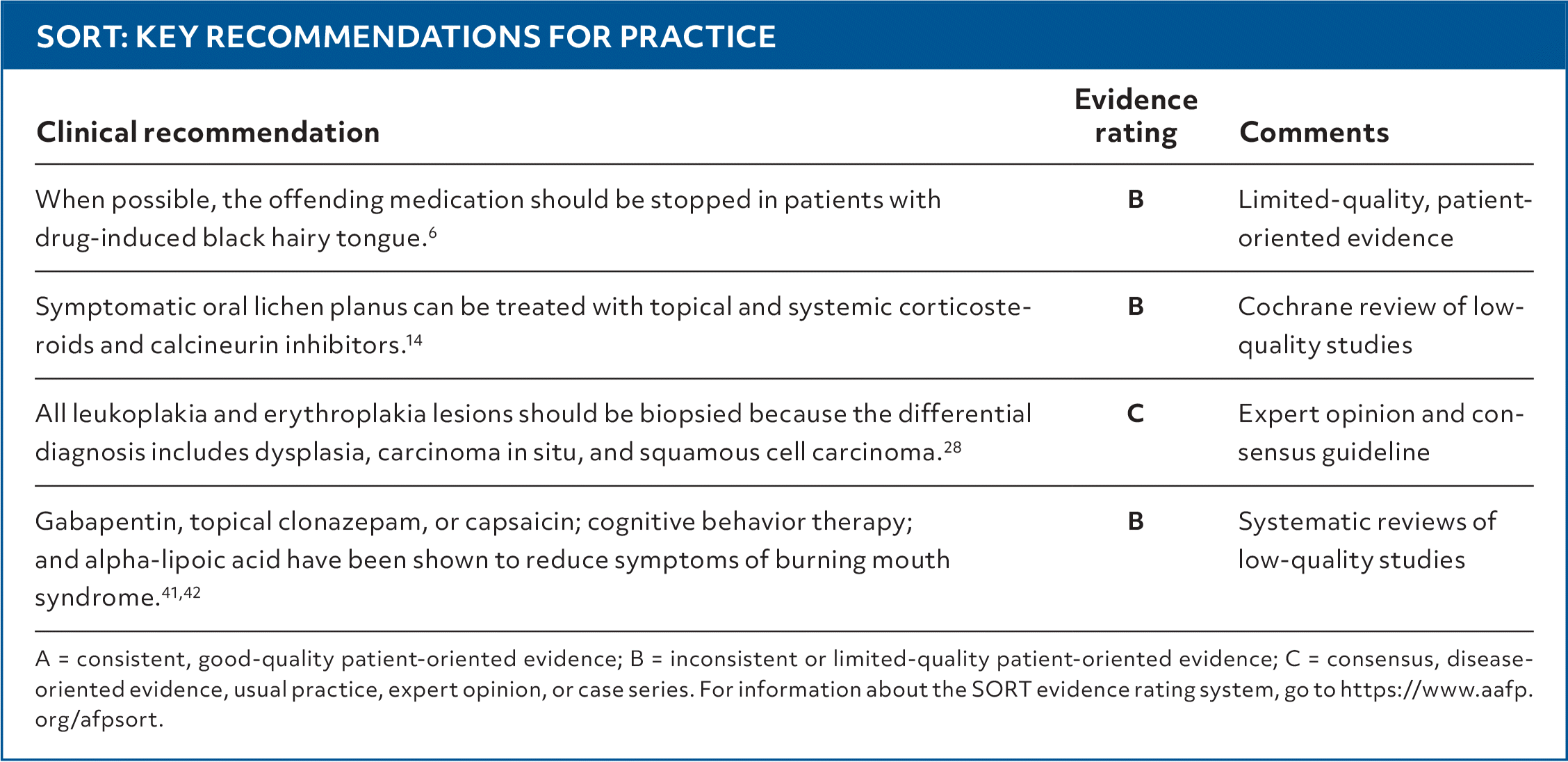
Tongue conditions occur in 15.5% of the US population. The most common tongue conditions are geographic tongue, fissured tongue, and black hairy tongue; these conditions do not require treatment. Median rhomboid glossitis can be associated with a candidal infection; symptomatic lesions usually improve with use of antifungals. Atrophic glossitis is often linked to a nutritional deficiency and resolves with treatment of the underlying condition. Oral hairy leukoplakia is caused by Epstein-Barr virus and most often presents in patients with severely compromised immunity; it can be treated with oral antivirals. Growths of the tongue usually require biopsy to differentiate benign lesions (eg, traumatic fibromas, squamous cell papillomas) from leukoplakia and squamous cell carcinoma. Referral to an oral and maxillofacial surgeon, otolaryngologist, or a dentist experienced in oral pathology may be indicated. Burning mouth syndrome often involves the tongue, and if it does not resolve spontaneously, studies have shown improvement with gabapentin, topical clonazepam, capsaicin, and cognitive behavior therapy. Oral lichen planus is a chronic inflammatory disorder that can affect the tongue and is best treated with topical or systemic corticosteroids and calcineurin inhibitors. There is a lack of consensus on the definition and treatment of ankyloglossia (tongue-tie); however, some evidence supports that frenotomy can improve breastfeeding and decrease lactation-associated nipple pain.

LIZA STRAUB, MD, is an assistant professor in the Department of Family Medicine at the University of North Carolina School of Medicine, Chapel Hill.

PRISCILLE SCHETTINI, MD, is a family medicine physician at Piedmont Health Services, Inc., Chapel Hill, N.C.

PALEE MYREX, MD, is an assistant professor in the Department of Family Medicine at the University of North Carolina School of Medicine, Chapel Hill.

Address correspondence to Liza Straub, MD, at liza_straub@med.unc.edu.

Author disclosure: No relevant financial relationships.

  1. 1.Shulman JD, Beach MM, Rivera-Hidalgo F. The prevalence of oral mucosal lesions in U.S. adults: data from the Third National Health and Nutrition Examination Survey, 1988–1994. J Am Dent Assoc. 2004;135(9):1279-1286.
  2. 2.Reamy BV, Derby R, Bunt CW. Common tongue conditions in primary care. Am Fam Physician. 2010;81(5):627-634.
  3. 3.Byrd JA, Bruce AJ, Rogers RS. Glossitis and other tongue disorders. Dermatol Clin. 2003;21(1):123-134.
  4. 4.Walker LL. Glossitis. September 16, 2021. Accessed October 18, 2023. https://www.essentialevidenceplus.com/Home/Essential_Evidence_Topics?id=OTg=
  5. 5.Schlager E, St Claire C, Ashack K, et al. Black hairy tongue: pre-disposing factors, diagnosis, and treatment. Am J Clin Dermatol. 2017;18(4):563-569.
  6. 6.Thompson DF, Kessler TL. Drug-induced black hairy tongue. Pharmacotherapy. 2010;30(6):585-593.
  7. 7.Bakshi SS. Fissured tongue. Cleve Clin J Med. 2019;86(11):714.
  8. 8.Netto JN-S, Dias MC, Garcia T-R-U, et al. Geographic stomatitis: an enigmatic condition with multiple clinical presentations. J Clin Exp Dent. 2019;11(9):e845-e849.
  9. 9.Ogueta C, Ramírez P, Jiménez O, et al. Geographic tongue: what a dermatologist should know. Actas Dermosifiliogr (Engl Ed). 2019;110(5):341-346.
  10. 10.Randall DA, Westmark NLW, Neville BW. Common oral lesions. Am Fam Physician. 2022;105(4):369-376.
  11. 11.Solimani F, Forchhammer S, Schloegl A, et al. Lichen planus—a clinical guide. J Dtsch Dermatol Ges. 2021;19(6):864-882.
  12. 12.Di Fede O, Belfiore P, Cabibi D, et al. Unexpectedly high frequency of genital involvement in women with clinical and histological features of oral lichen planus. Acta Derm Venereol. 2006;86(5):433-438.
  13. 13.Ismail SB, Kumar SKS, Zain RB. Oral lichen planus and lichenoid reactions: etiopathogenesis, diagnosis, management and malignant transformation. J Oral Sci. 2007;49(2):89-106.
  14. 14.Lodi G, Manfredi M, Mercadante V, et al. Interventions for treating oral lichen planus: corticosteroid therapies. Cochrane Database Syst Rev. 2020(2):CD001168.
  15. 15.Zeng Q, Liu Y, Wang S, et al. Significant efficacy of short-course, low-concentration betamethasone mouthwash therapy for severe erosive oral lichen planus: a randomized controlled trial. Clin Oral Investig. 2023;27(8):4323-4334.
  16. 16.van der Waal I. Potentially malignant disorders of the oral and oropharyngeal mucosa; present concepts of management. Oral Oncol. 2010;46(6):423-425.
  17. 17.Anura A. Traumatic oral mucosal lesions: a mini review and clinical update. Oral Health Dent Manag. 2014;13(2):254-259.
  18. 18.Goregen M, Miloglu O, Buyukkurt MC, et al. Median rhomboid glossitis: a clinical and microbiological study. Eur J Dent. 2011;5(4):367-372.
  19. 19.Gonsalves WC, Chi AC, Neville BW. Common oral lesions: part I. Superficial mucosal lesions. Am Fam Physician. 2007;75(4):501-507.
  20. 20.Millsop JW, Fazel N. Oral candidiasis. Clin Dermatol. 2016;34(4):487-494.
  21. 21.Alramadhan SA, Bhattacharyya I, Cohen DM, et al. Oral hairy leukoplakia in immunocompetent patients revisited with literature review. Head Neck Pathol. 2021;15(3):989-993.
  22. 22.Mosca NG, Hathorn AR. HIV-positive patients: dental management considerations. Dent Clin North Am. 2006;50(4):635-657.
  23. 23.Moura MDG, Haddad JPA, Senna MIB, et al. A new topical treatment protocol for oral hairy leukoplakia. Oral Surg Oral Med Oral Pathol Oral Radiol Endod. 2010;110(5):611-617.
  24. 24.Abdallah-Matta MP, Dubarry PH, Pessey JJ, et al. Lingual thyroid and hyperthyroidism: a new case and review of the literature. J Endocrinol Invest. 2002;25(3):264-267.
  25. 25.Betz SJ. HPV-related papillary lesions of the oral mucosa: a review. Head Neck Pathol. 2019;13(1):80-90.
  26. 26.Diebold S, Overbeck M. Soft tissue disorders of the mouth. Emerg Med Clin North Am. 2019;37(1):55-68.
  27. 27.Warnakulasuriya S, Johnson NW, van der Waal I. Nomenclature and classification of potentially malignant disorders of the oral mucosa. J Oral Pathol Med. 2007;36(10):575-580.
  28. 28.van der Waal I. Potentially malignant disorders of the oral and oropharyngeal mucosa; terminology, classification and present concepts of management. Oral Oncol. 2009;45(4–5):317-323.
  29. 29.Napier SS, Speight PM. Natural history of potentially malignant oral lesions and conditions: an overview of the literature. J Oral Pathol Med. 2008;37(1):1-10.
  30. 30.Chamoli A, Gosavi AS, Shirwadkar UP, et al. Overview of oral cavity squamous cell carcinoma: risk factors, mechanisms, and diagnostics. Oral Oncol. 2021;121:105451.
  31. 31.Llewellyn CD, Johnson NW, Warnakulasuriya KA. Risk factors for squamous cell carcinoma of the oral cavity in young people—a comprehensive literature review. Oral Oncol. 2001;37(5):401-418.
  32. 32.Jones AS, Rafferty M, Fenton JE, et al. Treatment of squamous cell carcinoma of the tongue base: irradiation, surgery, or palliation?. Ann Otol Rhinol Laryngol. 2007;116(2):92-99.
  33. 33.Howard J, Masterson L, Dwivedi RC, et al. Minimally invasive surgery versus radiotherapy/chemoradiotherapy for small-volume primary oropharyngeal carcinoma. Cochrane Database Syst Rev. 2016(12):CD010963.
  34. 34.Suter VGA, Bornstein MM. Ankyloglossia: facts and myths in diagnosis and treatment. J Periodontol. 2009;80(8):1204-1219.
  35. 35.Messner AH, Walsh J, Rosenfeld RM, et al. Clinical consensus statement: ankyloglossia in children. Otolaryngol Head Neck Surg. 2020;162(5):597-611.
  36. 36.Batista CLC, Pereira ALP. Ankyloglossia severity in infants: maternal pain, self-efficacy, and functional aspects of breastfeeding. Rev Paul Pediatr. 2024:42.
  37. 37.O’Shea JE, Foster JP, O’Donnell CP, et al. Frenotomy for tongue-tie in newborn infants. Cochrane Database Syst Rev. 2017(3):CD011065.
  38. 38.Cordray H, Raol N, Mahendran GN, et al. Quantitative impact of frenotomy on breastfeeding: a systematic review and meta-analysis. Pediatr Res. 2024;95(1):34-42.
  39. 39.Carnino JM, Lara FR, Chan WP, et al. Speech outcomes of frenectomy for tongue-tie release: a systematic review and meta-analysis. Ann Otol Rhinol Laryngol. 2024;133(6):566-574.
  40. 40.Headache Classification Committee of the International Headache Society (IHS).. International Classification of Headache Disorders, 3rd edition. Cephalalgia. 2018;38(1):1-211.
  41. 41.Tan HL, Smith JG, Hoffmann J, et al. A systematic review of treatment for patients with burning mouth syndrome. Cephalalgia. 2022;42(2):128-161.
  42. 42.McMillan R, Forssell H, Buchanan JA, et al. Interventions for treating burning mouth syndrome. Cochrane Database Syst Rev. 2016(11):CD002779.
  43. 43.Liu YF, Kim Y, Yoo T, et al. Burning mouth syndrome: a systematic review of treatments. Oral Dis. 2018;24(3):325-334.

Copyright © 2026 by the American Academy of Family Physicians.

This content is owned by the AAFP. A person viewing it online may make one printout of the material and may use that printout only for his or her personal, non-commercial reference. This material may not otherwise be downloaded, copied, printed, stored, transmitted or reproduced in any medium, whether now known or later invented, except as authorized in writing by the AAFP. See permissions for copyright questions and/or permission requests.