Acute Abdominal Pain in Children: Evaluation and Management

Katie L. Buel, DO
James Wilcox, MD
Paul T. Mingo, MD

American Family Physician. 2024;110(6):621-631.

Author disclosure: Dr. Wilcox is a paid instructor for the Global Ultrasound Institute. Drs. Buel and Mingo have no relevant financial relationships.

This clinical content conforms to AAFP criteria for CME.

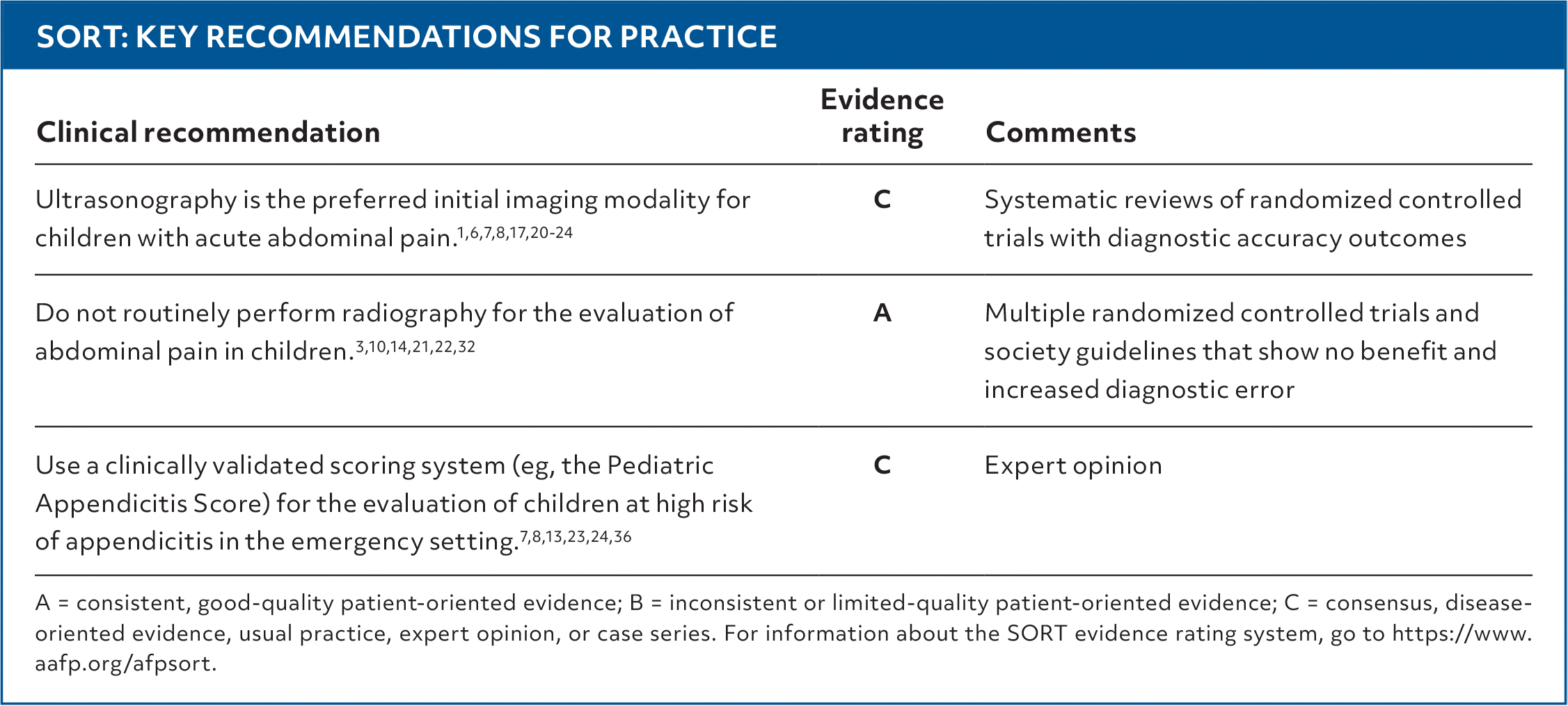
Acute abdominal pain in children is a common presentation in the clinic and emergency department settings and accounts for up to 10% of childhood emergency department visits. Determining the appropriate disposition of abdominal pain in children can be challenging. The differential diagnosis of acute abdominal pain, including gastroenteritis, constipation, urinary tract infection, acute appendicitis, tubo-ovarian abscess, testicular torsion, and volvulus, and the diagnostic approach vary by age. Most causes of acute abdominal pain in children are self-limited. Symptoms and signs that indicate referral for surgery include pain that is severe, localized, and increases in intensity; pain preceding vomiting; bilious vomiting; hematochezia; guarding; and rigidity. Physical examination findings suggestive of acute appendicitis in children include decreased or absent bowel sounds, psoas sign, obturator sign, Rovsing sign, and right lower quadrant rebound tenderness. Initial laboratory evaluation may include urinalysis; complete blood cell count; human chorionic gonadotropin, lactate, and C-reactive protein levels; and a comprehensive metabolic profile. Ultrasonography, including point-of-care ultrasonography, for the evaluation of acute abdominal pain in children is the preferred initial imaging modality due to its low cost, ease of use, and lack of ionizing radiation. In addition to laboratory evaluation and imaging, children with red-flag or high-risk symptoms should be referred for urgent surgical consultation. Validated scoring systems, such as the Pediatric Appendicitis Score, can be used to help determine the patient's risk of appendicitis.

KATIE L. BUEL, DO, is an assistant professor of Clinical Family Medicine in the Department of Family Medicine at Indiana University School of Medicine, Indianapolis.

JAMES WILCOX, MD, FAAFP, is an assistant professor of Clinical Family Medicine in the Department of Family Medicine at Indiana University School of Medicine.

PAUL T. MINGO, MD, is an assistant professor of Clinical Family Medicine in the Department of Family Medicine at Indiana University School of Medicine.

Address correspondence to Katie L. Buel, DO, at katie.buel@gmail.com.

Author disclosure: Dr. Wilcox is a paid instructor for the Global Ultrasound Institute. Drs. Buel and Mingo have no relevant financial relationships.

  1. 1.Hijaz NM, Friesen CA. Managing acute abdominal pain in pediatric patients: current perspectives. Pediatric Health Med Ther. 2017;8:83-91.
  2. 2.Filho EM, Carvalho WB, Silva FD. Acute pancreatitis in pediatrics: a systematic review of the literature. J Pediatr (Rio J). 2012;88(2):101-114.
  3. 3.Kim JS. Acute abdominal pain in children. Pediatr Gastroenterol Hepatol Nutr. 2013;16(4):219-224.
  4. 4.Yang WC, Chen CY, Wu HP. Etiology of non-traumatic acute abdomen in pediatric emergency departments. World J Clin Cases. 2013;1(9):276-284.
  5. 5.MDCalc. Pediatric Appendicitis Score (PAS). Accessed December 22, 2023. https://www.mdcalc.com/calc/3926/pediatric-appendicitis-score-pas#next-steps
  6. 6.Baker RD. Acute abdominal pain. Pediatr Rev. 2018;39(3):130-139.
  7. 7.Snyder MJ, Guthrie M, Cagle S. Acute appendicitis: efficient diagnosis and management. Am Fam Physician. 2018;98(1):25-33.
  8. 8.Benabbas R, Hanna M, Shah J, et al. Diagnostic accuracy of history, physical examination, laboratory tests, and point-of-care ultrasound for pediatric acute appendicitis in the emergency department: a systematic review and meta-analysis. Acad Emerg Med. 2017;24(5):523-551.
  9. 9.Feng S, Yang H, Lou Y, et al. Clinical characteristics of testicular torsion and identification of predictors of testicular salvage in children: a retrospective study in a single institution. Urol Int. 2020;104(11–12):878-883.
  10. 10.Gerhardt RT, Nelson BK, Keenan S, et al. Derivation of a clinical guideline for the assessment of nonspecific abdominal pain: the Guideline for Abdominal Pain in the ED Setting (GAPEDS) phase 1 study. Am J Emerg Med. 2005;23(6):709-717.
  11. 11.Saito JM. Beyond appendicitis: evaluation and surgical treatment of pediatric acute abdominal pain. Current Opin Pediatr. 2012;24(3):357-364.
  12. 12.Kelley-Quon LI, Arthur LG, Williams RF, et al. Management of intussusception in children: a systematic review. J Pediatr Surg. 2021;56(3):587-596.
  13. 13.Iftikhar MA, Dar SH, Rahman UA, et al. Comparison of Alvarado score and pediatric appendicitis score for clinical diagnosis of acute appendicitis in children—a prospective study [published online April 15, 2021]. Ann Pediatr Surg. Accessed December 20, 2023. https://aops.springeropen.com/articles/10.1186/s43159-021-00079-7
  14. 14.Allen P, Setya A, Lawrence VN. Pediatric functional constipation. StatPearls. Updated January 11, 2024. Accessed September 28, 2024. https://www.ncbi.nlm.nih.gov/books/NBK537037
  15. 15.Reust CE, Williams A. Acute abdominal pain in children. Am Fam Physician. 2016;93(10):830-836.
  16. 16.Chi CH, Shiesh SC, Chen KW, et al. C-reactive protein for the evaluation of acute abdominal pain. Am J Emerg Med. 1996;14(3):254-256.
  17. 17.Bundy DG, Byerley JS, Liles EA, et al. Does this child have appendicitis? JAMA. 2007;298(4):438-451.
  18. 18.Sand M, Bechara FG, Holland-Letz T, et al. Diagnostic value of hyperbilirubinemia as a predictive factor for appendiceal perforation in acute appendicitis. Am J Surg. 2009;198(2):193-198.
  19. 19.Sabbi T, De Angelis P, Colistro F, et al. Efficacy of noninvasive tests in the diagnosis of Helicobacter pylori infection in pediatric patients. Arch Pediatr Adolesc Med. 2005;159(3):238-241.
  20. 20.Riedesel EL, John SD, Linam LE. Imaging of acute abdominal pain in the pediatric population. Pediatr Ann. 2020;49(9):e380-e388.
  21. 21.Mayumi T, Yoshida M, Tazuma S, et al. The practice guidelines for primary care of acute abdomen 2015. Jpn J Radiol. 2016;34(1):80-115.
  22. 22.Laméris W, van Randen A, van Es HW, et al.; OPTIMA study group. Imaging strategies for detection of urgent conditions in patients with acute abdominal pain: diagnostic accuracy study. BMJ. 2009;338:b2431.
  23. 23.Lee SH, Yun SJ. Diagnostic performance of emergency physician-performed point-of-care ultrasonography for acute appendicitis: a meta-analysis. Am J Emerg Med. 2019;37(4):696-705.
  24. 24.Fields JM, Davis J, Alsup C, et al. Accuracy of point-of-care ultrasonography for diagnosing acute appendicitis: a systematic review and meta-analysis. Acad Emerg Med. 2017;24(9):1124-1136.
  25. 25.Lee EJ, Lee YJ, Park JH. Usefulness of ultrasonography in the diagnosis of peptic ulcer disease in children. Pediatr Gastroenterol Hepatol Nutr. 2019;22(1):57-62.
  26. 26.Karimi E, Aminianfar M, Zarafshani K, et al. The accuracy of emergency physicians in ultrasonographic screening of acute appendicitis; a cross sectional study. Emerg (Tehran). 2017;5(1):e22.
  27. 27.Yu SH, Kim CB, Park JW, et al. Ultrasonography in the diagnosis of appendicitis: evaluation by meta-analysis. Korean J Radiol. 2005;6(4):267-277.
  28. 28.Ashjaei B, Mehdizadeh M, Alizadeh H, et al. Evaluating the value of different sonographic findings in diagnosis of acute appendicitis in children. Afr J Paediatr Surg. 2022;19(1):13-17.
  29. 29.Reddan T, Corness J, Mengersen K, et al. Ultrasound of paediatric appendicitis and its secondary sonographic signs: providing a more meaningful finding. J Med Radiat Sci. 2016;63(1):59-66.
  30. 30.Lee MW, Kim YJ, Jeon HJ, et al. Sonography of acute right lower quadrant pain: importance of increased intraabdominal fat echo. AJR Am J Roentgenol. 2009;192(1):174-179.
  31. 31.Ross MJ, Liu H, Netherton SJ, et al. Outcomes of children with suspected appendicitis and incompletely visualized appendix on ultrasound. Acad Emerg Med. 2014;21(5):538-542.
  32. 32.Choosing Wisely Campaign. Five things patients and physicians should question. Accessed December 22, 2023. https://downloads.aap.org/AAP/PDF/Choosing%20Wisely/CWEmergencyMedicine.pdf
  33. 33.Kokki H, Lintula H, Vanamo K, et al. Oxycodone vs placebo in children with undifferentiated abdominal pain: a randomized, double-blind clinical trial of the effect of analgesia on diagnostic accuracy. Arch Pediatr Adolesc Med. 2005;159(4):320-325.
  34. 34.Green R, Bulloch B, Kabani A, et al. Early analgesia for children with acute abdominal pain. Pediatrics. 2005;116(4):978-983.
  35. 35.Woll C, Neuman MI, Aronson PL. Management of the febrile young infant: update for the 21st century. Pediatr Emerg Care. 2017;33(11):748-753.
  36. 36.St Peter SD, Sharp SW, Holcomb GW, et al. An evidence-based definition for perforated appendicitis derived from a prospective randomized trial. J Pediatr Surg. 2008;43(12):2242-2245.
  37. 37.Buckley RG, King KJ, Disney JD, et al. History and physical examination to estimate the risk of ectopic pregnancy: validation of a clinical prediction model. Ann Emerg Med. 1999;34(5):589-594.
  38. 38.National Institute for Health and Care Excellence. Ectopic pregnancy and miscarriage: diagnosis and initial management. NICE guideline [NG 126]. Updated August 23, 2023. Accessed November 28, 2023. https://www.nice.org.uk/guidance/ng126
  39. 39.Bowlin PR, Gatti JM, Murphy JP. Pediatric testicular torsion. Surg Clin North Am. 2017;97(1):161-172.
  40. 40.Shafii T, Levine D. Office-based screening for sexually transmitted infections in adolescents. Pediatrics. 2020;145(suppl 2):S219-S224.
  41. 41.Leung AKC, Sigalet DL. Acute abdominal pain in children. Am Fam Physician. 2003;67(11):2321-2326.

Copyright © 2026 by the American Academy of Family Physicians.

This content is owned by the AAFP. A person viewing it online may make one printout of the material and may use that printout only for his or her personal, non-commercial reference. This material may not otherwise be downloaded, copied, printed, stored, transmitted or reproduced in any medium, whether now known or later invented, except as authorized in writing by the AAFP. See permissions for copyright questions and/or permission requests.