Anemia in Infants and Children: Evaluation and Treatment

Meghan F. Raleigh, MD
Ashley S. Yano, MD
Nathan E. Shaffer, DO

American Family Physician. 2024;110(6):612-620.

Author disclosure: No relevant financial relationships.

This clinical content conforms to AAFP criteria for CME.

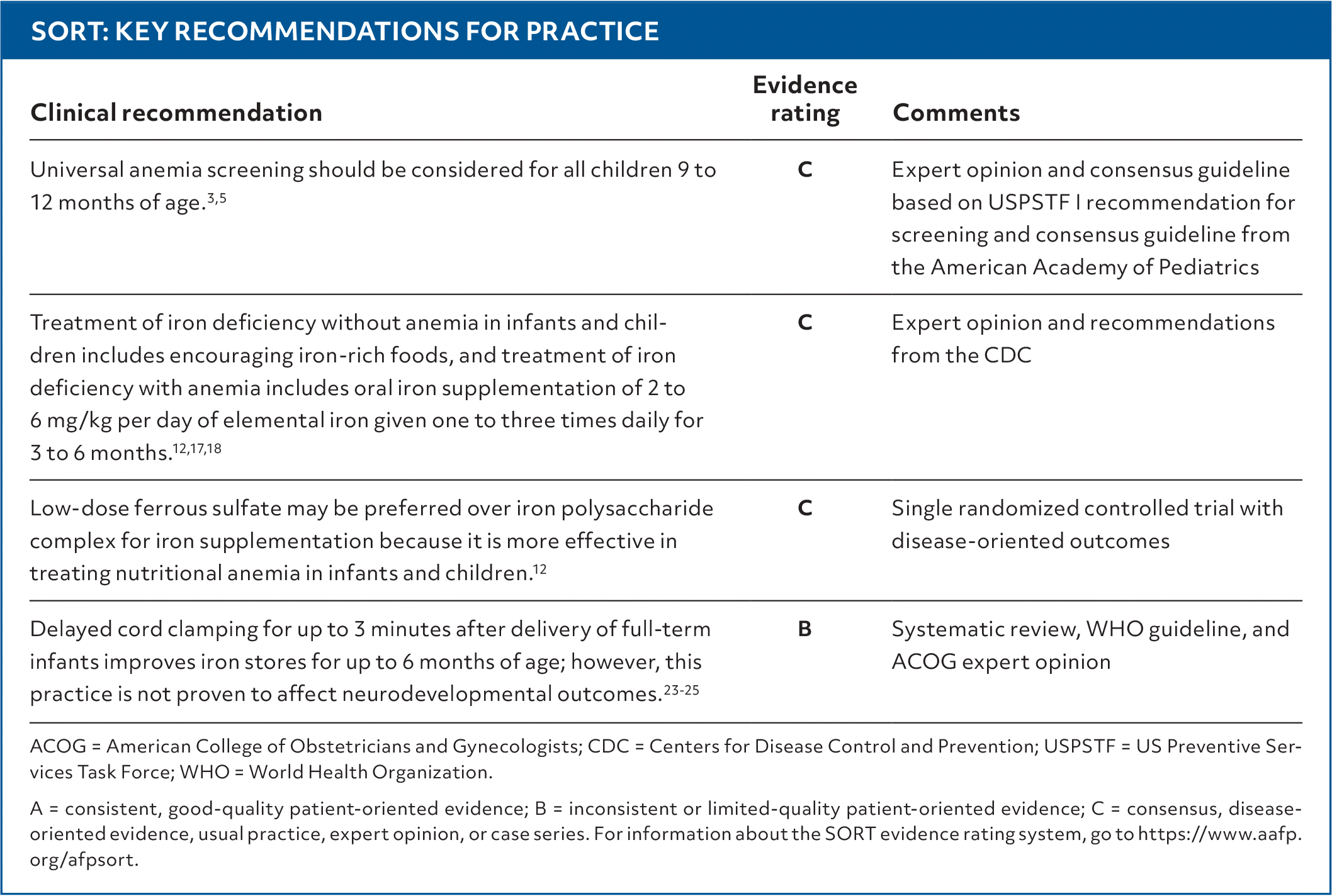
Anemia affects more than 269 million children globally, including 1.2 million children in the United States. Although anemia can present with numerous symptoms, children are most often asymptomatic at the time of diagnosis. Anemia in infants and children most often arises from nutritional iron deficiency but can also be a result of genetic hemoglobin disorders, blood loss, infections, and other diseases. In the United States, newborn screening programs assess for various genetic causes of anemia at birth. The US Preventive Services Task Force notes insufficient evidence to recommend universal screening of asymptomatic children in the first year of life; however, the American Academy of Pediatrics recommends screening all children before 1 year of age. Initial laboratory evaluation consists of a complete blood cell count, with further testing dependent on mean corpuscular volume. Microcytic anemia is the most common hematologic disorder in children, with iron deficiency as the most common cause. A recommended dosage of 2 to 6 mg/kg per day of ferrous sulfate is the most effective oral iron supplementation for patients with iron deficiency anemia. Delayed cord clamping at birth might prevent early iron deficiency, but no clinically relevant outcomes are certain. Normocytic anemia is classified by reticulocyte count and can reflect hemolysis (high reticulocyte count) or bone marrow suppression (low reticulocyte count). Macrocytic anemia is less common in children and is typically a result of nutritional deficiencies or poor absorption of cobalamin (vitamin B12) or folate. Pediatric hematology referral might be beneficial for patients who do not respond to treatment, and referrals are critical for any bone marrow suppression that is diagnosed.

MEGHAN F. RALEIGH, MD, FAAFP, is program director at Carl R. Darnall Army Medical Center, Fort Cavazos, Texas, and an assistant professor in the Department of Family Medicine at the Uniformed Services University of the Health Sciences, Bethesda, Maryland.

ASHLEY S. YANO, MD, IBCLC, is faculty in the Department of Family Medicine at Carl R. Darnall Army Medical Center.

NATHAN E. SHAFFER, DO, is faculty at Dwight D. Eisenhower Army Medical Center, Fort Eisenhower, Georgia.

Address correspondence to Meghan F. Raleigh, MD, FAAFP, at mraleigh32@yahoo.com.

Author disclosure: No relevant financial relationships.

  1. 1.World Health Organization. Number of children aged 6–59 months with anaemia (thousands). Last updated March 31, 2021. Accessed December 2023. https://www.who.int/data/gho/data/indicators/indicator-details/GHO/anaemia-in-children-under-5-years-number
  2. 2.World Health Organization. Anaemia. May 1, 2023. Accessed December 2023. https://www.who.int/news-room/fact-sheets/detail/anaemia
  3. 3.Baker RD, Greer FR; Committee on Nutrition, American Academy of Pediatrics. Diagnosis and prevention of iron deficiency and iron-deficiency anemia in infants and young children (0–3 years of age). Pediatrics. 2010;126(5):1040-1050.
  4. 4.Adam H; American Academy of Pediatrics. Screening for anemia. Quick references (2020). June 11, 2022. Accessed December 2023. https://doi.org/10.1542/aap.ppcqr.396021
  5. 5.Siu AL; US Preventive Services Task Force. Screening for iron deficiency anemia in young children: USPSTF recommendation statement. Pediatrics. 2015;136(4):746-752.
  6. 6.USDA Food and Nutrition Service. WIC eligibility requirements. Accessed July 21, 2024. https://www.fns.usda.gov/wic/wic-eligibility-requirements
  7. 7.Health Resources and Services Administration. Newborn screening in your state. Accessed December 2023. https://newbornscreening.hrsa.gov/your-state
  8. 8.Gallagher PG. Anemia in the pediatric patient. Blood. 2022;140(6):571-593.
  9. 9.Wang M. Iron deficiency and other types of anemia in infants and children. Am Fam Physician. 2016;93(4):270-278.
  10. 10.Janus J, Moerschel SK. Evaluation of anemia in children. Am Fam Physician. 2010;81(12):1462-1471.
  11. 11.Moscheo C, Licciardello M, Samperi P, et al. New insights into iron deficiency anemia in children: a practical review. Metabolites. 2022;12(4):289.
  12. 12.Powers JM, Buchanan GR, Adix L, et al. Effect of low-dose ferrous sulfate vs iron polysaccharide complex on hemoglobin concentration in young children with nutritional iron-deficiency anemia: a randomized clinical trial. JAMA. 2017;317(22):2297-2304.
  13. 13.Park J. Hematology. Anderson CC, Kapoor S, Mark TE, eds. The Harriet Lane Handbook. 23rd ed. Elsevier; 2024: 865.
  14. 14.Brotanek JM, Gosz J, Weitzman M, et al. Iron deficiency in early childhood in the United States: risk factors and racial/ethnic disparities. Pediatrics. 2007;120(3):568-575.
  15. 15.Jefferds MED, Mei Z, Addo Y, et al. Iron deficiency in the United States: limitations in guidelines, data, and monitoring of disparities. Am J Public Health. 2022;112(S8):S826-S835.
  16. 16.US Department of Agriculture and US Department of Health and Human Services. Dietary guidelines for Americans. Food sources of iron. Accessed November 7, 2024. https://www.dietaryguidelines.gov/resources/2020-2025-dietary-guidelines-online-materials/food-sources-select-nutrients/food-sources-iron#standardization
  17. 17.Centers for Disease Control and Prevention. Recommendations to prevent and control iron deficiency in the United States. MMWR Recomm Rep. 1998;47(RR-3):1-29.
  18. 18.US Department of Agriculture and US Department of Health and Human Services. Dietary guidelines for Americans, 2020–2025. 9th ed. Published December 2020. Accessed September 8, 2024. https://www.dietaryguidelines.gov/sites/default/files/2020-12/Dietary_Guidelines_for_Americans_2020-2025.pdf
  19. 19.Parodi E, Giraudo MT, Ricceri F, et al. Absolute reticulocyte count and reticulocyte hemoglobin content as predictors of early response to exclusive oral iron in children with iron deficiency anemia. Anemia. 2016;2016:7345835.
  20. 20.Siu AL; U.S. Preventive Services Task Force. Screening for iron deficiency anemia and iron supplementation in pregnant women to improve maternal health and birth outcomes: U.S. Preventive Services Task Force Recommendation Statement. Ann Intern Med. 2015;163(7):529-536.
  21. 21.World Health Organization. Nutritional anaemias: tools for effective prevention and control. 2017. Accessed September 8, 2024. https://iris.who.int/bitstream/handle/10665/259425/9789241513067-eng.pdf
  22. 22.Scholl TO. Maternal iron status: relation to fetal growth, length of gestation, and iron endowment of the neonate. Nutr Rev. 2011;69 suppl 1(suppl 1):S23-S29.
  23. 23.American College of Obstetricians and Gynecologists’ Committee on Obstetric Practice. Delayed umbilical cord clamping after birth: ACOG Committee Opinion, Number 814. Obstet Gynecol. 2020;136(6):e100-e106.
  24. 24.World Health Organization. Guideline: delayed umbilical cord clamping for improved maternal and infant health and nutrition outcomes. 2014. Accessed September 8, 2024. https://iris.who.int/bitstream/handle/10665/148793/9789241508209_eng.pdf
  25. 25.McDonald SJ, Middleton P, Dowswell T, et al. Effect of timing of umbilical cord clamping of term infants on maternal and neonatal outcomes. Cochrane Database Syst Rev. 2013(7):CD004074.
  26. 26.Taylor SN. ABM Clinical Protocol #29: Iron, zinc, and vitamin D supplementation during breastfeeding. Breastfeed Med. 2018;13(6):398-404.
  27. 27.World Health Organization. Guideline: daily iron supplementation in infants and children. Published March 11, 2016. Accessed September 8, 2024. https://www.who.int/publications/i/item/9789241549523
  28. 28.Mayans L. Lead poisoning in children. Am Fam Physician. 2019;100(1):24-30.
  29. 29.Halmo L, Nappe TM; National Library of Medicine. Lead toxicity. StatPearls [Internet]. Last updated July 4, 2023. Accessed September 8, 2024. https://www.ncbi.nlm.nih.gov/books/NBK541097
  30. 30.Mitra P, Sharma S, Purohit P, et al. Clinical and molecular aspects of lead toxicity: an update. Crit Rev Clin Lab Sci. 2017;54(7–8):506-528.
  31. 31.Wengrovitz AM, Brown MJ; Advisory Committee on Childhood Lead Poisoning, Division of Environmental and Emergency Health Services, National Center for Environmental Health; Centers for Disease Control and Prevention. Recommendations for blood lead screening of Medicaid-eligible children aged 1–5 years: an updated approach to targeting a group at high risk. MMWR Recomm Rep. 2009;58(RR-9):1-11.
  32. 32.Curry SJ, Krist AH, Owens DK, et al.; US Preventive Services Task Force. Screening for elevated blood lead levels in children and pregnant women. US Preventive Services Task Force recommendation statement. JAMA. 2019;321(15):1502-1509.
  33. 33.Association of Public Health Laboratories; Centers for Disease Control and Prevention. Hemoglobinopathies: current practices for screening, confirmation and follow-up. December 2015. Accessed September 8, 2024. https://stacks.cdc.gov/view/cdc/42387
  34. 34.Baird DC, Batten SH, Sparks SK. Alpha- and beta-thalassemia: rapid evidence review. Am Fam Physician. 2022;105(3):272-280.
  35. 35.Gulen H, Hanimeli O, Karaca O, et al. α-Thalassemia frequency and mutations in children with hypochromic microcytic anemias and relation with β-thalassemia, iron deficiency anemia. Pediatr Hematol Oncol. 2012;29(3):241-246.
  36. 36.Martinez-Torres V, Torres N, Davis JA, et al. Anemia and associated risk factors in pediatric patients. Pediatric Health Med Ther. 2023;14:267-280.
  37. 37.Demir N, Koc A, Üstyol L, et al. Clinical and neurological findings of severe vitamin B12 deficiency in infancy and importance of early diagnosis and treatment. J Paediatr Child Health. 2013;49(10):820-824.
  38. 38.Güitrón Leal CE, Palma Molina XE, Venkatramanan S, et al. Vitamin B12 supplementation for growth, development, and cognition in children. Cochrane Database Syst Rev. 2022(11):CD015264.
  39. 39.Martini L, Pecoraro L, Salvottini C, et al. Appropriate and inappropriate vitamin supplementation in children. J Nutr Sci. 2020;9:e20.
  40. 40.Irwin JJ, Kirchner JT. Anemia in children. Am Fam Physician. 2001;64(8):1379-1386.

Copyright © 2026 by the American Academy of Family Physicians.

This content is owned by the AAFP. A person viewing it online may make one printout of the material and may use that printout only for his or her personal, non-commercial reference. This material may not otherwise be downloaded, copied, printed, stored, transmitted or reproduced in any medium, whether now known or later invented, except as authorized in writing by the AAFP. See permissions for copyright questions and/or permission requests.