Management of Keloids and Hypertrophic Scars

Justin Bailey, MD
Megan Schwehr, MD
Alexandra Beattie, MD, MS

American Family Physician. 2024;110(6):605-611.

Author disclosure: No relevant financial relationships.

This clinical content conforms to AAFP criteria for CME.

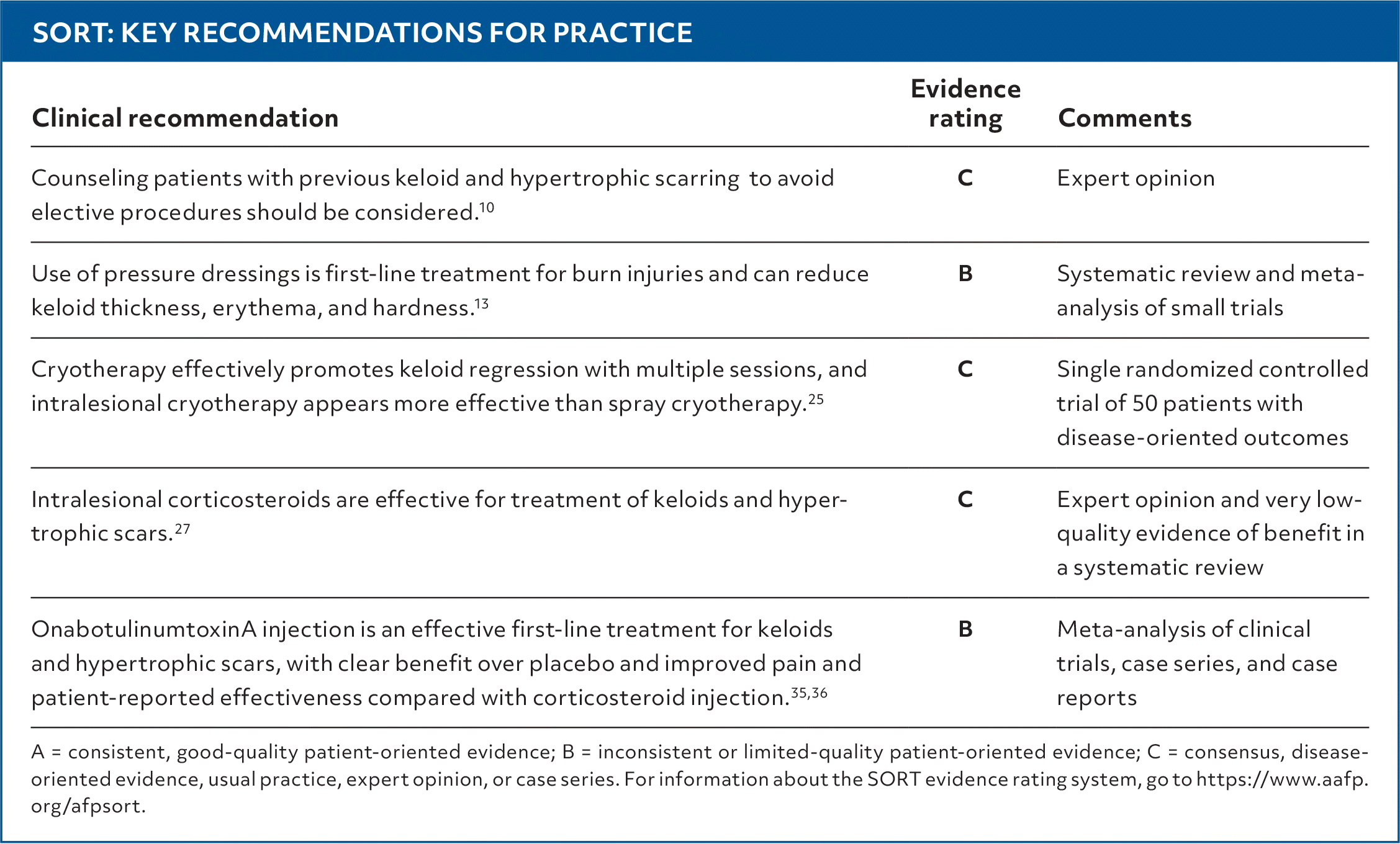
Keloid and hypertrophic scars are a result of aberrant wound healing responses within the reticular dermis. They are thought to be secondary to the formation of a disorganized extracellular matrix due to excessive fibroproliferative collagen response. Prevention of these scars focuses on avoiding elective or cosmetic procedures such as piercings in patients at high risk, reducing tension across the lesion, and decreasing the inflammatory response. Topical treatments, including tension reduction with gel sheets, inflammatory reduction with corticosteroid ointments, and combined treatment with corticosteroid-infused tapes and plasters, can reduce scarring. Liquid nitrogen is beneficial, especially when injected into the scar through intralesional cryotherapy. Corticosteroid injection is effective for prevention and treatment. OnabotulinumtoxinA appears to be superior to both fluorouracil and corticosteroid injections for treating keloids and hypertrophic scars. Advanced treatment includes laser therapies (direct ablation, postsurgical, or laser-assisted drug delivery). Surgical revisions can be successful when tension-reducing techniques are used and when combined with other treatments such as postoperative steroid injection, laser ablation, and radiation therapy. For keloid prevention, corticosteroid injections administered 10 to 14 days postsurgery is superior to injections administered before or during surgery. Radiation therapy is considered safe with low cancer risk and can be used alone or in combination with other therapies.

JUSTIN BAILEY, MD, FAAFP, is an associate professor in the Department of Family Medicine at the University of Washington, Seattle, and director of the Procedure Institute at Full Circle Health, Boise, Idaho.

MEGAN SCHWEHR, MD, is a staff physician at the Terry Reilly Health Services, Caldwell, Idaho. At the time this article was written, she was a resident physician at the Full Circle Health Family Medicine Residency Program.

ALEXANDRA BEATTIE, MD, MS, is a faculty development fellow at Full Circle Health. At the time this article was written, he was a resident physician at the Full Circle Health Family Medicine Residency Program.

Address correspondence to Justin Bailey, MD, at justinbailey@fullcircleidaho.org.

Author disclosure: No relevant financial relationships.

  1. 1.Ekstein SF, Wyles SP, Moran SL, et al. Keloids: a review of therapeutic management. Int J Dermatol. 2021;60(6):661-671.
  2. 2.Ogawa R, Dohi T, Tosa M, et al. The latest strategy for keloid and hypertrophic scar prevention and treatment: the Nippon Medical School (NMS) Protocol. J Nippon Med Sch. 2021;88(1):2-9.
  3. 3.Wolfram D, Tzankov A, Pülzl P, et al. Hypertrophic scars and keloids—a review of their pathophysiology, risk factors, and therapeutic management. Dermatol Surg. 2009;35(2):171-181.
  4. 4.Berman B, Maderal A, Raphael B. Keloids and hypertrophic scars: pathophysiology, classification, and treatment. Dermatol Surg. 2017;43(suppl 1):S3-S18.
  5. 5.Frech FS, Hernandez L, Urbonas R, et al. Hypertrophic scars and keloids: advances in treatment and review of established therapies. Am J Clin Dermatol. 2023;24(2):225-245.
  6. 6.Clark JA, Turner ML, Howard L, et al. Description of familial keloids in five pedigrees: evidence for autosomal dominant inheritance and phenotypic heterogeneity. BMC Dermatol. 2009;9:8.
  7. 7.Liu R, Xiao H, Wang R, et al. Risk factors associated with the progression from keloids to severe keloids. Chin Med J (Engl). 2022;135(7):828-836.
  8. 8.Ogunbiyi A. Acne keloidalis nuchae: prevalence, impact, and management challenges. Clin Cosmet Investig Dermatol. 2016;9:483-489.
  9. 9.Ogawa R, Akaishi S, Hyakusoku H. Differential and exclusive diagnosis of diseases that resemble keloids and hypertrophic scars. Ann Plast Surg. 2009;62(6):660-664.
  10. 10.Ogawa R. The most current algorithms for the treatment and prevention of hypertrophic scars and keloids: a 2020 update of the algorithms published 10 years ago. Plast Reconstr Surg. 2022;149(1):79e-94e.
  11. 11.Zhang Y, Wu M, Liu D, et al. Recurrence and complications of perioperative steroid injection of keloids: a systematic review and meta-analysis. Aesthetic Plast Surg. 2024;48(15):2927-2940.
  12. 12.Atkinson JAM, McKenna KT, Barnett AG, et al. A randomized, controlled trial to determine the efficacy of paper tape in preventing hypertrophic scar formation in surgical incisions that traverse Langer’s skin tension lines. Plast Reconstr Surg. 2005;116(6):1648-1656.
  13. 13.Ai JW, Liu JT, Pei SD, et al. The effectiveness of pressure therapy (15–25 mmHg) for hypertrophic burn scars: a systematic review and meta-analysis. Sci Rep. 2017;7:40185.
  14. 14.Hsu KC, Luan CW, Tsai YW. Review of silicone gel sheeting and silicone gel for the prevention of hypertrophic scars and keloids. Wounds. 2017;29(5):154-158.
  15. 15.Goutos I, Ogawa R. Steroid tape: a promising adjunct to scar management. Scars Burn Heal. 2017;3 : 2059513117690937.
  16. 16.Shin TM, Bordeaux JS. The role of massage in scar management: a literature review. Dermatol Surg. 2012;38(3):414-423.
  17. 17.O’Brien L, Jones DJ. Silicone gel sheeting for preventing and treating hypertrophic and keloid scars. Cochrane Database Syst Rev. 2013(9):CD003826.
  18. 18.Chittoria RK, Padi TR. A prospective, randomized, placebo controlled, double blind study of silicone gel in prevention of hypertrophic scar at donor site of skin grafting. J Cutan Aesthet Surg. 2013;6(1):12-16.
  19. 19.Tian F, Jiang Q, Chen J, et al. Silicone gel sheeting for treating keloid scars. Cochrane Database Syst Rev. 2023(1):CD013878.
  20. 20.Ogawa R, Akita S, Akaishi S, et al. Diagnosis and treatment of keloids and hypertrophic scars-Japan scar workshop consensus document 2018. Burns Trauma. 2019;7:39.
  21. 21.Ogawa R, Akaishi S, Kuribayashi S, et al. Keloids and hypertrophic scars can now be cured completely. J Nippon Med Sch. 2016;83(2):46-53.
  22. 22.Sidgwick GP, McGeorge D, Bayat A. A comprehensive evidence-based review on the role of topicals and dressings in the management of skin scarring. Arch Dermatol Res. 2015;307(6):461-477.
  23. 23.Sheng M, Chen Y, Li H, et al. The application of corticosteroids for pathological scar prevention and treatment. Burns Trauma. 2023;11 : tkad009.
  24. 24.Shin JY, Yun SK, Roh SG, et al. Efficacy of 2 representative topical agents to prevent keloid recurrence after surgical excision. J Oral Maxillofac Surg. 2017;75(2):401.e1-401.e6.
  25. 25.Mourad B, Elfar N, Elsheikh S. Spray versus intralesional cryotherapy for keloids. J Dermatolog Treat. 2016;27(3):264-269.
  26. 26.Gold MH, McGuire M, Mustoe TA, et al.; International Advisory Panel on Scar Management. Updated international clinical recommendations on scar management: part 2—algorithms for scar prevention and treatment. Dermatol Surg. 2014;40(8):825-831.
  27. 27.Trisliana Perdanasari A, Torresetti M, Grassetti L, et al. Intralesional injection treatment of hypertrophic scars and keloids: a systematic review regarding outcomes. Burns Trauma. 2015;3:14.
  28. 28.Yin Q, Niessen FB, Gibbs S, et al. Intralesional corticosteroid administration in the treatment of keloids. J Dermatolog Treat. 2023;34(1):2159308.
  29. 29.Wong TS, Li JZH, Chen S, et al. The efficacy of triamcinolone acetonide in keloid treatment: a systematic review and meta-analysis. Front Med (Lausanne). 2016;3:71.
  30. 30.Kafka M, Collins V, Kamolz LP, et al. Evidence of invasive and noninvasive treatment modalities for hypertrophic scars: a systematic review. Wound Repair Regen. 2017;25(1):139-144.
  31. 31.Khalid FA, Mehrose MY, Saleem M, et al. Comparison of efficacy and safety of intralesional triamcinolone and combination of triamcinolone with 5-fluorouracil in the treatment of keloids and hypertrophic scars: randomised control trial. Burns. 2019;45(1):69-75.
  32. 32.Ren Y, Zhou X, Wei Z, et al. Efficacy and safety of triamcinolone acetonide alone and in combination with 5-fluorouracil for treating hypertrophic scars and keloidss. Int Wound J. 2017;14(3):480-487.
  33. 33.Yang W, Li G. The safety and efficacy of botulinum toxin type A injection for postoperative scar prevention: a systematic review and meta-analysis. J Cosmet Dermatol. 2020;19(4):799-808.
  34. 34.Ismail SA, Mohammed NHK, Sotohy M, et al. Botulinum toxin type A versus 5-fluorouracil in treatment of keloid. Arch Dermatol Res. 2021;313(7):549-556.
  35. 35.Fu Z, Huang H, Huang J. Efficacy and safety of botulinum toxin type A for postoperative scar prevention and wound healing improvement. J Cosmet Dermatol. 2022;21(1):176-190.
  36. 36.Bi M, Sun P, Li D, et al. Intralesional injection of botulinum toxin type A compared with intralesional injection of corticosteroid for the treatment of hypertrophic scar and keloid: a systematic review and meta-analysis. Med Sci Monit. 2019;25:2950-2958.
  37. 37.Elshahed AR, Elmanzalawy KS, Shehata H, et al. Effect of botulinum toxin type A for treating hypertrophic scars. J Cosmet Dermatol. 2020;19(9):2252-2258.
  38. 38.Seago M, Shumaker PR, Spring LK, et al. Laser treatment of traumatic scars and contractures: 2020 international consensus recommendations. Lasers Surg Med. 2020;52(2):96-116.
  39. 39.Jin R, Huang X, Li H, et al. Laser therapy for prevention and treatment of pathologic excessive scars. Plast Reconstr Surg. 2013;132(6):1747-1758.
  40. 40.Mankowski P, Kanevsky J, Tomlinson J, et al. Optimizing radiotherapy for keloids. Ann Plast Surg. 2017;78(4):403-411.
  41. 41.Juckett G, Hartman-Adams H. Management of keloids and hypertrophic scars. Am Fam Physician. 2009;80(3):253-260.

Copyright © 2026 by the American Academy of Family Physicians.

This content is owned by the AAFP. A person viewing it online may make one printout of the material and may use that printout only for his or her personal, non-commercial reference. This material may not otherwise be downloaded, copied, printed, stored, transmitted or reproduced in any medium, whether now known or later invented, except as authorized in writing by the AAFP. See permissions for copyright questions and/or permission requests.