Noninvasive Cardiac Testing

William E. Cayley, Jr, MD, MDiv

American Family Physician. 2024;110(6):577-584.

Author disclosure: No relevant financial relationships.

This clinical content conforms to AAFP criteria for CME.

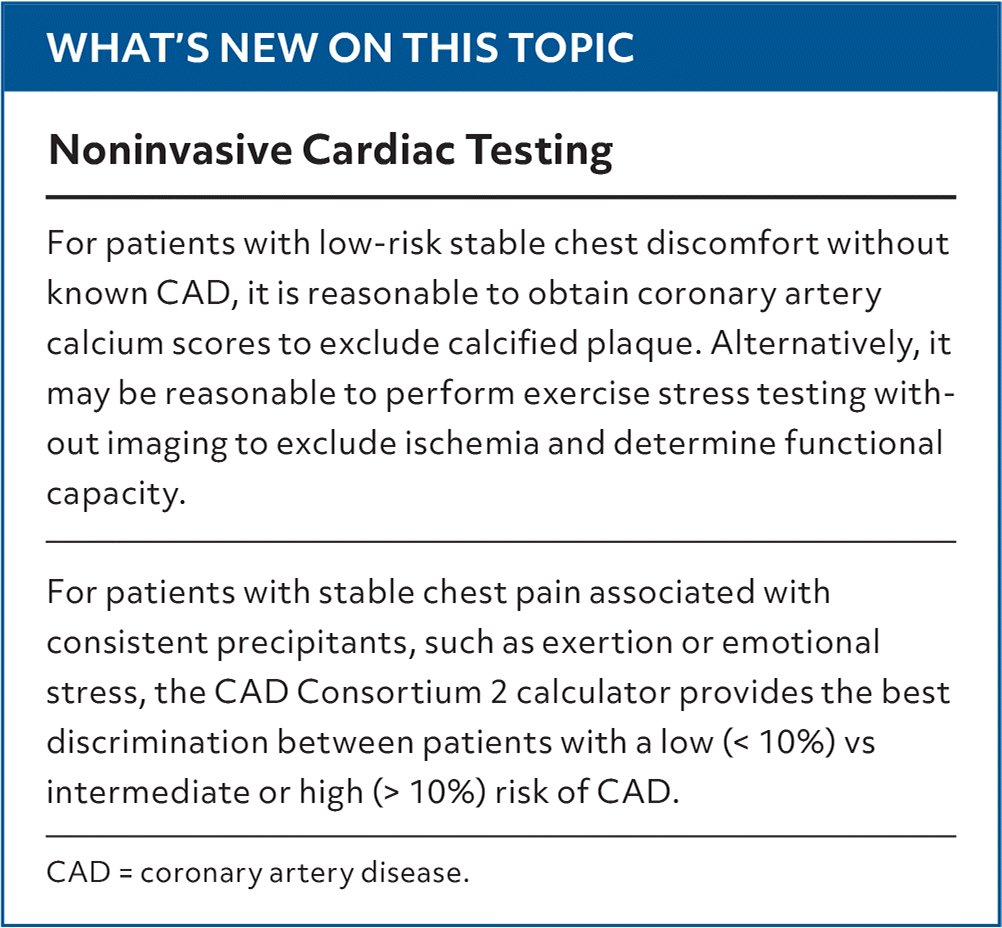
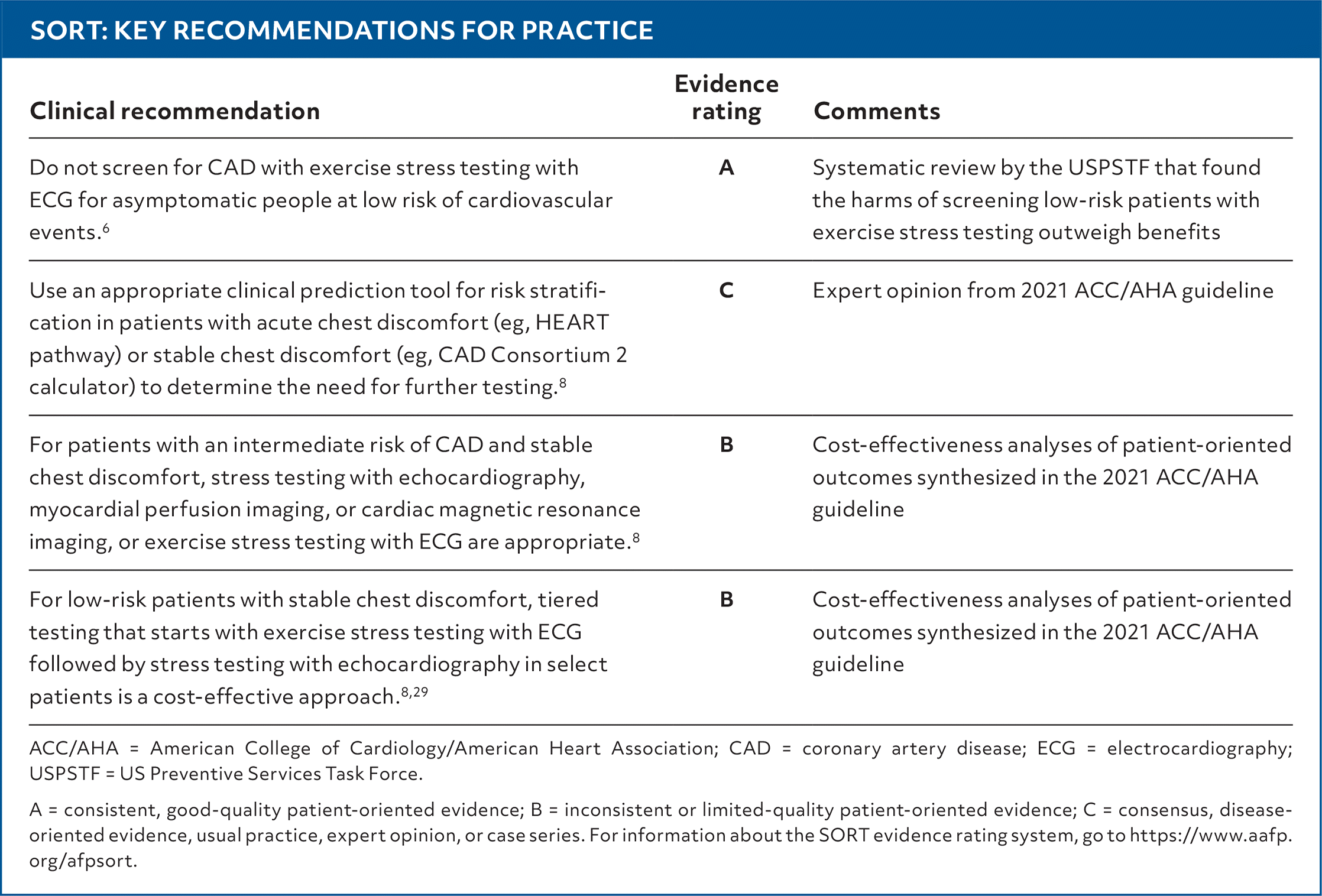
For patients with chest discomfort, noninvasive cardiac testing can be used for the diagnosis of acute coronary syndrome and for the evaluation of the risk of future cardiovascular events and disease severity in patients with known coronary artery disease. Clinical prediction rules can guide risk assessment for patients with acute or stable chest discomfort. For acute chest discomfort, patients with low risk do not need urgent testing, and those at high risk should have invasive coronary angiography. For acute chest discomfort in patients at intermediate risk, exercise stress testing can provide useful prognostic information on the likelihood of future mortality and survival despite modest sensitivity and specificity for coronary artery disease. Exercise or pharmacologic stress testing with imaging allows dynamic assessment of ventricular function and perfusion. For stable chest discomfort in patients with low risk, coronary artery calcium scoring can be used to exclude calcified plaque or exercise stress testing can be used for the evaluation of future cardiac risk and prognosis. For stable chest discomfort in patients with intermediate or high risk, exercise stress testing or stress testing with imaging (ie, echocardiography, myocardial perfusion imaging, or cardiac magnetic resonance imaging) may be used for the evaluation for myocardial ischemia.

WILLIAM E. CAYLEY JR, MD, MDiv, is an adjunct clinical professor at the University of Wisconsin School of Medicine and Public Health in Eau Claire, and practices at Eau Claire Medical Clinic in Wisconsin.

Address correspondence to William E. Cayley Jr, MD, MDiv, at bcayley@yahoo.com.

Author disclosure: No relevant financial relationships.

  1. 1.Murphy SL, Kochanek KD, Xu JQ, et al. NCHS data brief no. 427. Mortality in the United States, 2020. December 2021. Accessed October 8, 2024. https://www.cdc.gov/nchs/data/databriefs/db427.pdf
  2. 2.Santo L, Kang K. National Ambulatory Medical Care Survey: 2019 national summary tables. Accessed October 8, 2024. https://www.cdc.gov/nchs/data/ahcd/namcs_summary/2019-namcs-web-tables-508.pdf
  3. 3.Fletcher GF, Ades PA, Kligfield P, et al.; American Heart Association Exercise, Cardiac Rehabilitation, and Prevention Committee of the Council on Clinical Cardiology; Council on Nutrition, Physical Activity and Metabolism; Council on Cardiovascular and Stroke Nursing; and Council on Epidemiology and Prevention. Exercise standards for testing and training: a scientific statement from the American Heart Association. Circulation. 2013;128(8):873-934.
  4. 4.Elkholy KO, Hegazy O, Okunade A, et al. Regadenoson stress testing: a comprehensive review with a focused update. Cureus. 2021;13(1):e12940.
  5. 5.Winchester DE, Maron DJ, Blankstein R, et al.; Multimodality Writing Group for Chronic Coronary Disease. ACC/AHA/ASE/ASNC/ASPC/HFSA/HRS/SCAI/SCCT/SCMR/STS 2023 multimodality appropriate use criteria for the detection and risk assessment of chronic coronary disease. J Am Coll Cardiol. 2023;81(25):2445-2467.
  6. 6.Curry SJ, Krist AH, Owens DK, et al. Screening for cardiovascular disease risk with electrocardiography: US Preventive Services Task Force recommendation statement. JAMA. 2018;319(22):2308-2314.
  7. 7.Pellikka PA, Arruda-Olson A, Chaudhry FA, et al. Guidelines for performance, interpretation, and application of stress echocardiography in ischemic heart disease: from the American Society of Echocardiography. J Am Soc Echocardiogr. 2020;33(1):1-41.e8.
  8. 8.Gulati M, Levy PD, Mukherjee D, et al. 2021 AHA/ACC/ASE/CHEST/SAEM/SCCT/SCMR guideline for the evaluation and diagnosis of chest pain: a report of the American College of Cardiology/American Heart Association Joint Committee on Clinical Practice Guidelines. Circulation. 2021;144(22):e368-e454.
  9. 9.Lee C, Dow S, Shah K, et al. Complications of exercise and pharmacologic stress echocardiography. Front Cardiovasc Med. 2023;10:1228613.
  10. 10.Pinkstaff S, Peberdy MA, Kontos MC, et al. Quantifying exertion level during exercise stress testing using percentage of age-predicted maximal heart rate, rate pressure product, and perceived exertion. Mayo Clin Proc. 2010;85(12):1095-1100.
  11. 11.Gianrossi R, Detrano R, Mulvihill D, et al. Exercise-induced ST depression in the diagnosis of coronary artery disease. A meta-analysis. Circulation. 1989;80(1):87-98.
  12. 12.Peterson PN, Magid DJ, Ross C, et al. Association of exercise capacity on treadmill with future cardiac events in patients referred for exercise testing. Arch Intern Med. 2008;168(2):174-179.
  13. 13.Harb SC, Bhat P, Cremer PC, et al. Prognostic value of functional capacity in different exercise protocols. J Am Heart Assoc. 2020;9(13):e015986.
  14. 14.Mark DB, Hlatky MA, Harrell FE, et al. Exercise treadmill score for predicting prognosis in coronary artery disease. Ann Intern Med. 1987;106(6):793-800.
  15. 15.Mark DB, Shaw L, Harrell FE, et al. Prognostic value of a treadmill exercise score in outpatients with suspected coronary artery disease. N Engl J Med. 1991;325(12):849-853.
  16. 16.Cheezum MK, Subramaniyam PS, Bittencourt MS, et al. Prognostic value of coronary CTA vs. exercise treadmill testing: results from the Partners registry. Eur Heart J Cardiovasc Imaging. 2015;16(12):1338-1346.
  17. 17.Pontone G, Guaricci AI, Palmer SC, et al. Diagnostic performance of non-invasive imaging for stable coronary artery disease: a meta-analysis. Int J Cardiol. 2020;300:276-281.
  18. 18.Henzlova MJ, Duvall WL, Einstein AJ, et al. ASNC imaging guidelines for SPECT nuclear cardiology procedures: stress, protocols, and tracers. J Nucl Cardiol. 2016;23(3):606-639.
  19. 19.Weberling LD, Lossnitzer D, Frey N, et al. Coronary computed tomography vs. cardiac magnetic resonance imaging in the evaluation of coronary artery disease. Diagnostics (Basel). 2022;13(1):125.
  20. 20.Trankle CR, Canada JM, Jordan JH, et al. Exercise cardiovascular magnetic resonance: a review. J Magn Reson Imaging. 2022;55(3):720-754.
  21. 21.Knuuti J, Ballo H, Juarez-Orozco LE, et al. The performance of noninvasive tests to rule-in and rule-out significant coronary artery stenosis in patients with stable angina: a meta-analysis focused on post-test disease probability. Eur Heart J. 2018;39(35):3322-3330.
  22. 22.Faes TJC, Meer R, Heyndrickx GR, et al. Fractional flow reserve evaluated as metric of coronary stenosis - a mathematical model study. Front Cardiovasc Med. 2020;6:189.
  23. 23.Meinel FG, Nance JW, Harris BS, et al. Radiation risks from cardiovascular imaging tests. Circulation. 2014;130(5):442-445.
  24. 24.Fanaroff AC, Rymer JA, Goldstein SA, et al. Does this patient with chest pain have acute coronary syndrome?: The rational clinical examination systematic review. JAMA. 2015;314(18):1955-1965.
  25. 25.Mahler SA, Riley RF, Hiestand BC, et al. The HEART Pathway randomized trial: identifying emergency department patients with acute chest pain for early discharge. Circ Cardiovasc Qual Outcomes. 2015;8(2):195-203.
  26. 26.Genders TSS, Steyerberg EW, Alkadhi H, et al.; CAD Consortium. A clinical prediction rule for the diagnosis of coronary artery disease: validation, updating, and extension. Eur Heart J. 2011;32(11):1316-1330.
  27. 27.Genders TSS, Steyerberg EW, Hunink MGM, et al. Prediction model to estimate presence of coronary artery disease: retrospective pooled analysis of existing cohorts. BMJ. 2012;344:e3485.
  28. 28.Baskaran L, Danad I, Gransar H, et al. A comparison of the updated Diamond-Forrester, CAD Consortium, and CONFIRM history-based risk scores for predicting obstructive coronary artery disease in patients with stable chest pain: the SCOT-HEART coronary CTA cohort. JACC Cardiovasc Imaging. 2019;12(7 pt 2):1392-1400.
  29. 29.Min JK, Gilmore A, Jones EC, et al. Cost-effectiveness of diagnostic evaluation strategies for individuals with stable chest pain syndrome and suspected coronary artery disease. Clin Imaging. 2017;43:97-105.
  30. 30.Bourque JM, Charlton GT, Holland BH, et al. Prognosis in patients achieving ≥10 METS on exercise stress testing: was SPECT imaging useful? J Nucl Cardiol. 2011;18(2):230-237.
  31. 31.Fine NM, Pellikka PA, Scott CG, et al. Characteristics and outcomes of patients who achieve high workload (≥10 metabolic equivalents) during treadmill exercise echocardiography. Mayo Clin Proc. 2013;88(12):1408-1419.

Copyright © 2026 by the American Academy of Family Physicians.

This content is owned by the AAFP. A person viewing it online may make one printout of the material and may use that printout only for his or her personal, non-commercial reference. This material may not otherwise be downloaded, copied, printed, stored, transmitted or reproduced in any medium, whether now known or later invented, except as authorized in writing by the AAFP. See permissions for copyright questions and/or permission requests.