Sudden Infant Death Syndrome: Common Questions and Answers

Hillary J. Darrow, MD
Kayla A. Carman, DO
Vernon Wheeler, MD

American Family Physician. 2025;111(2):164-170.

Author disclosure: No relevant financial relationships.

This clinical content conforms to AAFP criteria for CME.

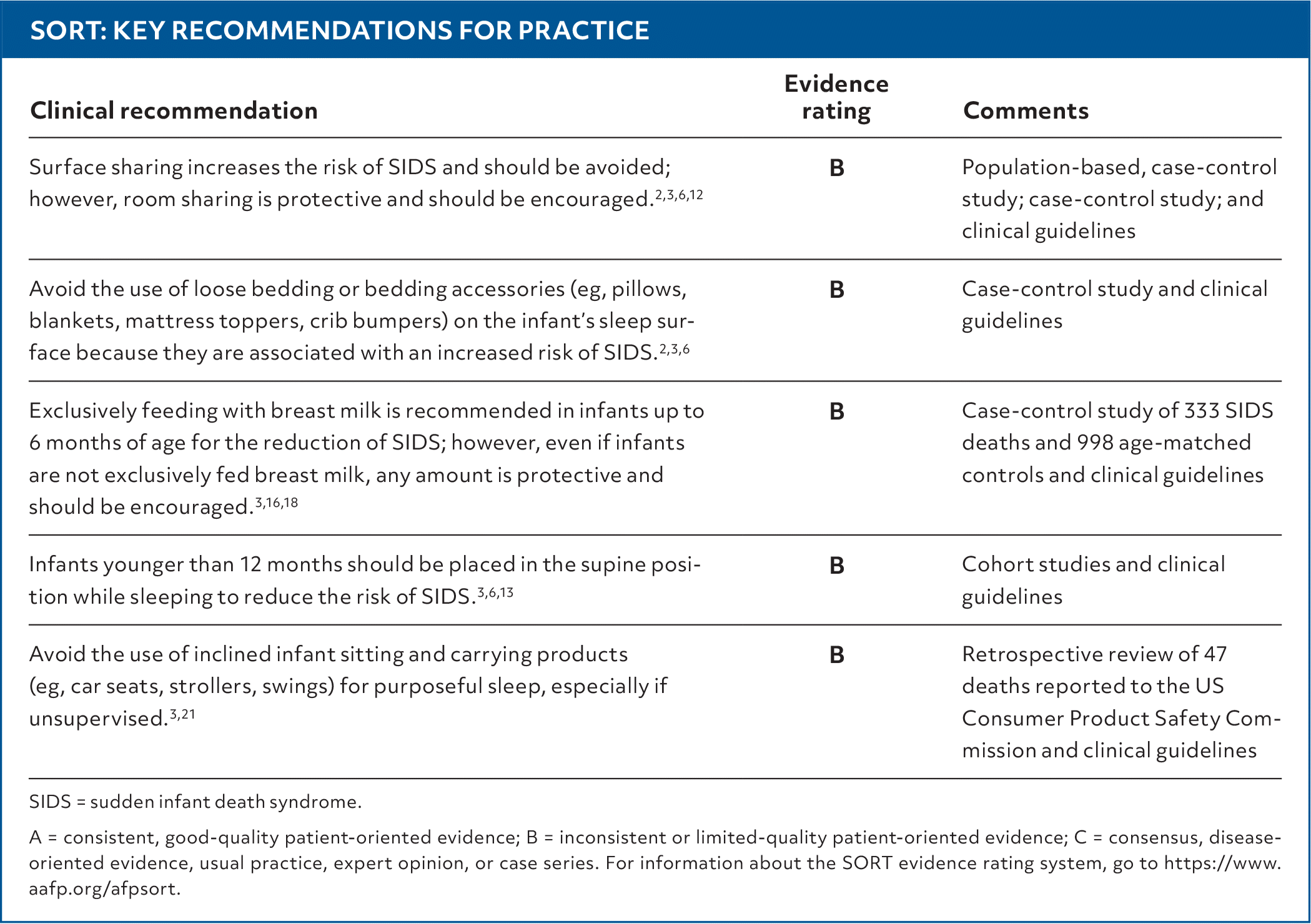
Sudden unexpected infant death is an umbrella term that describes death that occurs in infants younger than 12 months that does not have an immediately obvious cause. Sudden infant death syndrome (SIDS) is diagnosed when there is no other explanation for the death after a detailed investigation. Despite a decrease in the incidence of SIDS after instituting the Back to Sleep campaign in 1992, sudden unexpected infant death remains a leading cause of infant death, and rates have plateaued. Although there has been a decrease in the incidence of SIDS, these numbers likely reflect improved investigations because rates of sudden unexpected infant death have remained stable. Recommended risk reduction strategies include promotion of a supine sleep position, safe sleep surfaces, room sharing, breast milk feeding, and pacifier use. Families should be counseled to avoid sharing sleep surfaces, overheating, loose bedding and inclined surfaces, and parental use of tobacco or alcohol. Infant swaddling without hats is recommended until they are attempting to roll over, after which appropriate clothing or wearable blankets can be worn. Family physicians should prioritize early education and consistent messaging to promote SIDS risk reduction.

HILLARY J. DARROW, MD, is family medicine obstetrics staff at the Family Medicine Residency Program at Fort Eisenhower Army Medical Center in Georgia. At the time this article was written, she was adjunct faculty at the Family Medicine Residency Program at Carl R. Darnall Army Medical Center, Fort Cavazos, Texas.

KAYLA A. CARMAN, DO, is adjunct faculty at the Family Medicine Residency Program at Carl R. Darnall Army Medical Center.

VERNON WHEELER, MD, FAAFP, is the research director and Family Medicine Obstetrics faculty member at the Family Medicine Residency Program at Carl R. Darnall Army Medical Center; an assistant professor in the Department of Family Medicine at the Uniformed Services University of the Health Sciences, Bethesda, Maryland; and a clinical assistant professor at Texas A&M Health Science Center College of Medicine, Temple.

Address correspondence to Hillary J. Darrow, MD, at culli1hj@cmich.edu.

Author disclosure: No relevant financial relationships.

  1. 1.Centers for Disease Control and Prevention. Data and Statistics for SUID and SIDS. Accessed February 01, 2024. https://www.cdc.gov/sudden-infant-death/data-research/data/
  2. 2.Ellis C, Pease A, Garstang J, et al. Interventions to improve safer sleep practices in families with children considered to be at increased risk for sudden unexpected death in infancy: a systematic review. Front Pediatr. 2022;9:778186.
  3. 3.Moon RY, Carlin RF, Hand I; Task Force On Sudden Infant Death Syndrome and the Committee On Fetus and Newborn. Sleep-related infant deaths: updated 2022 recommendations for reducing infant deaths in the sleep environment. Pediatrics. 2022;150(1):e2022057990.
  4. 4.Malloy MH. Trends in postneonatal aspiration deaths and reclassification of sudden infant death syndrome: impact of the “Back to Sleep” program. Pediatrics. 2002;109(4):661-665.
  5. 5.Adams SM, Ward CE, Garcia KL. Sudden infant death syndrome. Am Fam Physician. 2015;91(11):778-783.
  6. 6.Hauck FR, Herman SM, Donovan M, et al. Sleep environment and the risk of sudden infant death syndrome in an urban population: the Chicago Infant Mortality Study. Pediatrics. 2003;111(5 pt 2):1207-1214.
  7. 7.Gilbert NL, Auger N, Wilkins R, et al. Neighbourhood income and neonatal, postneonatal and sudden infant death syndrome (SIDS) mortality in Canada, 1991–2005. Can J Public Health. 2013;104(3):e187-e192.
  8. 8.Leach CE, Blair PS, Fleming PJ, et al.; CESDI SUDI Research Group. Epidemiology of SIDS and explained sudden infant deaths. Pediatrics. 1999;104(4):e43.
  9. 9.Van Nguyen JM, Abenhaim HA. Sudden infant death syndrome: review for the obstetric care provider. Am J Perinatol. 2013;30(9):703-714.
  10. 10.Spencer N, Logan S. Sudden unexpected death in infancy and socioeconomic status: a systematic review. J Epidemiol Community Health. 2004;58(5):366-373.
  11. 11.Matthews TJ, MacDorman MF. Infant mortality statistics from the 2010 period linked birth/infant death data set. Natl Vital Stat Rep. 2013;62(8):1-26.
  12. 12.Tappin D, Ecob R, Brooke H. Bedsharing, roomsharing, and sudden infant death syndrome in Scotland: a case-control study. J Pediatr. 2005;147(1):32-37.
  13. 13.Colvin JD, Collie-Akers V, Schunn C, et al. Sleep environment risks for younger and older infants. Pediatrics. 2014;134(2):e406-e412.
  14. 14.O’Leary CM, Jacoby PJ, Bartu A, et al. Maternal alcohol use and sudden infant death syndrome and infant mortality excluding SIDS. Pediatrics. 2013;131(3):e770-778.
  15. 15.Vennemann MM, Hense HW, Bajanowski T, et al. Bed sharing and the risk of sudden infant death syndrome: can we resolve the debate? J Pediatr. 2012;160(1):44-48.e2.
  16. 16.Vennemann MM, Bajanowski T, Brinkmann B, et al.; GeSID Study Group. Does breastfeeding reduce the risk of sudden infant death syndrome? Pediatrics. 2009;123(3):e406-e410.
  17. 17.Weiss PP, Kerbl R. The relatively short duration that a child retains a pacifier in the mouth during sleep: implications for sudden infant death syndrome. Eur J Pediatr. 2001;160(1):60.
  18. 18.American Academy of Family Physicians. Breastfeeding, family physicians supporting (position paper). Accessed March 10, 2024. https://www.aafp.org/about/policies/all/breastfeeding-position-paper.html
  19. 19.Moon RY, Tanabe KO, Yang DC, et al. Pacifier use and SIDS: evidence for a consistently reduced risk. Matern Child Health J. 2012;16(3):609-614.
  20. 20.Carpenter RG, Irgens LM, Blair PS, et al. Sudden unexplained infant death in 20 regions in Europe: case control study. Lancet. 2004;363(9404):185-191.
  21. 21.Batra EK, Midgett JD, Moon RY. Hazards associated with sitting and carrying devices for children two years and younger. J Pediatr. 2015;167(1):183-187.
  22. 22.Rosen R, Vandenplas Y, Singendonk M, et al. Pediatric gastroesophageal reflux clinical practice guidelines: joint recommendations of the North American Society for Pediatric Gastroenterology, Hepatology, and Nutrition and the European Society for Pediatric Gastroenterology, Hepatology, and Nutrition. J Pediatr Gastroenterol Nutr. 2018;66(3):516-554.
  23. 23.Ponsonby AL, Dwyer T, Gibbons LE, et al. Thermal environment and sudden infant death syndrome: case-control study. BMJ. 1992;304(6822):277-282.
  24. 24.Jhun I, Mata DA, Nordio F, et al. Ambient temperature and sudden infant death syndrome in the United States. Epidemiology. 2017;28(5):728-734.
  25. 25.McDonnell E, Moon RY. Infant deaths and injuries associated with wearable blankets, swaddle wraps, and swaddling. J Pediatr. 2014;164(5):1152-1156.
  26. 26.Blair PS, Mitchell EA, Heckstall-Smith EMA, et al. Head covering–a major modifiable risk factor for sudden infant death syndrome: a systematic review. Arch Dis Child. 2008;93(9):778-783.
  27. 27.Unwin S, Dika C. Deformational plagiocephaly–a focus on prevention. J Nurse Pract. 2017;13(2):162-169.
  28. 28.Lennartsson F. Nonsynostotic plagiocephaly: prevention strategies in child health care. J Clin Med. 2020;9(12):3946.
  29. 29.Behnam-Terneus M, Clemente M. SIDS, BRUE, and safe sleep guidelines. Pediatr Rev. 2019;40(9):443-455.
  30. 30.Ramanathan R, Corwin MJ, Hunt CE, et al.; Collaborative Home Infant Monitoring Evaluation (CHIME) Study Group. Cardiorespiratory events recorded on home monitors: comparison of healthy infants with those at increased risk for SIDS. JAMA. 2001;285(17):2199-2207.
  31. 31.Dangerfield MI, Ward K, Davidson L, et al. Initial experience and usage patterns with the Owlet Smart Sock monitor in 47,495 newborns. Glob Pediatr Health. 2017;4 : 233379X17742751.
  32. 32.Al Khushi N, Côté A. Apparent life-threatening events: assessment, risks, reality. Paediatr Respir Rev. 2011;12(2):124-132.
  33. 33.Tieder JS, Altman RL, Bonkowsky JL, et al. Management of apparent life-threatening events in infants: a systematic review. J Pediatr. 2013;163(1):94-9.e1-94-9.e6.
  34. 34.Moon RY; Task Force on Sudden Infant Death Syndrome. SIDS and other sleep-related infant deaths: expansion of recommendations for a safe infant sleeping environment. Pediatrics. 2011;128(5):1030-1039.
  35. 35.Hirai AH, Kortsmit K, Kaplan L, et al. Prevalence and factors associated with safe infant sleep practices. Pediatrics. 2019;144(5):e20191286.
  36. 36.Vilvens HL, Vaughn LM, Southworth H, et al. Personalising safe sleep messaging for infant caregivers in the United States. Health Soc Care Community. 2020;28(3):891-902.
  37. 37.Ahlers-Schmidt CR, Schunn C, Engel M, et al. Implementation of a statewide program to promote safe sleep, breastfeeding and tobacco cessation to high risk pregnant women. J Community Health. 2019;44(1):185-191.
  38. 38.Schonfeld DJ, Demaria T; Committee on Psychosocial Aspects of Child and Family Health, Disaster Preparedness Advisory Council. Supporting the grieving child and family. Pediatrics. 2016;138(3):e20162147.
  39. 39.Goldstein RD, Lederman RI, Lichtenthal WG, et al.; PASS Network. The grief of mothers after the sudden unexpected death of their infants. Pediatrics. 2018;141(5):e20173651.
  40. 40.Centers for Disease Control and Prevention. Providing care for babies to sleep safely. September 17, 2024. Accessed December 26,2024. https://www.cdc.gov/sudden-infant-death/sleep-safely/index.html
  41. 41.Adams SM, Good MW, Defranco GM. Sudden infant death syndrome. Am Fam Physician. 2009;79(10):870-874.
  42. 42.Carroll JL, Siska ES. SIDS: counseling parents to reduce the risk. Am Fam Physician. 1998;57(7):1566-1572.

Copyright © 2026 by the American Academy of Family Physicians.

This content is owned by the AAFP. A person viewing it online may make one printout of the material and may use that printout only for his or her personal, non-commercial reference. This material may not otherwise be downloaded, copied, printed, stored, transmitted or reproduced in any medium, whether now known or later invented, except as authorized in writing by the AAFP. See permissions for copyright questions and/or permission requests.