Acute Migraine Headache: Treatment Strategies

Anna T. Wiley, MD
James C. Watson, MD
Delaney N. Lehmann, DO

American Family Physician. 2025;111(4):317-327.

Author disclosure: No relevant financial relationships.

This clinical content conforms to AAFP criteria for CME.

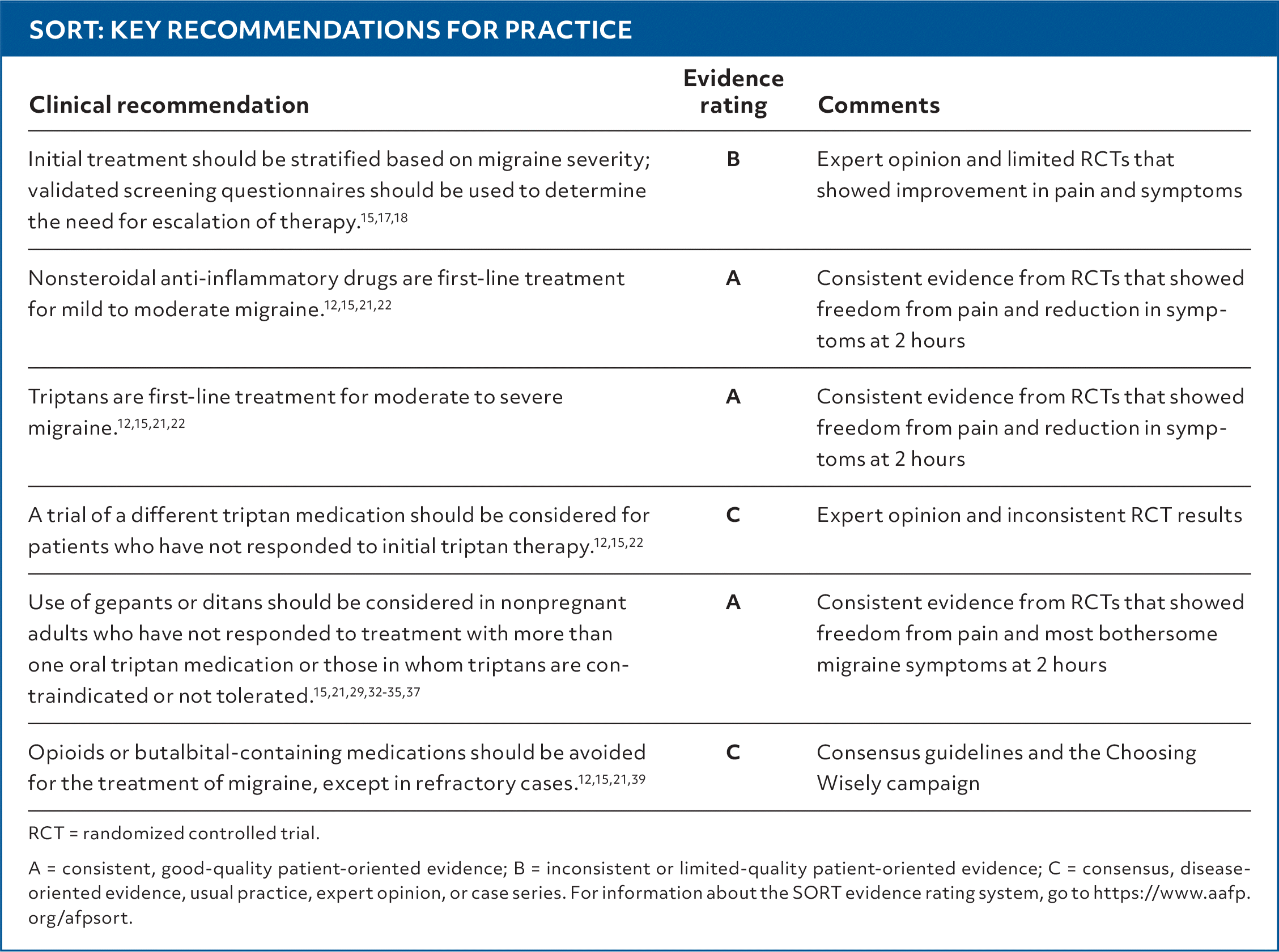
Migraine is a primary headache disorder characterized by recurrent disabling attacks. Pharmacologic treatment of acute migraine episodes should be individualized based on route of administration, cost, contraindications, and adverse effects. Stratifying treatment based on migraine severity may result in more rapid resolution of symptoms and return of function. Simple analgesics, such as acetaminophen and nonsteroidal anti-inflammatory drugs, are first-line treatments for mild to moderate migraine episodes, and triptans are first-line therapy for moderate to severe attacks. Antiemetics and ergot alkaloids are recommended as second-line agents and in cases of refractory migraine. Gepants and ditans are promising newer agents that are supported by quality evidence for second-line use. Unlike triptans and ergot alkaloids, gepants and ditans do not have vascular contraindications. The use of these medications is largely limited by cost, although the adverse effects of ditans also may limit their use. Opioids and butalbital-containing medications are not recommended for the treatment of migraine unless other options have been ineffective. There is insufficient evidence to recommend nonpharmacologic therapies, such as neuromodulatory devices, acupuncture, and greater occipital nerve blocks, but these therapies may be appropriate for select patients.

ANNA T. WILEY, MD, FAAFP, is a hospitalist at Mercy Hospital, Council Bluffs, Iowa. At the time this article was written, she was a faculty physician in the Department of Family Medicine at the Uniformed Services University of the Health Sciences, Offut Air Force Base, Nebraska.

JAMES C. WATSON, MD, FAAFP, is an assistant professor in the Department of Family Medicine at the University of Nebraska Medical Center, Omaha. At the time this article was written, he was an assistant professor at the Uniformed Services University of the Health Sciences.

DELANEY N. LEHMANN, DO, is a resident in the Department of Family Medicine at the University of Nebraska Medical Center.

Address correspondence to Anna T. Wiley, MD, FA AFP, at anna.t.wiley.md@gmail.com.

Author disclosure: No relevant financial relationships.

  1. 1.Fan L, Wu Y, Wei J, et al. Global, regional, and national time trends in incidence for migraine, from 1990 to 2019: an age-period-cohort analysis for the GBD 2019. J Headache Pain. 2023;24(1):79.
  2. 2.Bonafede M, Sapra S, Shah N, et al. Direct and indirect healthcare resource utilization and costs among migraine patients in the United States. Headache. 2018;58(5):700-714.
  3. 3.Peters GL. Migraine overview and summary of current and emerging treatment options. Am J Manag Care. 2019;25(suppl 2):S23-S34.
  4. 4.Burch R, Rizzoli P, Loder E. The prevalence and impact of migraine and severe headache in the United States: figures and trends from government health studies. Headache. 2018;58(4):496-505.
  5. 5.Mayans L, Walling A. Acute migraine headache: treatment strategies. Am Fam Physician. 2018;97(4):243-251.
  6. 6.Viera AJ, Antono B. Acute headache in adults: a diagnostic approach. Am Fam Physician. 2022;106(3):260-268.
  7. 7.Headache Classification Committee of the International Headache Society (IHS). The International Classification of Headache Disorders, 3rd edition. Cephalalgia. 2018;38(1):1-211.
  8. 8.Gilmore B, Michael M. Treatment of acute migraine headache. Am Fam Physician. 2011;83(3):271-280.
  9. 9.Detsky ME, McDonald DR, Baerlocher MO, et al. Does this patient with headache have a migraine or need neuroimaging? JAMA. 2006;296(10):1274-1283.
  10. 10.Ebell MH. Diagnosis of migraine headache. Am Fam Physician. 2006;74(12):2087-2088.
  11. 11.Martin VT, Feoktistov A, Solomon GD. A rational approach to migraine diagnosis and management in primary care. Ann Med. 2021;53(1):1979-1990.
  12. 12.US Department of Veterans Affairs and US Department of Defense. Management of headache. Updated November 8, 2024. Accessed February 5, 2025. https://www.healthquality.va.gov/guidelines/Pain/headache/
  13. 13.Burch RC, Buse DC, Lipton RB. Migraine: epidemiology, burden, and comorbidity. Neurol Clin. 2019;37(4):631-649.
  14. 14.Marmura MJ. Triggers, protectors, and predictors in episodic migraine. Curr Pain Headache Rep. 2018;22(12):81.
  15. 15.Ailani J, Burch RC, Robbins MS; Board of Directors of the American Headache Society. The American Headache Society consensus statement: update on integrating new migraine treatments into clinical practice. Headache. 2021;61(7):1021-1039.
  16. 16.Becker WJ. Acute migraine treatment in adults. Headache. 2015;55(6):778-793.
  17. 17.Lipton RB, Stewart WF, Stone AM, et al.; Disability in Strategies of Care Study Group. Stratified care vs step care strategies for migraine: the Disability in Strategies of Care (DISC) Study: a randomized trial. JAMA. 2000;284(20):2599-2605.
  18. 18.Lipton RB, Stewart WF, Sawyer J, et al. Clinical utility of an instrument assessing migraine disability: the Migraine Disability Assessment (MIDAS) questionnaire. Headache. 2001;41(9):854-861.
  19. 19.Steiner TJ, Stovner LJ, Vos T, et al. Migraine is first cause of disability in under 50s: will health politicians now take notice? J Headache Pain. 2018;19(1):17.
  20. 20.Lipton RB, Fanning KM, Serrano D, et al. Ineffective acute treatment of episodic migraine is associated with new-onset chronic migraine. Neurology. 2015;84(7):688-695.
  21. 21.Halker Singh RB, VanderPluym JH, Morrow AS, et al. Acute treatments for episodic migraine. Comparative effectiveness review no. 239. Agency for Healthcare Research and Quality; December 2020. Accessed April 12, 2024. https://www.ncbi.nlm.nih.gov/books/NBK566246/
  22. 22.VanderPluym JH, Halker Singh RB, Urtecho M, et al. Acute treatments for episodic migraine in adults: a systematic review and meta-analysis. JAMA. 2021;325(23):2357-2369.
  23. 23.Khan ZZ, Ahmed U, Shahzad F, et al. Safety and efficacy of zavegepant in treating migraine: a systematic review. Cureus. 2023;15(7):e41991.
  24. 24.Lipton RB, Croop R, Stock DA, et al. Safety, tolerability, and efficacy of zavegepant 10 mg nasal spray for the acute treatment of migraine in the USA: a phase 3, double-blind, randomised, placebo-controlled multicentre trial. Lancet Neurol. 2023;22(3):209-217.
  25. 25.Ubrelvy (ubrogepant) [package insert]. Allergan, Inc.; 2019. Accessed March 20, 2024. https://www.accessdata.fda.gov/drugsatfda_docs/label/2019/211765s000lbl.pdf
  26. 26.Nurtec ODT (rimegepant) [package insert]. Biohaven Pharmaceuticals, Inc.; 2021. Accessed March 20, 2024. https://www.accessdata.fda.gov/drugsatfda_docs/label/2021/212728s006lbl.pdf
  27. 27.Vila-Pueyo M. Targeted 5-HT1F therapies for migraine. Neurotherapeutics. 2018;15(2):291-303.
  28. 28.Reyvow (lasmiditan) [package insert]. Eli Lilly and Company; 2022. Accessed March 20, 2024. https://pi.lilly.com/us/reyvow-uspi.pdf
  29. 29.Krege JH, Rizzoli PB, Liffick E, et al. Safety findings from phase 3 lasmiditan studies for acute treatment of migraine: results from SAMURAI and SPARTAN. Cephalalgia. 2019;39(8):957-966.
  30. 30.Lipton RB, Munjal S, Dodick DW, et al. Acute treatment of migraine with celecoxib oral solution: results of a randomized, placebo-controlled clinical trial. J Pain Res. 2021;14:549-560.
  31. 31.Messlinger K. The big CGRP flood - sources, sinks and signalling sites in the trigeminovascular system. J Headache Pain. 2018;19(1):22.
  32. 32.Huang T, Xu Y, Chen Y, et al. Efficacy and safety of calcitonin gene–related peptide antagonists in migraine treatment: a meta-analysis. Brain Behav. 2022;12(4):e2542.
  33. 33.Yang Y, Chen M, Sun Y, et al. Safety and efficacy of ubrogepant for the acute treatment of episodic migraine: a meta-analysis of randomized clinical trials. CNS Drugs. 2020;34(5):463-471.
  34. 34.Gao B, Yang Y, Wang Z, et al. Efficacy and safety of rimegepant for the acute treatment of migraine: evidence from randomized controlled trials. Front Pharmacol. 2020;10:1577.
  35. 35.Charles AC, Digre KB, Goadsby PJ, et al.; American Headache Society. Calcitonin gene–related peptide-targeting therapies are a first-line option for the prevention of migraine: an American Headache Society position statement update. Headache. 2024;64(4):333-341.
  36. 36.Zavzpret (zavegepant) [package insert]. Pfizer Labs; 2023. Accessed March 20, 2024. www.accessdata.fda.gov/drugsatfda_docs/label/2023/216386s000lbl.pdf
  37. 37.Marshall C, Torro J. Lasmiditan (Reyvow) for the treatment of acute migraine. Am Fam Physician. 2020;102(12):756-757.
  38. 38.Saper JR, Silberstein S. Pharmacology of dihydroergotamine and evidence for efficacy and safety in migraine. Headache. 2006;46(suppl 4):S171-S181.
  39. 39.Loder E, Weizenbaum E, Frishberg B, et al.; American Headache Society Choosing Wisely Task Force. Choosing wisely in headache medicine: the American Headache Society's list of five things physicians and patients should question. Headache. 2013;53(10):1651-1659.
  40. 40.Iljazi A, Chua A, Rich-Fiondella R, et al. Unrecognized challenges of treating status migrainosus: an observational study. Cephalalgia. 2020;40(8):818-827.
  41. 41.Kiarashi J, Jion Y, Giglio B, et al. Elective hospitalizations for intractable headache: outcomes and response predictors. Neurol Clin Pract. 2021;11(3):188-193.
  42. 42.Liu Y, Wang Y, Mi C, et al. Efficacy of acupuncture-related therapy for migraine: a systematic review and network meta-analysis. J Pain Res. 2024;17:1107-1132.
  43. 43.Ni X, Dong L, Tian T, et al. Acupuncture versus various control treatments in the treatment of migraine: a review of randomized controlled trials from the past 10 years. J Pain Res. 2020;13:2033-2064.
  44. 44.Ou MQ, Fan WH, Sun FR, et al. A systematic review and meta-analysis of the therapeutic effect of acupuncture on migraine. Front Neurol. 2020;11:596.
  45. 45.Linde K, Allais G, Brinkhaus B, et al. Acupuncture for the prevention of episodic migraine. Cochrane Database Syst Rev. 2016(6):CD001218.
  46. 46.Chowdhury D, Datta D, Mundra A. Role of greater occipital nerve block in headache disorders: a narrative review. Neurol India. 2021;69(suppl):S228-S256.
  47. 47.Cromb D, Grigoratos D. Acute treatment of migraine in children and adolescents: review of the American Academy of Neurology practice guideline update. Arch Dis Child Educ Pract Ed. 2021;106(6):358-361.
  48. 48.Tepper DE. Migraine in children. Headache. 2017;57(6):1021-1022.
  49. 49.Martin VT, Ahmed Z, Hochstetler HM, et al. Tolerability and safety of lasmiditan treatment in elderly patients with migraine: post hoc analyses from randomized studies. Clin Ther. 2021;43(6):1066-1078.
  50. 50.Headaches in pregnancy and postpartum: ACOG clinical practice guideline No. 3. Obstet Gynecol. 2022;139(5):944-972.
  51. 51.Saldanha IJ, Roth JL, Chen KK, et al. Management of primary headaches in pregnancy. Comparative effectiveness review no. 234. Agency for Healthcare Research and Quality; November 2020. Accessed April 11, 2024. https://www.ncbi.nlm.nih.gov/books/NBK564853/
  52. 52.Aukerman G, Knutson D, Miser WF. Management of the acute migraine headache. Am Fam Physician. 2002;66(11):2123-2131.

Copyright © 2026 by the American Academy of Family Physicians.

This content is owned by the AAFP. A person viewing it online may make one printout of the material and may use that printout only for his or her personal, non-commercial reference. This material may not otherwise be downloaded, copied, printed, stored, transmitted or reproduced in any medium, whether now known or later invented, except as authorized in writing by the AAFP. See permissions for copyright questions and/or permission requests.