

A 27-year-old man presented with a rash that was not painful or pruritic. During a haircut 4 days prior, clippers nicked the back of his neck. The first lesions appeared at this site. The rash then spread over the back of his neck and side of his face. Oral clindamycin, started 1 day prior, had not led to improvement. He did not have vision or hearing changes.
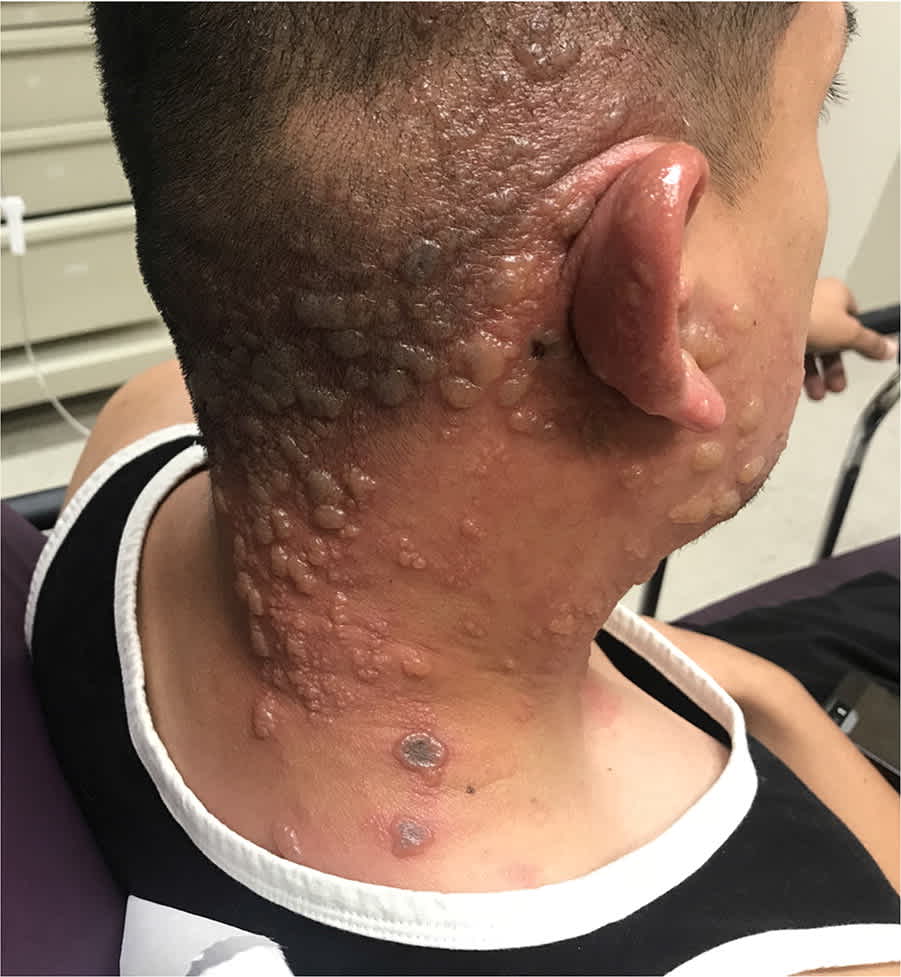
On examination, the patient was not in distress, and his vital signs were normal. A bullous, nonerythematous rash was present on his neck and face (Figure 1). The bullae were approximately 1 to 1.5 cm in diameter.
FIGURE 1
QUESTION
Based on the patient's history and physical examination, which one of the following is the most likely diagnosis?
- A. Bullous pemphigoid.
- B. Cutaneous anthrax.
- C. Herpes zoster.
- D. Primary herpes simplex virus infection.
DISCUSSION
The answer is D: primary herpes simplex virus (HSV) infection. HSV is a double-stranded DNA virus that enters the body through mucous membranes or damaged skin. An estimated 62% of adults in the United States are infected with HSV.1 When infected cells die, they release fluid intradermally, creating large vesicles filled with clear fluid. The vesicles typically occur on the oral mucous membranes or in the genital area. This patient was probably infected when the clippers nicked his skin. In primary infections, patients may also have fever, malaise, headache, and local lymphadenopathy. Without treatment, lesions resolve after 7 to 18 days.1
HSV infection can be diagnosed clinically; however, laboratory confirmation is recommended in primary infections. The diagnostic standard is viral culture or polymerase chain reaction testing for viral DNA. Samples should be taken from unroofed vesicles. A Tzanck test can also be used, but it has lower sensitivity and specificity vs polymerase chain reaction testing. Antibody testing is not useful for acute HSV infection, and positive results do not correlate with active infection.2
Three antiviral medications are approved by the US Food and Drug Administration for treatment of HSV infection: acyclovir, famciclovir, and valacyclovir. Treatment is most effective when started within 72 hours of rash onset.
Bullous pemphigoid is a chronic autoimmune skin reaction. It results in tense pruritic blisters that often rupture, leaving ulcers that may become infected. This rash is typically found over multiple locations, including the trunk and axillary and inguinal folds.3
Cutaneous anthrax occurs when Bacillus anthracis spores enter cut or abraded skin. A small painless papule forms then enlarges and progresses to a painless necrotic ulcer with black eschar.4
Herpes zoster (shingles) results from reactivation of dormant varicella-zoster virus. It generally involves a single or adjacent dermatomes. An erythematous rash progresses to grouped vesicles or bullae that become pustular and may cause a painful burning sensation. Long-term neuropathic pain is a potential complication.5
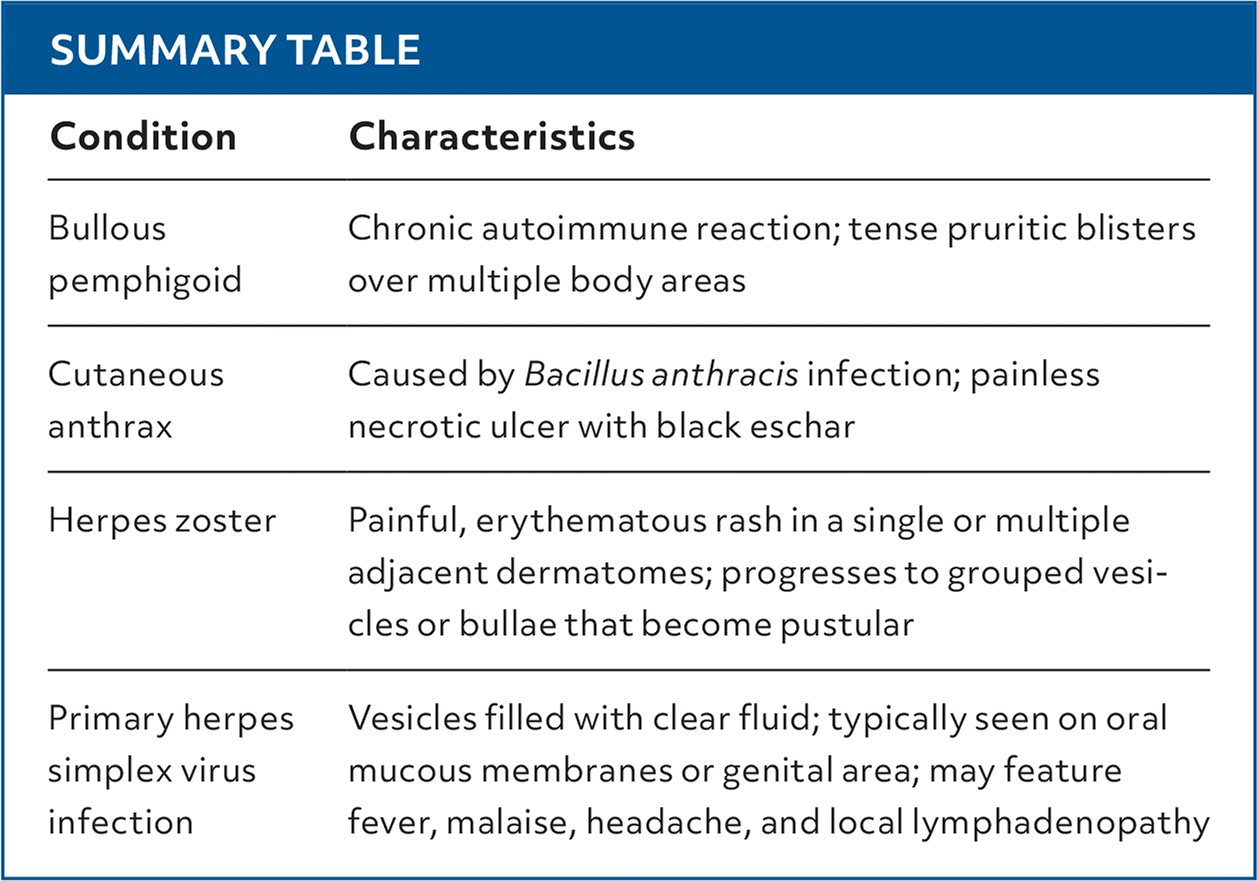
SUMMARY TABLE
| Condition | Characteristics |
|---|---|
| Bullous pemphigoid | Chronic autoimmune reaction; tense pruritic blisters over multiple body areas |
| Cutaneous anthrax | Caused by Bacillus anthracis infection; painless necrotic ulcer with black eschar |
| Herpes zoster | Painful, erythematous rash in a single or multiple adjacent dermatomes; progresses to grouped vesicles or bullae that become pustular |
| Primary herpes simplex virus infection | Vesicles filled with clear fluid; typically seen on oral mucous membranes or genital area; may feature fever, malaise, headache, and local lymphadenopathy |
Read the full article
Get immediate access, anytime, anywhere.
Choose a single article, issue, or full-access subscription.
Earn up to 14 CME credits per issue.
