Intimate Partner Violence

Elizabeth C. Halloran, PhD
Tiffany Fay Ho, MD, MPH

American Family Physician. 2025;112(1):62-71.

Author disclosure: No relevant financial relationships.

This clinical content conforms to AAFP criteria for CME.

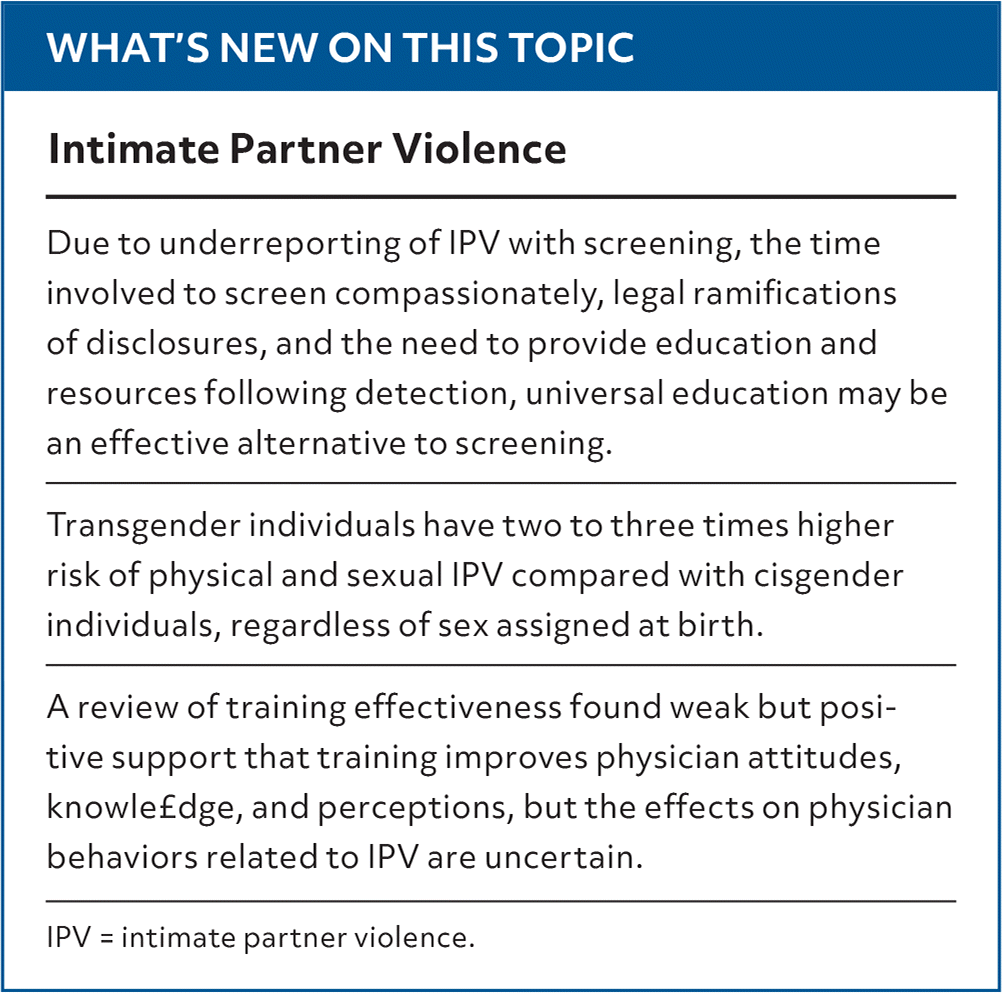
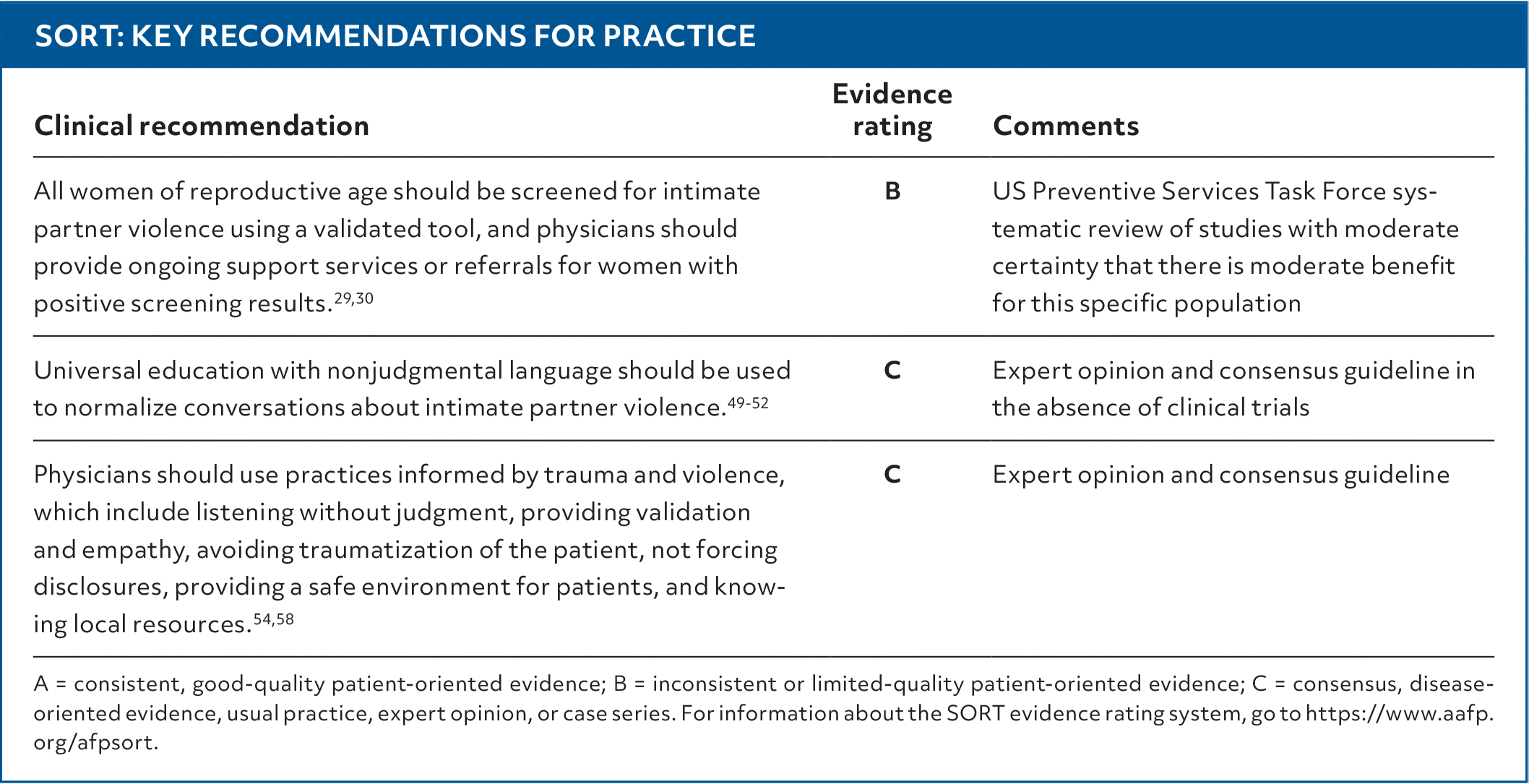
Intimate partner violence (IPV) is a significant and preventable public health problem defined as behavior by a romantic or sex partner that causes physical, sexual, or psychological harm. Although individuals of all gender identities experience IPV, women, especially those of reproductive age, are more likely to experience severe IPV. Patients who are from a rural area or are members of a historically marginalized population, such as immigrants, refugees, or the lesbian, gay, bisexual, transgender, queer, plus community, also have increased risk of IPV. Multiple negative physical and mental health outcomes are associated with IPV. Guidelines from the US Preventive Services Task Force and other organizations recommend screening women of reproductive age for IPV and recommend against universal screening. Universal education bypasses the need for disclosure of IPV and promotes normalizing conversations about IPV using nonjudgmental language while maintaining privacy and prioritizing resource provision. Universal education focuses on a patient-centered, trauma-informed approach that provides brief education, support, and referrals to services as desired; individuals can disclose IPV on their own terms.

ELIZABETH C. HALLORAN, PHD, is the director of behavioral sciences at the St. Vincent Family Medicine Residency Program, Bon Secours Mercy Health, Toledo, Ohio.

TIFFANY FAY HO, MD, MPH, FAAFP, is an assistant professor in the Department of Family and Preventive Medicine at the University of Utah School of Medicine, Salt Lake City, Utah.

Address correspondence to Elizabeth C. Halloran, PhD, at echalloran@mercy.com.

Author disclosure: No relevant financial relationships.

  1. 1.Leemis RW, Friar N, Khatiwada S, et al. The National Intimate Partner and Sexual Violence Survey: 2016/2017 Report on Intimate Partner Violence. National Center for Injury Prevention and Control, Centers for Disease Control and Prevention; 2022.
  2. 2.Jack SPD, Petrosky E, Lyons BH, et al. Surveillance for violent deaths — National Violent Death Reporting System, 27 states, 2015. MMWR Surveill Summ. 2018;67(11):1-32.
  3. 3.Peek-Asa C, Wallis A, Harland K, et al. Rural disparity in domestic violence prevalence and access to resources. J Womens Health (Larchmt). 2011;20(11):1743-1749.
  4. 4.Njie-Carr VPS, Sabri B, Messing JT, et al. Understanding intimate partner violence among immigrant and refugee women: a grounded theory analysis. J Aggress Maltreat Trauma. 2021;30(6):792-810.
  5. 5.Whitfield DL, Coulter RWS, Langenderfer-Magruder L, et al. Experiences of intimate partner violence among lesbian, gay, bisexual, and transgender college students: the intersection of gender, race, and sexual orientation. J Interpers Violence. 2021;36(11–12):NP6040-NP6064.
  6. 6.Peitzmeier SM, Malik M, Kattari SK, et al. Intimate partner violence in transgender populations: systematic review and meta-analysis of prevalence and correlates. Am J Public Health. 2020;110(9):e1-e14.
  7. 7.World Health Organization. Violence against women. March 25, 2024. Accessed May 30, 2024. https://www.who.int/news-room/fact-sheets/detail/violence-against-women
  8. 8.Finkelhor D, Turner HA, Shattuck A, et al. Prevalence of childhood exposure to violence, crime, and abuse: results from the National Survey of Children's Exposure to Violence. JAMA Pediatr. 2015;169(8):746-754.
  9. 9.Victor BG, Rousson AN, Henry C, et al. Child protective services guidelines for substantiating exposure to domestic violence as maltreatment and assigning caregiver responsibility: policy analysis and recommendations. Child Maltreat. 2021;26(4):452-463.
  10. 10.White SJ, Sin J, Sweeney A, et al. Global prevalence and mental health outcomes of intimate partner violence among women: a systematic review and meta-analysis. Trauma Violence Abuse. 2024;25(1):494-511.
  11. 11.Spencer CN, Khalil M, Herbert M, et al. Health effects associated with exposure to intimate partner violence against women and childhood sexual abuse: a burden of proof study. Nat Med. 2023;29(12):3243-3258.
  12. 12.Howell KH, Barnes SE, Miller LE, et al. Developmental variations in the impact of intimate partner violence exposure during childhood. J Inj Violence Res. 2016;8(1):43-57.
  13. 13.Thackeray J, Livingston N, Ragavan MI, et al.; Council on Child Abuse and Neglect. Council on Injury, Violence, and Poison Prevention. Intimate partner violence: role of the pediatrician. Pediatrics. 2023;152(1):e2023062509.
  14. 14.Tsavoussis A, Stawicki SPA, Stoicea N, et al. Child-witnessed domestic violence and its adverse effects on brain development: a call for societal self-examination and awareness. Front Public Health. 2014;2:178.
  15. 15.Penti B, Timmons J, Adams D. The role of the physician when a patient discloses intimate partner violence perpetration: a literature review. J Am Board Fam Med. 2018;31(4):635-644.
  16. 16.Lutgendorf MA. Intimate partner violence and women's health. Obstet Gynecol. 2019;134(3):470-480.
  17. 17.Miller E, McCaw B. Intimate partner violence. N Engl J Med. 2019;380(9):850-857.
  18. 18.Keynejad R, Baker N, Lindenberg U, et al. Identifying and responding to domestic violence and abuse in healthcare settings. BMJ. 2021;373(1047).
  19. 19.Stubbs A, Szoeke C. The effect of intimate partner violence on the physical health and health-related behaviors of women: a systematic review of the literature. Trauma Violence Abuse. 2022;23(4):1157-1172.
  20. 20.Farahi N, McEachern M. Sexual assault of women. Am Fam Physician. 2021;103(3):168-176.
  21. 21.Dicola D, Spaar E. Intimate partner violence. Am Fam Physician. 2016;94(8):646-651.
  22. 22.Campbell J, Matoff-Stepp S, Velez ML, et al. Pregnancy-associated deaths from homicide, suicide, and drug overdose: review of research and the intersection with intimate partner violence. J Womens Health (Larchmt). 2021;30(2):236-244.
  23. 23.Ehrensaft MK, Cohen P, Brown J, et al. Intergenerational transmission of partner violence: a 20-year prospective study. J Consult Clin Psychol. 2003;71(4):741-753.
  24. 24.American Academy of Family Physicians. Intimate partner violence. Accessed January 3, 2025. https://www.aafp.org/about/policies/all/intimate-partner-violence.html
  25. 25.American Academy of Family Physicians. Violence (position paper). Accessed January 3, 2025. https://www.aafp.org/about/policies/all/violence-position-paper.html
  26. 26.Dichter ME, Ogden SN, Tuepker A, et al. survivors' input on health care-connected services for intimate partner violence. J Womens Health (Larchmt). 2021;30(12):1744-1750.
  27. 27.O'Doherty L, Hegarty K, Ramsay J, et al. Screening women for intimate partner violence in healthcare settings. Cochrane Database Syst Rev. 2015(7):CD007007.
  28. 28.World Health Organization. Caring for women subjected to violence: a WHO curriculum for training health-care providers, revised edition, 2021. November 25, 2021. Accessed June 11, 2024. https://www.who.int/publications-detail-redirect/9789240039803
  29. 29.Curry SJ, Krist AH, Owens DK, et al. Screening for intimate partner violence, elder abuse, and abuse of vulnerable adults: US Preventive Services Task Force final recommendation statement. JAMA. 2018;320(16):1678-1687.
  30. 30.US Preventive Services Task Force. Intimate partner violence and caregiver abuse of older or vulnerable adults: screening. Updated October 29, 2024. Accessed November 10, 2024. https://www.uspreventiveservicestaskforce.org/uspstf/draft-update-summary/intimate-partner-violence-abuse-older-vulnerable-adults
  31. 31.ACOG Committee Opinion No. 518: intimate partner violence. Obstet Gynecol. 2012;119(2 pt 1):412-417.
  32. 32.US Institute of Medicine Committee on Preventive Services for Women. Clinical Preventive Services for Women: Closing the Gaps. National Academies Press; 2011.
  33. 33.US Department of Health and Human Services; Office for Civil Rights. Disclosures for public health activities. 45 CFR 164.512(b). Updated April 3, 2003. Accessed November 10, 2024. https://www.hhs.gov/hipaa/for-professionals/privacy/guidance/disclosures-public-health-activities/index.html
  34. 34.Thomas I. Against the mandatory reporting of intimate partner violence. Virtual Mentor. 2009;11(2):137-140.
  35. 35.Futures Without Violence. Compendium of state and US territory statutes and policies on domestic violence and health care. Accessed May 5, 2025. https://ipvhealth.org/wp-content/uploads/2019/09/Compendium-4th-Edition-2019-Final-small-file.pdf
  36. 36.Resource Center on Domestic Violence. Child Protection and Custody. Child abuse and exposure to domestic violence - definitions. Accessed January 4, 2025. https://rcdvcpc.org/map-child-abuse-and-exposure-to-domestic-violence-definitions.html
  37. 37.Messing JT, Campbell JC, Snider C. Validation and adaptation of the danger assessment-5: a brief intimate partner violence risk assessment. J Adv Nurs. 2017;73(12):3220-3230.
  38. 38.Danger Assessment-5 (DA-5) brief risk assessment for clinicians. Accessed April 30, 2025. https://static1.squarespace.com/static/635a1360b5d4b729bdb834f2/t/63c986f93728f36346abefb2/1674151673152/DV+Danger+Assessments.pdf
  39. 39.Sohal H, Eldridge S, Feder G. The sensitivity and specificity of four questions (HARK) to identify intimate partner violence: a diagnostic accuracy study in general practice. BMC Fam Pract. 2007;8:49.
  40. 40.Iverson KM, King MW, Gerber MR, et al. Accuracy of an intimate partner violence screening tool for female VHA patients: a replication and extension. J Trauma Stress. 2015;28(1):79-82.
  41. 41.Feltner C, Wallace I, Berkman N, et al. Screening for intimate partner violence, elder abuse, and abuse of vulnerable adults: an evidence review for the U.S. Preventive Services Task Force. Agency for Healthcare Research and Quality; 2018.
  42. 42.Rossi FS, Wu J, Timko C, et al. A clinical decision support tool for intimate partner violence screening among women veterans: development and qualitative evaluation of provider perspectives. JMIR Form Res. 2024;8:e57633.
  43. 43.Trabold N, King PR, Crasta D, et al. Leveraging integrated primary care to enhance the health system response to IPV: moving toward primary prevention primary care. Int J Environ Res Public Health. 2023;20(9):5701.
  44. 44.Portnoy GA, Colon R, Gross GM, et al. Patient and provider barriers, facilitators, and implementation preferences of intimate partner violence perpetration screening. BMC Health Serv Res. 2020;20(1):746.
  45. 45.Dichter ME, Makaroun L, Tuepker A, et al. Middle-aged women's experiences of intimate partner violence screening and disclosure: “It's a private matter. It's an embarrassing situation”. J Gen Intern Med. 2020;35(9):2655-2661.
  46. 46.Iverson KM, Adjognon O, Grillo AR, et al. Intimate partner violence screening programs in the Veterans Health Administration: informing scale-up of successful practices. J Gen Intern Med. 2019;34(11):2435-2442.
  47. 47.Portnoy GA, Iverson KM, Haskell SG, et al. A multisite quality improvement initiative to enhance the adoption of screening practices for intimate partner violence into routine primary care for women veterans. Public Health Rep. 2021;136(1):52-60.
  48. 48.Feder G, Davies RA, Baird K, et al. Identification and Referral to Improve Safety (IRIS) of women experiencing domestic violence with a primary care training and support programme: a cluster randomised controlled trial. Lancet. 2011;378(9805):1788-1795.
  49. 49.Implementing universal education strategies on domestic violence in Head Start programs. Updated February 21, 2025. Accessed May 5, 2025. https://headstart.gov/publication/implementing-universal-education-strategies-domestic-violence-head-start-programs
  50. 50.CommonSpirit Health, HEAL Trafficking, Pacific Survivor Center. PEARR tool: trauma-informed approach to victim assistance in healthcare settings. Accessed June 13, 2024. https://healtrafficking.org/resources/pearr-tool/
  51. 51.McKay TE, Kan ML, Landwehr J, et al. When disclosure isn't the goal: exploring responses to partner violence victimization screening and universal education among youth and adults. J Fam Violence. 2022;37(3):487-504.
  52. 52.National Academies of Sciences, Engineering, and Medicine. Essential Health Care Services Addressing Intimate Partner Violence. National Academies Press, 2024. Accessed May 13, 2025. https://www.ncbi.nlm.nih.gov/books/NBK605470
  53. 53.Bair-Merritt MH, Lewis-O'Connor A, Goel S, et al. Primary care-based interventions for intimate partner violence: a systematic review. Am J Prev Med. 2014;46(2):188-194.
  54. 54.Wathen CN, Mantler T. Trauma- and violence-informed care: orienting intimate partner violence interventions to equity. Curr Epidemiol Rep. 2022;9(4):233-244.
  55. 55.Scheer JR, Poteat VP. Trauma-informed care and health among LGBTQ intimate partner violence survivors. J Interpers Violence. 2021;36(13–14):6670-6692.
  56. 56.Futures Without Violence. CUES: an evidence-based intervention. Accessed June 13, 2024. https://ipvhealth.org/health-professionals/educate-providers/
  57. 57.Futures Without Violence. Prepare your health practice to support survivors of intimate partner violence. Accessed June 13, 2024. https://ipvhealth.org/health-professionals/prepare/
  58. 58.US Center for Substance Abuse Treatment. Trauma-Informed Care in Behavioral Health Services. US Substance Abuse and Mental Health Services Administration; 2014. Accessed May 13, 2025. http://www.ncbi.nlm.nih.gov/books/NBK207201/
  59. 59.Anyikwa VA. Trauma-informed approach to survivors of intimate partner violence. J Evid Inf Soc Work. 2016;13(5):484-491.
  60. 60.Ginwright S. The future of healing: shifting from trauma informed care to healing centered engagement. May 31, 2018. Accessed January 12, 2025. https://ginwright.medium.com/the-future-of-healing-shifting-from-trauma-informed-care-to-healing-centered-engagement-634f557ce69c
  61. 61.Trabold N, McMahon J, Alsobrooks S, et al. A systematic review of intimate partner violence interventions: state of the field and implications for practitioners. Trauma Violence Abuse. 2020;21(2):311-325.
  62. 62.Rivas C, Ramsay J, Sadowski L, et al. Advocacy interventions to reduce or eliminate violence and promote the physical and psychosocial well-being of women who experience intimate partner abuse. Cochrane Database Syst Rev. 2015(12):CD005043.
  63. 63.Hameed M, O'Doherty L, Gilchrist G, et al. Psychological therapies for women who experience intimate partner violence. Cochrane Database Syst Rev. 2020(7):CD013017.
  64. 64.Renner LM, Wang Q, Logeais ME, et al. Health care providers' readiness to identify and respond to intimate partner violence. J Interpers Violence. 2021;36(19–20):9507-9534.
  65. 65.Kalra N, Hooker L, Reisenhofer S, et al. Training healthcare providers to respond to intimate partner violence against women. Cochrane Database Syst Rev. 2021(5):CD012423.
  66. 66.Sohal AH, Feder G, Boomla K, et al. Improving the healthcare response to domestic violence and abuse in UK primary care: interrupted time series evaluation of a system-level training and support programme. BMC Med. 2020;18(1):48.
  67. 67.Cronholm PF, Fogarty CT, Ambuel B, et al. Intimate partner violence. Am Fam Physician. 2011;83(10):1165-1172.
  68. 68.Eyler AE, Cohen M. Case studies in partner violence. Am Fam Physician. 1999;60(9):2569-2576.

Copyright © 2026 by the American Academy of Family Physicians.

This content is owned by the AAFP. A person viewing it online may make one printout of the material and may use that printout only for his or her personal, non-commercial reference. This material may not otherwise be downloaded, copied, printed, stored, transmitted or reproduced in any medium, whether now known or later invented, except as authorized in writing by the AAFP. See permissions for copyright questions and/or permission requests.