

A 35-year-old woman presented with generalized hair thinning and hair loss that had begun 1 month prior. She was generally healthy but reported chronic constipation and anxiety. About 1 month prior, her sertraline dose had been increased from 50 to 100 mg. She did not braid her hair, wear tight ponytails, or use restrictive hair bands. She did not have recent illness, lightheadedness, menorrhagia, arthralgias, weight gain, rash, or personal or family history of autoimmune conditions.
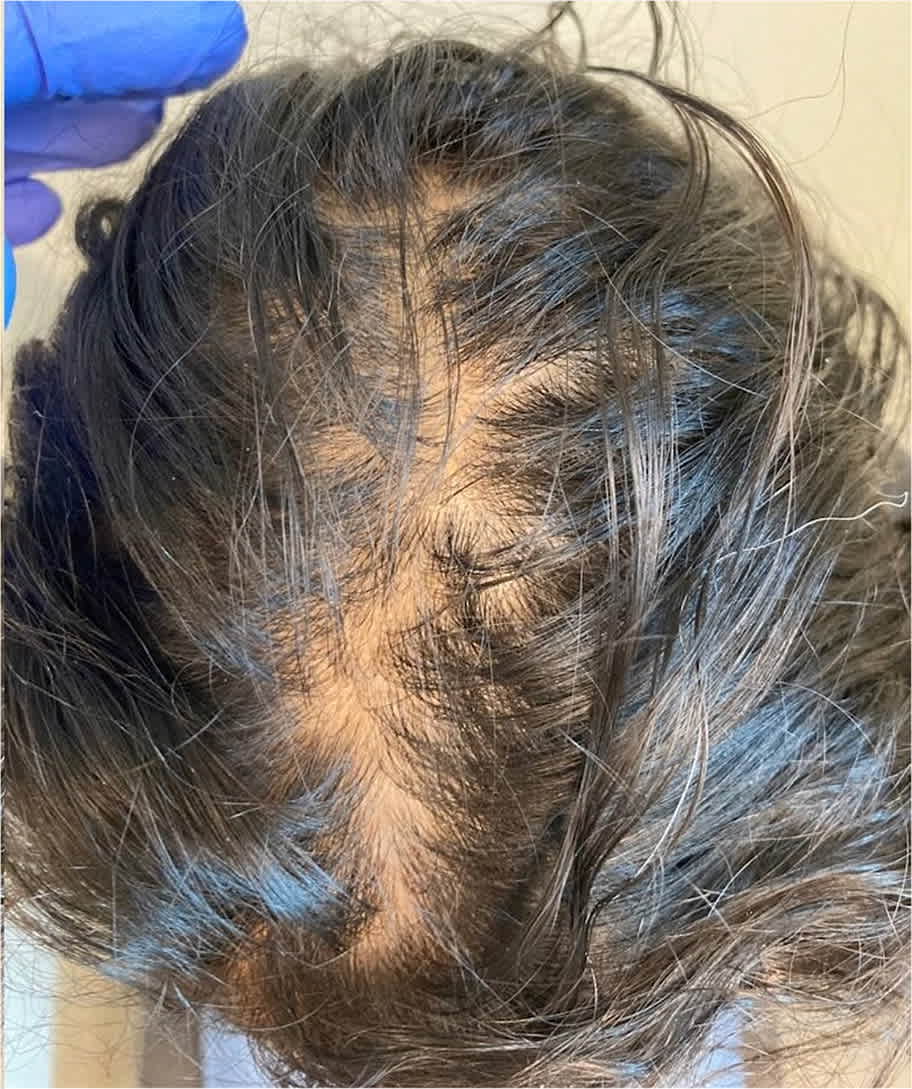
Her vital signs were normal. Physical examination revealed diffuse hair thinning across the scalp (Figure 1). No broken hairs, rash, scaling, or scarring were present. A hair pull test was positive for hair loss. The patient had no noticeable facial hair.
FIGURE 1
QUESTION
Based on the patient's history and physical examination, which one of the following is the most likely diagnosis?
- A. Alopecia areata.
- B. Androgenic alopecia.
- C. Telogen effluvium.
- D. Traction alopecia.
DISCUSSION
The answer is C: telogen effluvium, the second most common cause of nonscarring hair loss after androgenic alopecia. In telogen effluvium, large swathes of hair follicles transition from the anagen phase to the telogen (resting) phase of the growth cycle. This is typically caused by an internal or environmental stressor; however, many cases of telogen effluvium are idiopathic.
Patients typically present with hair shedding, which they notice while brushing or washing their hair. Physical examination shows diffuse hair thinning without scarring, in addition to a positive hair pull test result. A hair pull test is performed by gently gripping a small bundle of hairs between the fingers, applying gentle traction, and sliding the fingers along the hair shafts. The test result is considered positive when more than 10% of the hairs become plucked from the scalp.1
Causes of telogen effluvium include physical or psychological stress, endocrine disorders, chronic nutritional deficiencies, and certain medications.2 Medications associated with telogen effluvium include angiotensin-converting enzyme inhibitors, beta blockers, anticonvulsants, anticoagulants, hormonal contraceptives, chemotherapy, lithium, and selective serotonin reuptake inhibitors (SSRIs) such as sertraline.2–5 Although uncommon, the contribution of SSRIs to drug-induced hair loss is significant due to how often they are prescribed.6 Laboratory testing is indicated to rule out metabolic causes of telogen effluvium, such as thyroid disease and chronic iron deficiency.2
Treatment includes removing the offending factor, reassuring the patient, and awaiting hair regrowth. The patient in this scenario experienced hair regrowth within several weeks of discontinuing sertraline.
Alopecia areata is a nonscarring autoimmune form of hair loss characterized by patchy alopecia. The patches can become confluent. All the hair may be lost, leading to alopecia areata totalis (baldness). A hallmark physical examination finding is “exclamation mark” hairs. These are broken-off, club-shaped hairs; the distal ends are larger than the proximal ends of the hair shafts.2
Androgenic alopecia is a nonscarring form of hair loss related to androgenic effects on genetically predisposed hair follicles.2 The condition is more common in men. In women, this type of hair loss is often confined to the vertex of the scalp.
Traction alopecia occurs when physical stress on hair follicles leads to hair loss. Causes include use of wigs, hair extensions, or tight braids. Hair regrowth occurs with removal of the stressor.
Read the full article
Get immediate access, anytime, anywhere.
Choose a single article, issue, or full-access subscription.
Earn up to 14 CME credits per issue.
