

A 6-year-old boy presented after waking up with swelling of his forehead and bilateral eyelids. He had not experienced recent falls, trauma, or travel. The patient had not been outdoors in the previous 24 hours, but it was unclear whether he had any insect bites. He had a history of nonverbal autism.
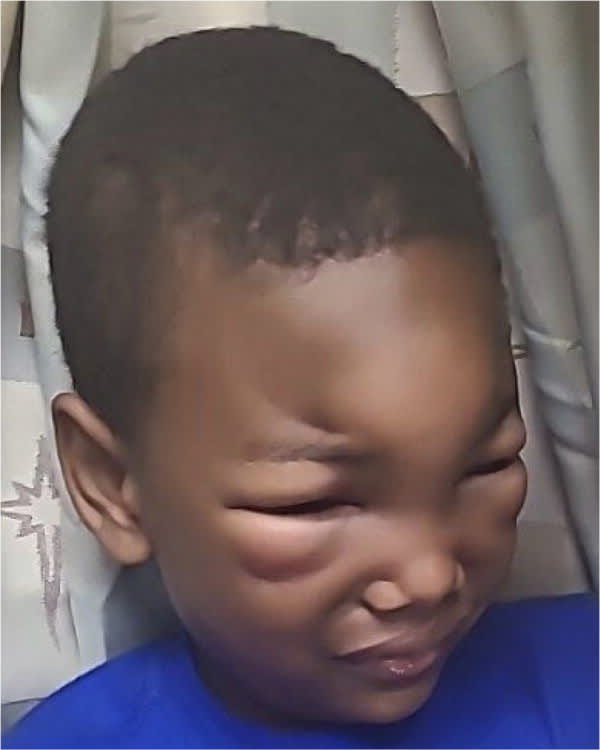
Physical examination confirmed swelling in the center of his forehead that was soft, nonfluctuant, mildly tender, and approximately 10 cm in diameter (Figure 1). The area was not pruritic and showed no indication of injury or insect bite. The patient had significant symmetrical periorbital edema but no discharge or erythema around the eyes. His extraocular movements were intact, and he had no proptosis, fever, shortness of breath, or rhinorrhea.
FIGURE 1
QUESTION
Based on the patient's history and physical examination, which one of the following is the most likely diagnosis?
- A. Allergic reaction to insect bite.
- B. Bacterial rhinosinusitis.
- C. Blunt forehead trauma.
- D. Cellulitis.
- E. Pott puffy tumor.
DISCUSSION
The answer is A: allergic reaction to insect bite. Due to the significant swelling on presentation, the pinpoint lesion suggestive of an insect bite was not apparent until after the patient received an oral antihistamine. Insect bites can cause a large local reaction, especially in children. In a normal immune response, peak swelling usually occurs within 20 minutes. With a large local reaction, swelling is usually progressive and peaks within 8 to 12 hours. Both forms of reaction have a good prognosis. Large local reactions can cover extensive areas in children, such as the entire face or a complete extremity.
Diagnosis is clinical based on history and physical examination findings. A large local reaction to a mosquito bite typically causes minimal pain, whereas Hymenoptera stings (eg, bees, hornets) are more painful. Local reactions must be distinguished from anaphylactic reactions to the venom of stinging insects, which should be promptly treated with intramuscular epinephrine. Treatment for a large local reaction involves nonsedating antihistamines, including cetirizine or loratadine. For severe reactions that are distressing or interfering with daily function, prednisone for 5 to 7 days should be considered. Stingers should be removed because they can cause foreign body reactions.1–3
Bacterial rhinosinusitis presents with symptoms such as fever, rhinorrhea, congestion, and sinus tenderness. Untreated cases in children can lead to complications, including preseptal and orbital cellulitis. Preseptal cellulitis is a soft tissue infection anterior to the orbital septum, leading to swelling of the eyelids. Orbital cellulitis is a more severe soft tissue infection posterior to the orbital septum, which leads to proptosis and ophthalmoplegia, and may cause vision loss. Orbital and preseptal cellulitis both commonly result from bacterial sinusitis, but preseptal cellulitis can also be an extension of adjacent cellulitis.4,5
Minor blunt forehead trauma may cause a prominent hematoma (goose egg). Swelling often decreases within hours but may take up to 1 week to completely resolve. Most minor blunt head traumas in children 2 years and older with normal neurologic examination findings do not cause clinically important traumatic brain injuries. Prompt neuroimaging should be performed in any child with a Glasgow Coma Scale score of 14 or less, palpable skull fracture, signs of basilar skull fracture, posttraumatic seizure, bulging fontanelle, or concern for abuse. Computed tomography without contrast or magnetic resonance imaging can detect clinically important traumatic brain injuries.6
Read the full article
Get immediate access, anytime, anywhere.
Choose a single article, issue, or full-access subscription.
Earn up to 14 CME credits per issue.
