

A 32-year-old man presented with a rash in his right axilla that had developed 7 days earlier. The patient described intense pruritus and discomfort in the affected area. He had no recent exposure to swimming pools or any new medications or products such as deodorants or body washes. Before the onset of symptoms, the patient had engaged in prolonged “armpit eating” with a sex partner. This involved the partner’s mouth, tongue, and teeth touching the patient’s axillary vault.
The patient had poorly controlled HIV that was diagnosed in 2017 and had recently started highly active antiretroviral therapy. He was evaluated 3 days earlier in an emergency department and was prescribed clotrimazole 1% cream, which provided no relief.
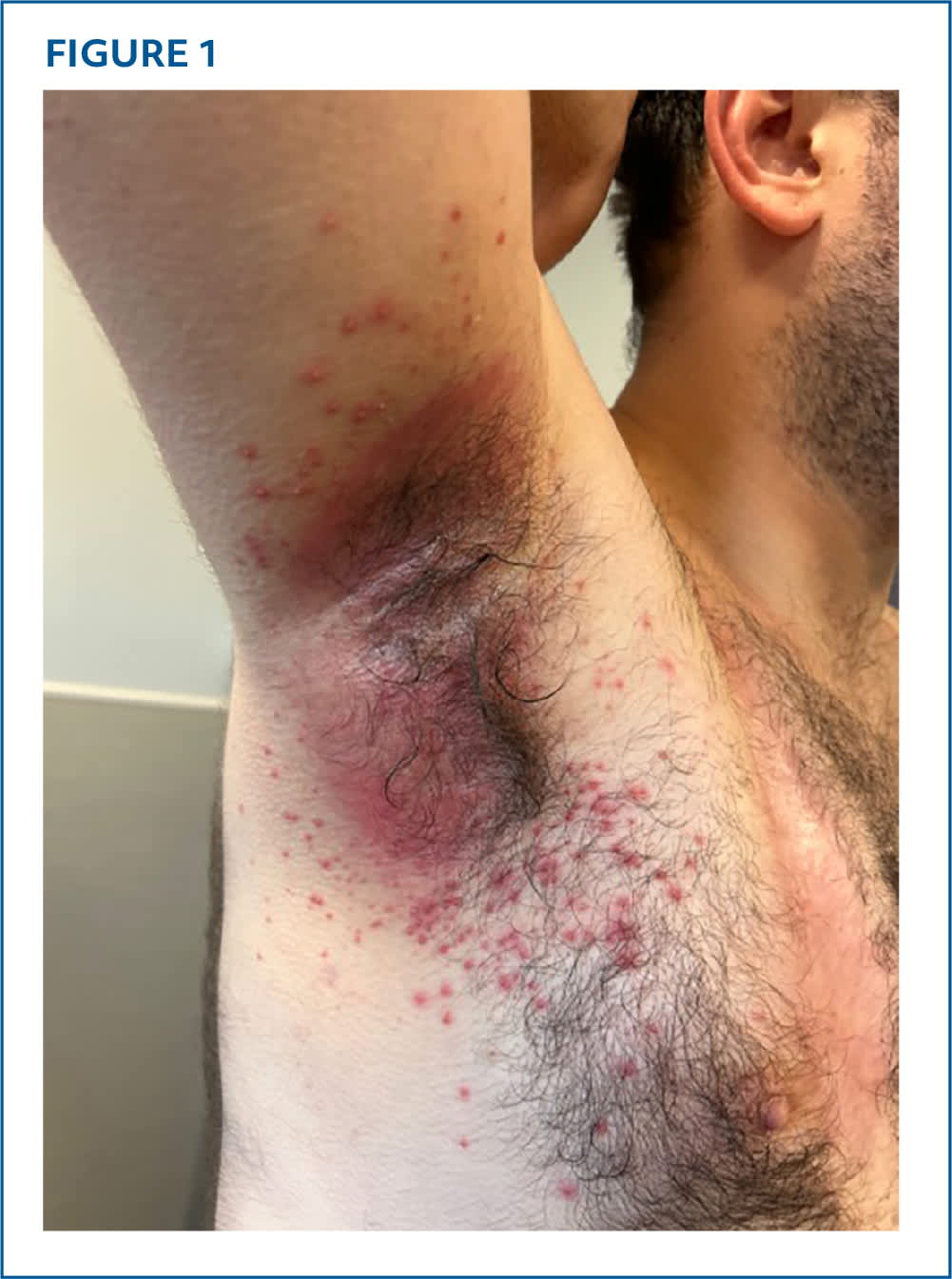
Physical examination revealed a large erythematous plaque with surrounding papules and pustules in the right axilla (Figure 1). The rash was tender and boggy to palpation but had no scaling or discharge.
FIGURE 1
QUESTION
Based on the patient’s history and physical examination, which one of the following is the most likely diagnosis?
A. Axillary folliculitis.
B. Candidal intertrigo.
C. Contact dermatitis.
D. Erythrasma.
E. Hidradenitis suppurativa.
DISCUSSION
The answer is B: candidal intertrigo. Intertrigo is a common superficial inflammatory skin condition that primarily affects the flexural surfaces of the body, such as the axillae, groin, and inframammary areas.1 The condition can lead to secondary infections, most commonly from Candida species, which thrive in these warm, moist environments.1
Intertrigo is caused by friction between adjacent skin surfaces, which leads to localized irritation and warmth. Moisture accumulation, particularly from sweating, macerates the stratum corneum, compromises the skin barrier, and increasing susceptibility to infection. Normal skin flora, including bacteria and yeast, can overgrow in these conditions, leading to candidal intertrigo.1
Candida albicans is part of the normal flora in the skin in approximately 70% of healthy individuals, but it can become pathogenic under certain conditions, particularly in immunocompromised individuals.2 Patients with HIV have a higher risk of candidal infections, as well as developing resistance to treatment and infection recurrence and complications. More than 90% of patients with HIV present with some form of candidiasis during their disease course. Immunosuppression secondary to HIV warrants early escalation of topical or oral treatment to resolve candidal infections.1
Clinically, intertrigo presents with pruritus, burning, and discomfort in affected skin folds.1 Initial examination typically reveals mildly erythematous patches and plaques, often with maceration, that can progress to overlying erosions, fissures, crusting, and weeping. The presence of satellite papules or pustules suggests a candidal infection.3 Candidal intertrigo can be confirmed by hyphae or budding yeast on microscopy of a skin scraping treated with potassium hydroxide 20% solution.1
Initial treatment consists of topical antifungals such as imidazoles, allylamines, or ciclopirox. When topical therapy is not effective, oral antifungals such as fluconazole or itraconazole are warranted.3
Axillary folliculitis is characterized by inflammation or infection of the hair follicles that causes erythematous papules or pustules.4 Symptoms include mild pain and pruritus.5 In this case, the large solitary erythematous plaque and surrounding pustules without direct follicular involvement made this diagnosis unlikely.
Read the full article
Get immediate access, anytime, anywhere.
Choose a single article, issue, or full-access subscription.
Earn up to 14 CME credits per issue.
