


FUNDED CONTENT BY WILEY
CME Quiz available at https://medicaleducation.focus.wiley.com/content/major-depressive-disorder
John Wiley & Sons, Inc. is accredited by the Accreditation Council for Continuing Medical Education to provide continuing medical education for physicians.
John Wiley & Sons, Inc. designates this enduring activity for a maximum of 0.5 AMA Category 1 Credit(s)™. Physicians should claim only the credit commensurate with the extent of their participation in the enduring activity.
This grant-funded resource is made available by the AAFP to provide convenient access to information that may be of interest. It should not be considered an AAFP endorse-ment or recommendation of the grantor’s products, services, policies, or procedures. Journal editors were not involved in the development of this content.
This activity is supported by an independent educational grant from Johnson & Johnson Innovative Medicine.
Learning Objectives
- Consistently use and interpret validated screening tools (e.g., PHQ-9, HADS-D) to improve diagnostic accuracy for major depressive disorder (MDD) and reduce reliance on subjective clinical judgment in primary care.
- Differentiate MDD from other psychiatric and medical conditions (e.g., bipolar disorder, dysthymia, hypothyroidism, adjustment disorder) and determine when specialist referral is warranted.
Overview and Screening Methodology
Introduction and Overview
Major depressive disorder (MDD) is a common, chronic psychiatric condition and one of the leading contributors to disability worldwide, affecting individuals across all age groups and health care settings.1
MDD affects approximately 10% to 15% of individuals globally during their lifetime, with adult prevalence in the US closer to 9% and higher rates among adolescents and young adults.1,2
The burden of MDD extends well beyond emotional suffering. Depression is associated with impaired functioning in one's occupation and daily activity, diminished quality of life, increased health care utilization, and reduced workplace productivity.3 The economic burden of MDD in the US rose from $333.7 billion in 2019 to more than $381 billion during the pandemic (a 14.3% increase) driven by health care expenditures and mortality related costs.3 Depression also commonly coexists with chronic medical illnesses (e.g., cardiovascular disease, diabetes, other physical disorders) creating bidirectional effects that complicate management and worsen outcomes.4
Primary care physicians (PCPs) are uniquely positioned to identify depression early, initiate treatment, coordinate care, and facilitate referral when appropriate. Many patients do not recognize symptoms such as fatigue, poor concentration, or loss of interest as depression, so PCPs are frequently the first clinicians to identify these undifferentiated presentations. Because mental health concerns now comprise an increasing proportion of primary care encounters,5 improving diagnostic accuracy remains a critical component of comprehensive patient care and in preventing the clinical and functional deterioration associated with delayed intervention.6
Screening for MDD
Why Systematic Screening Matters
Early identification of MDD is associated with improved clinical trajectories. The landmark STAR*D study demonstrated that early achievement of remission (i.e., near-complete symptom resolution), rather than mere response (a clinically meaningful reduction in symptom severity), is a key determinant of longer-term outcomes (6 to 8 weeks).7 Systematic screening, rather than opportunistic or intuition-based case finding, is the foundation for achieving this goal in busy primary care environments.
The US Preventive Services Task Force (USPSTF) recommends screening all adults for depression but does not define an optimal interval, citing insufficient evidence.8 Practical anchors fill this gap: Screen every patient at least once, use annual screening as a workable default, and screen more frequently in higher-risk patients, such as those with chronic medical illness or a prior depressive episode, and pregnant or postpartum patients (at postpartum and well-child visits). Adequate systems should be in place to ensure accurate diagnosis, effective treatment, and appropriate follow-up.8 Despite this recommendation, real-world implementation remains inconsistent. There is significant variability in how systematically and completely screenings are carried out.9
Validated Screening Tools: PHQ-9 and HADS-D
Numerous depression rating scales are available, including the Hamilton Depression Rating Scale (HDRS) and Beck Depression Inventory-II (BDI-II). Nonetheless, for routine primary care screening, the Patient Health Questionnaire-9 (PHQ-9) has the strongest evidence base within current guidelines and implementation studies, with Hospital Anxiety and Depression Scale–Depression sub-scale (HADS-D) serving as a useful alternative in selected medical populations.10,11
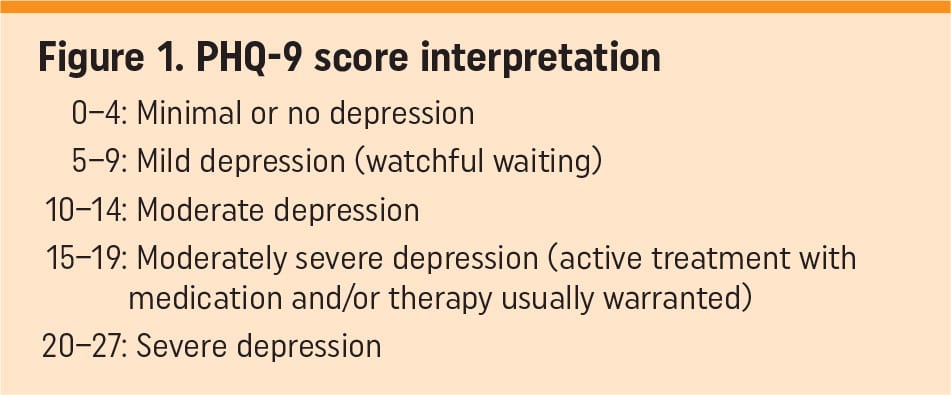
The PHQ-9 is the most widely used and extensively validated screening tool for MDD in primary care and takes less than 5 minutes to complete. A systematic review confirmed good sensitivity and specificity for identifying major depression, and its nine-item structure maps directly onto Diagnostic and Statistical Manual of Mental Disorders (DSM)-5-TR symptom criteria, facilitating both detection and severity monitoring (Figure 1).10 An affirmative response on Item 9 (suicidality) warrants immediate risk assessment regardless of the total score and flags risk that warrants follow-up.
Figure 1.
The HADS-D is a validated alternative and, as its items are designed to minimize confounding by somatic symptoms, is particularly useful in patients with comorbid physical illness. A systematic review and meta-analysis found that a HADS-D threshold of 8 or higher yielded good sensitivity for identifying major depression across diverse clinical populations.11 PHQ-9 items on sleep, appetite, energy, and concentration overlap with symptoms of chronic illness (e.g., cancer, chronic kidney disease, recovery after myocardial infarction), which can inflate scores and lower specificity in medically ill patients. The HADS-D omits somatic items for this reason.
Practical guidance for PCPs: Both tools should be administered consistently across institutions and scored systematically, not selectively applied based on clinical intuition alone. These instruments support rather than replace clinical diagnosis. Positive screens must be followed by a structured clinical interview to confirm diagnosis, assess severity and suicidality, and rule out alternative explanations. Documentation of results facilitates longitudinal monitoring of treatment response.12
Addressing the Subjectivity Gap
A barrier to accurate identification of MDD in primary care settings is overreliance on subjective clinical judgment without a more systematic assessment that can be afforded by these brief rating scales. Incomplete symptom assessment that relies only on presenting complaints without a comprehensive review of all symptoms and supportive use of validated rating scales can contribute to missed diagnoses and inappropriate interventions.13
Diagnosis and Differential Diagnosis
DSM-5-TR Criteria for MDD
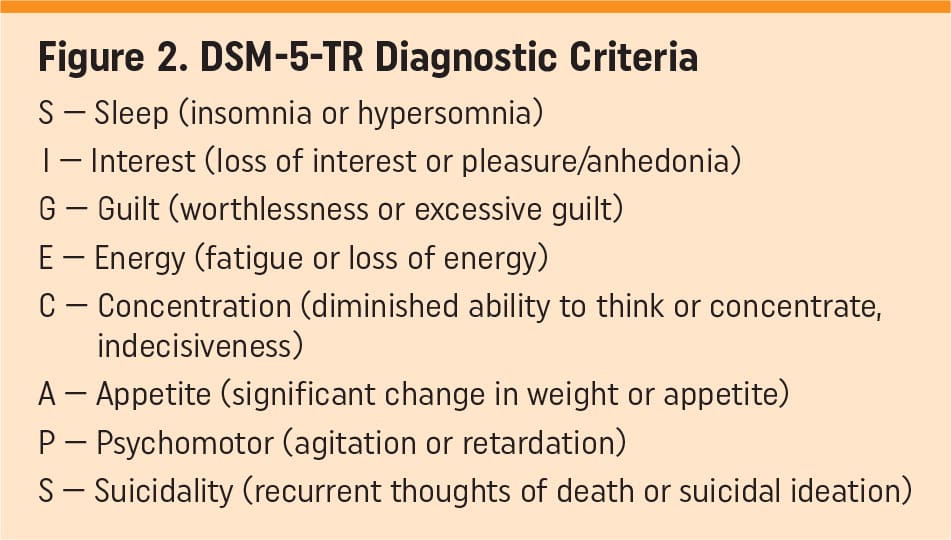
Formal diagnosis of MDD requires the presence of five or more of nine DSM-5-TR-defined symptom criteria that must include either depressed mood or loss of interest/pleasure (anhedonia) different from prior functioning as one of the symptoms during the same 2-week period.14 Figure 2 summarizes the DSM-5-TR symptom criteria using the SIG E CAPS mnemonic.14 To meet criteria for MDD, the identified symptoms must cause clinically significant distress or functional impairment and must not be attributable to a substance or another medical condition. Severity specifiers (i.e., mild, moderate, severe) and clinical features such as melancholic or psychotic features carry implications for treatment selection.15
Figure 2.
Limitations of Clinical Interview Alone
While the standard clinical interview (i.e., history, examination, and review of systems) remains central to diagnosis, its accuracy is influenced by the clinician's familiarity with DSM-5-TR criteria, the patient's ability to articulate and recall symptoms, and the time available in the clinical encounter. Underdiagnosis is common with somatic or fatigue-predominant presentations, while overdiagnosis can occur when depressive symptoms stem from acute stressors or other psychiatric conditions.16
Key Conditions in the Differential Diagnosis
Bipolar disorder can be missed in acutely depressed patients when the previous history is unknown. It may be the most consequential alternative diagnosis because antidepressant monotherapy without mood stabilization in a patient with unrecognized bipolar disorder can precipitate manic symptoms.17 A careful longitudinal history, including prior episodes of elevated mood, grandiosity, decreased need for sleep, or impulsive behavior, is essential.
Dysthymia (persistent depressive disorder) shares many features with MDD but is distinguished by its chronicity (depressed mood present for at least 2 years) at a lower average severity. Patients may describe their mood as “always” depressed, with fewer discrete episodes. Double depression, in which MDD episodes are superimposed on a dysthymic baseline, is clinically important to recognize as it portends a more difficult treatment course.16
Hypothyroidism can also closely mimic MDD, presenting with fatigue, cognitive slowing, psychomotor retardation, depressed mood, and weight gain. Measurement of thyroid-stimulating hormone (TSH), often with free T4, is commonly recommended to exclude hypothyroidism as a contributor to depressive symptoms, particularly since hypothyroidism may be subclinical.16
Anxiety disorders frequently co-occur with MDD and can complicate both diagnosis and management. Comorbid generalized anxiety disorder (GAD), for example, is associated with greater functional impairment and reduced quality of life compared to MDD alone.18 Careful symptom mapping is required to determine whether anxiety is primary, secondary to depression, or independently comorbid.
Adjustment disorder presents within 3 months of an identifiable stressor, falls short of full MDD criteria, and resolves within 6 months of the stressor resolving. Distinguishing it from MDD guides whether pharmacotherapy is warranted. Misclassifying it is a common primary care pitfall.16
Other medical conditions to consider include anemia, sleep disorders (including obstructive sleep apnea [OSA], which has a high comorbid depression rate), and vitamin deficiencies, such as vitamin D, B12, and folate, for which testing may be warranted if malnutrition is suspected.16,19
When to Refer
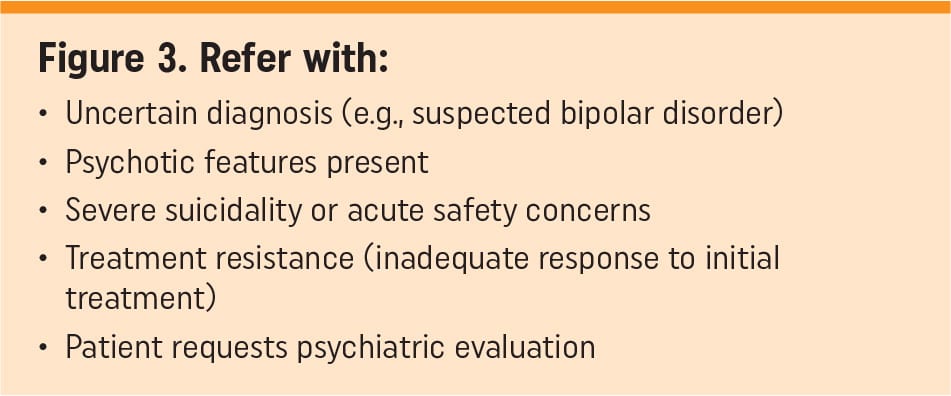
There are specific triggers for referral, which are outlined in Figure 3.6 Collaborative care models, in which mental health professionals (sometimes including social workers) work within the primary care setting, have demonstrated improved outcomes and are increasingly supported by evidence and health system infrastructure.20
The Horizon: Biomarkers and Neuroimaging
Ongoing research is evaluating biological adjuncts to clinical diagnosis (e.g., inflammatory biomarkers, neuroimaging signatures genetic profiling) as tools to improve diagnostic precision and predict treatment response. While none is yet recommended for routine clinical use, PCPs should be aware that this landscape is evolving and may eventually supplement current diagnostic approaches.1
Key Practice Points
Screen consistently: Apply the PHQ-9 (or other appropriate screening tool) systematically to all eligible patients, not selectively based on clinical impression alone.
Differentiate carefully: Conduct a thorough history to distinguish MDD from bipolar disorder, dysthymia, and other medical mimics (e.g., hypothyroidism) before initiating treatment.
Refer appropriately: Engage psychiatric and mental health specialist resources when diagnosis is uncertain, when safety concerns arise, or when initial treatment trials are inadequate.
Monitor and adjust: Use validated scales longitudinally to track treatment response, optimize therapy, and support individualized, evidence-based treatment and shared decision-making.
Disclaimers
This activity was reviewed in line with editorial integrity and publication ethics standards. Conflicts of interest were identified and resolved under John Wiley and Sons, Inc.’s Policy on Activity Disclosure and Conflict of Interest, primarily through review by an unconflicted expert. For accreditation information, contact cme@wiley.com.
Parts of this content were developed using Claude Opus 4.8 (July 2026) and reviewed and approved by the Wiley content strategist team, an external peer reviewer and faculty member. No clinical material was created using Claude or any other artificial intelligence.
This educational activity is supported by an independent medical educational grant from Johnson & Johnson Innovative Medicine.
Medical writing support was provided by Dr. M. James.
Dr. M. James previously received compensation from Promiss Diagnostics and PharmaBase for writing support unrelated to this manuscript; these relationships have ended.
All other planners and reviewers involved in the development of this activity declared no relevant financial relationships with ineligible companies.
The CME Bulletin is published by the American Academy of Family Physicians, 11400 Tomahawk Creek Parkway, Leawood, Kansas 66211-2680 • www.aafp.org
© 2026 John Wiley and Sons, Inc. All rights reserved. Reuse of this material is prohibited without the express written consent of John Wiley and Sons, Inc. In print and online: John Wiley and Sons, Inc., 111 River Street, Hoboken, NJ 07030-5774.