
Lymphedema care

Practical, evidence‑based tools to confidently manage cancer‑related lymphedema and support patients’ lifelong health and quality of life.
As cancer survivors transition from oncology to primary care, family physicians are increasingly responsible for delivering long-term follow-up care. Family physicians are integral to the continuum of cancer care—from prevention and screening to post-treatment surveillance and palliative care. However, many report uncertainty about their role in survivorship. This gap is particularly evident in the management of chronic treatment-related conditions such as cancer-related lymphedema.
The clinical guidance, educational materials and care coordination tools on this page support family physicians in their delivery of whole-person, longitudinal survivorship care—helping cancer survivors manage lymphedema, restore function, and reclaim quality of life.
This content was independently developed by the AAFP with support provided by Tactile Medical.
Assessment and diagnosis of lymphedema for post-cancer patients
Goal: Differentiate treatment-related lymphedema from disease recurrence and perform appropriate assessment and diagnosis of lymphedema for patients in the post-cancer stage
Identify and differentiate lymphedema from these other forms of edema
Secondary lymphedema is more common than the primary type.1 It typically develops after a disruption or obstruction of lymphatic pathways associated with a disease process, or following surgery or radiotherapy.
Lipedema is a chronic, often inherited disorder causing abnormal, painful and symmetrical fat accumulation.2 It occurs primarily in the legs and sometimes arms, while sparing the hands and feet.
The risk of lymphedema is the highest with surgical lymph node dissection, plus regional radiation therapy.3 It can develop days or decades after treatment. However, 80% of cases start within three years of surgery.4
Targeted history: cancer-specific triggers 5,6
- Surgical history: How many nodes were removed? (sentinel biopsy versus full dissection)
- Radiation fields: Has there been radiation to the axilla, supraclavicular or inguinal region?
Stemmer sign: Positive: Skin on the dorsal base of the second toe/middle finger cannot be pinched/lifted. This is highly specific for lymphedema.
Limb measurements: Measure circumference at standardized points (e.g., 10 cm above/below the olecranon or patella). Diagnostic threshold: a >2 cm difference between limbs or a 10% volume increase.
Skin changes: "Peaud’orange" (orange-peel texture), radiation dermatitis scars or new nodules near the surgical site.
Nodal exam: Palpate the regional node basin for new, hard or fixed masses.
Venous Doppler ultrasound to rule out DVT
Ankle-brachial index (ABI) must be >0.5 (ideally >0.8) before initiating compression therapy
If swelling is proximal or painful: Order CT or MRI of the chest/abdomen/pelvis to rule out tumor recurrence obstructing the lymphatic trunk
Gold standard mapping: Lymphoscintigraphy if diagnosis is unclear
Bioimpedance (BIS/L-Dex): If available, check for subclinical extracellular fluid changes
- Huffman GB. Evaluation and management of lymphedema. Am Fam Physician. 2001;64(8):1451-1452.
- Cifarelli V. Lipedema: Progress, challenges, and the road ahead. Obes Rev. 2025;26(10):e13953.
- Allam O, Park KE, Chandler L, et al. The impact of radiation on lymphedema: A review of the literature. Gland Surg. 2020;9(2):596-602.
- Lin WC, Safa B, Buntic RF. Approach to lymphedema management. Semin Plast Surg. 2022;36(4):260-273.
- Bakri NAC, Kwasnicki RM, Khan N, et al. Impact of axillary lymph node dissection and sentinel lymph node biopsy on upper limb morbidity in breast cancer patients: A systematic review and meta-analysis. Ann Surg. 2023;277(4):572-580.
- Riches P. What is lymphedema? MedicalNewsToday. Accessed May 5, 2026. www.medicalnewstoday.com/articles/180919
- Goss JA, Greene AK. Sensitivity and specificity of the Stemmer sign for lymphedema: A clinical lymphoscintigraphic study. PlastReconstr Surg Glob Open . 2019;7(6):e2295.
- Tanori-Tapia JM, Romero-Perez EM, Camberos NA, et al. Determination of the minimum detectable change in the total and segmental volumes of the upper limb, evaluated by perimeter measurements. Healthcare (Basel). 2020;8(3):285.
- Horbal SR, Chu SY, Wang NC, et al. Comparisons of manual tape measurement and morphomics measurement of patients with upper extremity lymphedema. PlastReconstr Surg Glob Open . 2019;7(10):e2431.
- Raja A, Karch J, Shih AF, et al. Part II: Cutaneous manifestations of peripheral vascular disease. J Am Acad Dermatol. 2022;89(2):211-226.
- Borman P. Lymphedema diagnosis, treatment, and follow-up from the view point of physical medicine and rehabilitation specialists. Turk J Phys MedRehabil . 2018;64(3):179-197.
- Ruela VHM, Bochl GS, Junior EAS. Lymphedema and lower limb edema: What do foot and ankle orthopedists need to know? A narrative review. J Foot Ankle. 2025;19(2):e1893.
- McClary KN, Massey P. Ankle brachial index. 2026. StatPearls Publishing. Treasure Island, FL.
- Moon T, O’Donnell TF, Weycker D, et al. Lymphoscintigraphy is frequently recommended but seldom used in a “real world setting.” JVasc Surg VenousLymphat Disord . 2023;12(2):101738.
- Vicini F, Shah C, Whitworth P, et al. Correlation of bioimpedance spectroscopy with risk factors for the development of breast cancer-related lymphedema. Lymphat Res Biol. 2018;16(6):533-537.
Complete decongestive therapy (CDT) of lymphedema for patients in the post-cancer stage
Goal: Coordinate complete decongestive therapy (CDT) and prevent complications of lymphedema for patients in the post-cancer stage
Gold standard: complete decongestive therapy1
Management is divided into two distinct phases. Family physicians should monitor progress through both.
Lymphedema creates a localized immunodeficiency.2 Cellulitis is a common and costly cause of hospital readmission in these patients.3,4
Early recognition: In lymphedema, cellulitis often lacks the typical "streaking."5 Look for a sudden increase in swelling, flu-like symptoms and patchy erythema. Educate patients on the signs of cellulitis and contact their family physician promptly if signs or symptoms occur.
Antibiotic choice: Coverage forStaphylococcus and Streptococcus.
Prophylaxis: Consider low-dose penicillin or cephalexin for patients with two or more episodes of cellulitis per year.
Reinforce these lifestyle modifications during every annual wellness visit:
Trauma prevention: No blood draws, IVs, or blood pressure cuffs on the affected limb. While evidence is evolving, the "better safe than sorry" rule remains the clinical standard.
Skin integrity: Daily moisturizing with low-pH lotion to prevent fissures.
Air travel: Patients should wear compression garments/sleeves during flights to counteract cabin pressure changes.
Weight management: Obesity is a primary driver of lymphatic load; weight loss can significantly improve drainage.
Limb volume increases by >10% despite treatment adherence.7
New, firm skin nodules or "weeping" of clear fluid (lymphorrhea).8
Failure of phase II maintenance (garments no longer fit or are worn out—typically every six months).
References
- Gultekin SC, Karadibak D, Cakir AB, et al. Self-administered versus lymphedema therapist-administered complex decongestive therapy protocol in breast cancer-related lymphedema: a non-inferiority randomized controlled trial with three-month follow-up. Breast Cancer Res Treat. 2025;212(1):123-138.
- Varghese SA. Secondary lymphedema: Pathogenesis. J Skin Sex Transm Dis. 2021;3(1):7-15.
- Pankayatselvan V, Vitarello J, Fitzgerald C, et al. Readmissions following cellulitis hospitalizations in patients with lymphedema: A nationwide cohort stud. J Am CollCardiol . 2021;77(18):suppl 1.
- Fisher JM, Feng JY, Tan SY, et al. Analysis of readmissions following hospitalization for cellulitis in the United States. JAMA Dermatol. 2019;155(6):720-723.
- Herchline TE, Swaminathan S, Chandrasekar PH. Cellulitis. Practice essentials. Medscape. December 30, 2024. Accessed May 11, 2026. https://emedicine.medscape.com/article/214222-overview
- Cemal Y, Pusic A, Mehrara BJ. Preventative measures for lymphedema: Separating fact from fiction. J Am Coll Surg. 2011;213(4):543-551.
- Armer JM, Ballman KV, McCall L, et al. Lymphedema symptoms and limb measurement changes in breast cancer survivors treated with neoadjuvant chemotherapy and axillary dissection: results of the ACOSOG Z1071 substudy. Support Care Cancer. 2018;27(2):495-503.
- Medical Education Partnership. International consensus. Best practice for the management of lymphedema. 2006. Accessed May 11, 2026. www.lympho.org/uploads/files/files/Best_practice.pdf
Goal: Use shared clinical decision-making (SCDM) to make collaborative decisions with patients for managing lymphedema in their post-cancer stage.
Lymphedema is a long-term condition, and different people can manage it in different ways. The right plan is the one that works best for you and your daily routine. After cancer surgery or radiation, the lymph system may not drain properly, leading to swelling in an arm or leg.1 Treatment can usually keep the swelling under control and reduce infections.
Use the information in this section to:
- Frame a structured, empathetic conversation with patients
- Help patients understand their treatment options
- Align treatment with daily function, goals and capacity to achieve goals
- Support documented SCDM
Key points about lymphedema for patients in the post-cancer stage1
Lymphedema can appear months or even years after cancer treatment.
Lymphedema is long-term, but manageable.
Early and consistent care improves health outcomes.
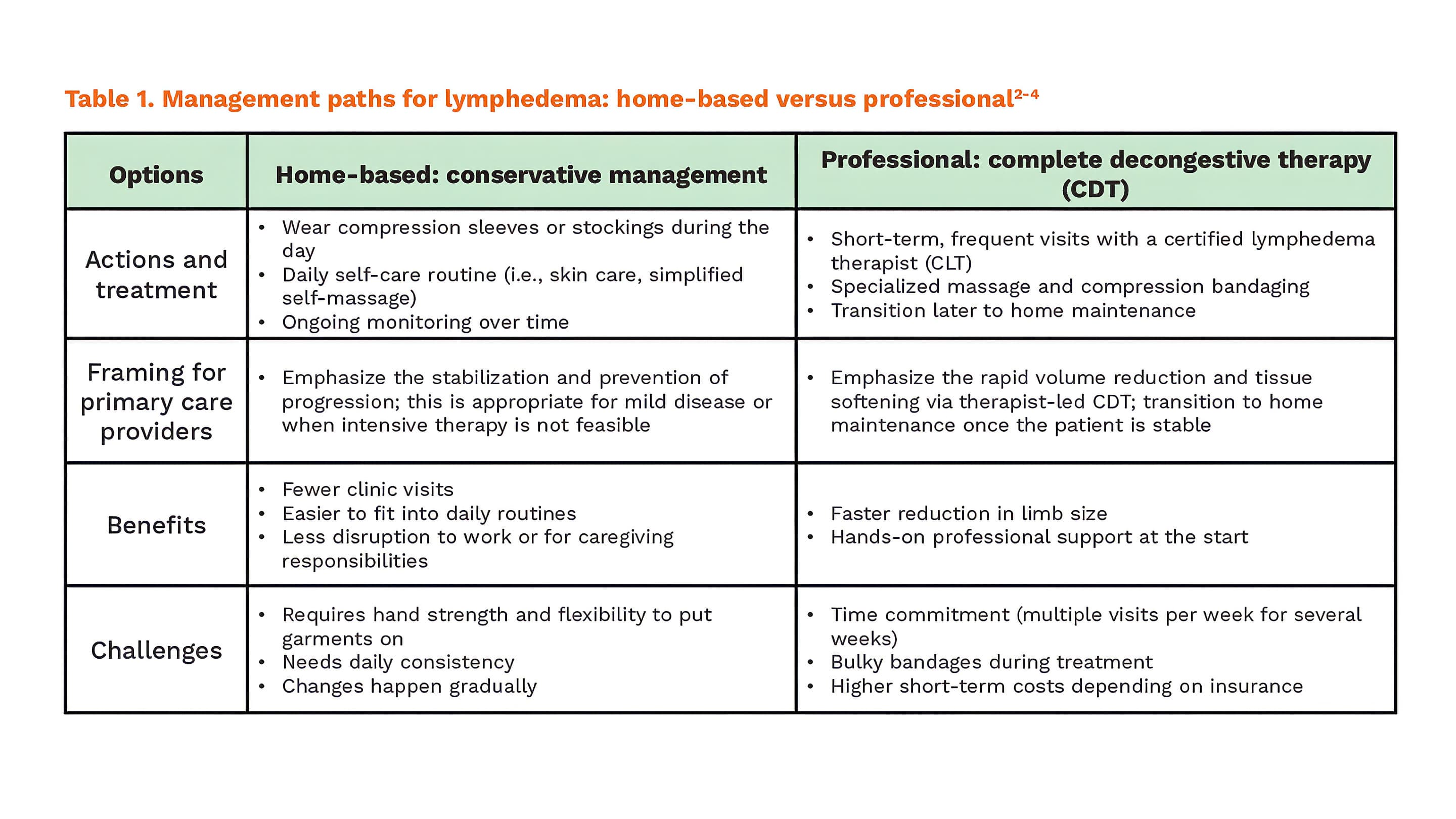
Schedule and logistics: “Do you currently have the time and transportation to attend therapy sessions several times a week?
Daily function: “Do you feel comfortable putting on a tight compression garment by yourself (or do you have assistance available) every day?”
Priorities: “Is your main goal to reduce the swelling as much as possible right now? What treatment will fit in with your current daily routine?”
Compression is not started during active infection.
Skin care is essential to prevent cellulitis.
Swelling may fluctuate over time.
Compression sleeves and garments typically need replacement approximately every three to six months.
Document: stage/severity (i.e., measurements), current management path (i.e., home-based versus CDT) and barriers (e.g., dexterity, transport, cost)
Counsel: chronicity, infection prevention and red flagsprompting urgent intervention
Plan: referral to CLT when indicated, follow-up interval and criteria for re-referral.
Prescription logistics: anticipate garment replacement and refit approximately every three to six months and renew prescriptions, as required.
- Nimmana BK, Kimyaghalam A, Manna B. Lymphedema. 2026. StatPearls Publishing. Treasure Island, FL.
- Bergmann A, Baiocchi JMT, Carvalho de Andrade MF. Conservative treatment of lymphedema: the state of the art. J Vasc Bras.
2021;20:e20200091. - Karaca-Mandic P, Solid CA, Armer JM, et al. Lymphedema self-care: economic cost savings and opportunities to improve adherence. Cost
Eff Resour Alloc. 2023;21:47. - Gultekin SC, Karadibak D, Cakir AB, et al. Self-administered versus lymphedema therapist-administered complex decongestive therapy
protocol in breast cancer-related lymphedema: a non-inferiority randomized controlled trial with three-month follow-up. Breast Cancer Res
Treat. 2025;212(1):123-138. - Schaverien MV, Moeller JA, Cleveland SD. Nonoperative treatment of lymphedema. Semin Plast Surg. 2018;32(1):17-21.
- Beck M. Compression sleeves and garments for lymphedema. March 7, 2024. Accessed May 11, 2026. https://www.breastcancer.org/
treatment-side-effects/lymphedema/treatments/compression-sleeves
Related resources
This content was independently developed by the American Academy of Family Physicians with support provided by Tactile Medical.
Patient resources
Use these patient-facing resources for Lymphedema on the AAFP’s patient education website FamilyDoctor.org to help patients not just understand common survivorship challenges and symptoms to monitor, but to also connect physical recovery with emotional well-being and daily quality of life.