Lower Extremity Abnormalities in Children

Drew C. Baird, MD
Caleb G. Dickison, DO
Hayley I. Spires, MD

American Family Physician. 2025;111(2):125-139.

Author disclosure: No relevant financial relationships.

This clinical content conforms to AAFP criteria for CME.

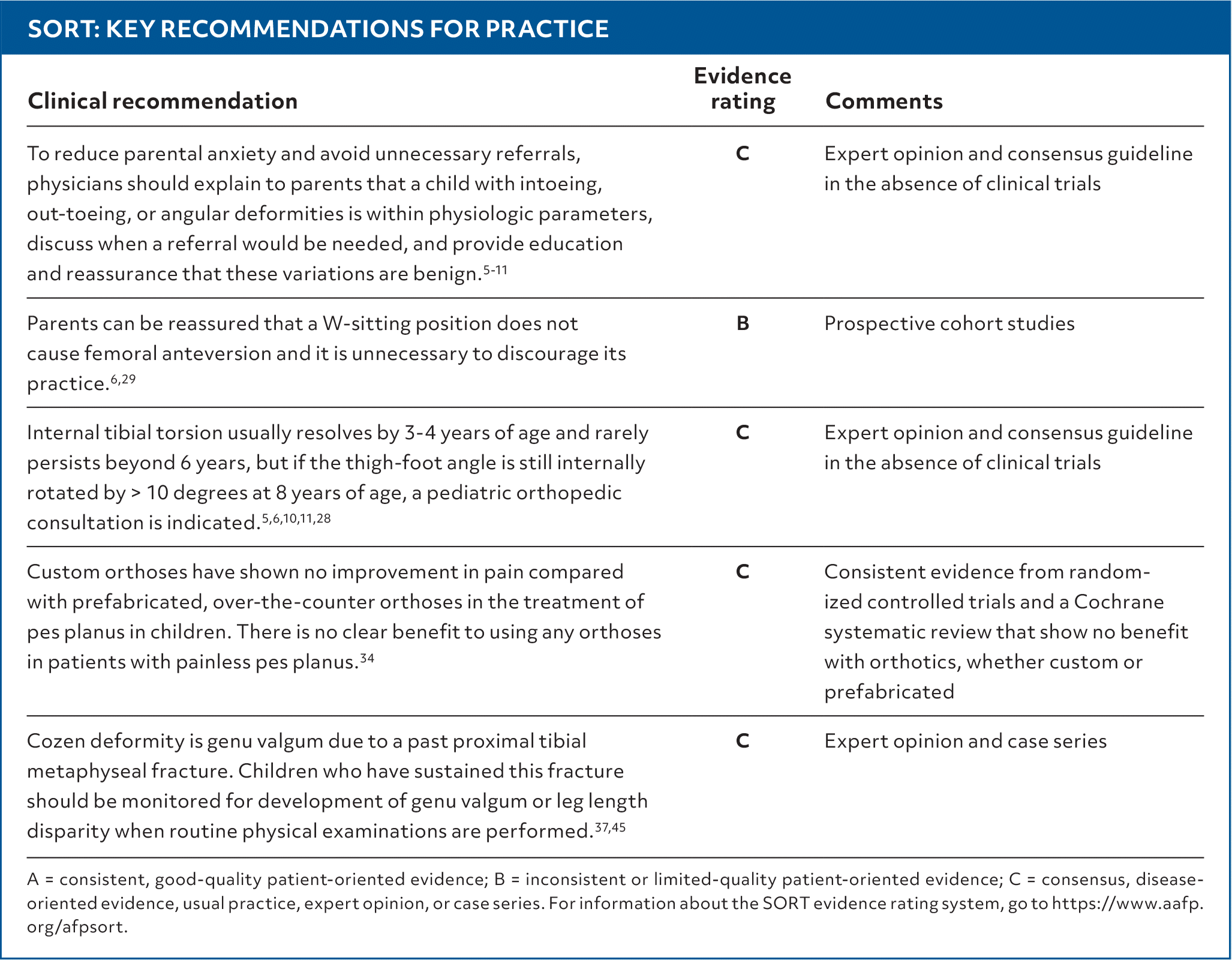
Rotational and angular variations of the lower extremities in children are common conditions seen in primary care. These visits are often due to parental concerns about the appearance of their child's lower extremities. Common variations include intoeing (metatarsus adductus, internal tibial torsion, and femoral anteversion); out-toeing (external tibial torsion, femoral retroversion, and pes planus); and angular variations (genu varum and genu valgum). History, particularly age of onset; duration; progression; appearance and impact; prenatal and birth history; nutritional deficiencies; growth and development; medical and family history of related disorders, including rheumatologic, autoimmune, or neurologic conditions, can help differentiate normal variations from true deformities. In addition to a routine physical examination, a focused examination measuring a variety of parameters, such as foot progression angle, internal and external hip rotation, thigh-foot angle, joint laxity, and other condition-specific tests should be performed. If an underlying cause is identified, it should be treated; however, these conditions typically do not require further evaluation or treatment if measurements are within age-related normal ranges and patients are asymptomatic, and parents can be reassured that they are benign. There is minimal evidence to support the use of orthotics or braces. Referral to a pediatric orthopedist should be considered when measurements are more than 2 standard deviations outside of normal values, children have pain, or function is affected.

DREW C. BAIRD, MD, FAAFP, is the director of medical education at Carl R. Darnall Army Medical Center, Fort Cavazos, Texas; an associate professor in the Department of Family Medicine at the Uniformed Services University of the Health Sciences School of Medicine, Bethesda, Maryland; and the associate site dean and affiliate adjunct clinical associate professor of Military Medicine at Texas A&M School of Medicine, College Station.

CALEB G. DICKISON, DO, CAQSM, RSMK, is core faculty at the Family Medicine Residency Program at Carl R. Darnall Army Medical Center, and an assistant professor in the Department of Family Medicine at the Uniformed Services University of the Health Sciences School of Medicine.

HAYLEY I. SPIRES, MD, is a family medicine staff physician at Blanchfield Army Community Hospital, Fort Campbell, Kentucky. At the time this article was written, she was the chief resident at the Family Medicine Residency Program at Carl R. Darnall Army Medical Center.

Address correspondence to Drew C. Baird, MD, FAAFP, at drewbaird2002@yahoo.com.

Author disclosure: No relevant financial relationships.

  1. 1.Schwend RM, Geiger J. Outpatient pediatric orthopedics. Common and important conditions. Pediatr Clin North Am. 1998;45(4):943-971.
  2. 2.Carli A, Saran N, Kruijt J, et al. Physiological referrals for paediatric musculoskeletal complaints: a costly problem that needs to be addressed. Paediatr Child Health. 2012;17(9):e93-e97.
  3. 3.Fallatah S, Felemban M, Farran A, et al. Awareness of common paediatric orthopaedic problems among paediatricians and family medicine physicians. J Taibah Univ Med Sci. 2018;13(4):338-343.
  4. 4.Hsu EY, Schwend RM, Julia L. How many referrals to a pediatric orthopaedic hospital specialty clinic are primary care problems? J Pediatr Orthop. 2012;32(7):732-736.
  5. 5.Sielatycki JA, Hennrikus WL, Swenson RD, et al. In-toeing is often a primary care orthopedic condition. J Pediatr. 2016;177:297-301.
  6. 6.Honig EL, Haeberle HS, Kehoe CM, et al. Pediatric orthopedic mythbusters: the truth about flexible flatfeet, tibial and femoral torsion, W-sitting, and idiopathic toe-walking. Curr Opin Pediatr. 2021;33(1):105-113.
  7. 7.Evans AM. Mitigating clinician and community concerns about children’s flatfeet, intoeing gait, knock knees or bow legs. J Paediatr Child Health. 2017;53(11):1050-1053.
  8. 8.Faulks S, Brown K, Birch JG. Spectrum of diagnosis and disposition of patients referred to a pediatric orthopaedic center for a diagnosis of intoeing. J Pediatr Orthop. 2017;37(7):e432-e435.
  9. 9.Scorcelletti M, Reeves ND, Rittweger J, et al. Femoral anteversion: significance and measurement. J Anat. 2020;237(5):811-826.
  10. 10.Kahf H, Kesbeh Y, van Baarsel E, et al. Approach to pediatric rotational limb deformities. Orthop Rev (Pavia). 2019;11(3):8118.
  11. 11.Lincoln TL, Suen PW. Common rotational variations in children. J Am Acad Orthop Surg. 2003;11(5):312-320.
  12. 12.Payares-Lizano M, Pino C. Pediatric orthopedic examination. Pediatr Clin North Am. 2020;67(1):1-21.
  13. 13.Gibson ME, Stork N. Gait disorders. Prim Care. 2021;48(3):395-415.
  14. 14.Rerucha CM, Dickison C, Baird DC. Lower extremity abnormalities in children. Am Fam Physician. 2017;96(4):226-233.
  15. 15.Thijs Y, Bellemans J, Rombaut L, et al. Is high-impact sports participation associated with bowlegs in adolescent boys? Med Sci Sports Exerc. 2012;44(6):993-998.
  16. 16.Kirby JC, Jones H, Johnson BL, et al. Genu valgum in pediatric patients presenting with patellofemoral instability. J Pediatr Orthop. 2024;44(3):168-173.
  17. 17.Sprouse C, Tosi L, Stapleton E, et al. Musculoskeletal anomalies in a large cohort of boys with 49, XXXXY. Am J Med Genet C Semin Med Genet. 2013;163C(1):44-49.
  18. 18.Davids JR, Fisher R, Lum G, et al. Angular deformity of the lower extremity in children with renal osteodystrophy. J Pediatr Orthop. 1992;12(3):291-299.
  19. 19.Voloc A, Esterle L, Nguyen TM, et al. High prevalence of genu varum/valgum in European children with low vitamin D status and insufficient dairy products/calcium intakes. Eur J Endocrinol. 2010;163(5):811-817.
  20. 20.Jackson JC, Runge MM, Nye NS. Common questions about developmental dysplasia of the hip. Am Fam Physician. 2014;90(12):843-850.
  21. 21.Rocca G, De Venuto A, Colasanto G, et al. Congenital metatarsus varus: early diagnosis and conservative treatment in 112 patients. Musculoskelet Surg. 2023;107(4):379-384.
  22. 22.Jamil K, Chew WY, Bohari NE, et al. Knee measurements among children with normal alignment, physiologic and pathologic bowing aged 0–3 years old: a systematic review. J Pediatr Orthop B. 2022;31(2):105-113.
  23. 23.Sass P, Hassan G. Lower extremity abnormalities in children. Am Fam Physician. 2003;68(3):461-468.
  24. 24.Harris E. The intoeing child: etiology, prognosis, and current treatment options. Clin Podiatr Med Surg. 2013;30(4):531-565.
  25. 25.Gonzales AS, Saber AY, Ampat G, et al. Intoeing. StatPearls [Internet]. Updated July 22, 2023. Accessed December 23, 2023. https://www.ncbi.nlm.nih.gov/books/NBK499993/
  26. 26.Wenger DR, Rang M. The Art and Practice of Children’s Orthopaedics. Raven Press; 1993.
  27. 27.Reeder BM, Lyne ED, Patel DR, et al. Referral patterns to a pediatric orthopedic clinic: implications for education and practice. Pediatrics. 2004;113(3 pt 1):e163-e167.
  28. 28.Ditmar MF, Roye BD. Orthopedics. In: Ditmar MF, Polin RA, eds. Pediatric Secrets 7th ed. Elsevier; 2021: 552–585.
  29. 29.Rethlefsen SA, Mueske NM, Nazareth A, et al. Hip dysplasia is not more common in W-sitters. Clin Pediatr (Phila). 2020;59(12):1074-1079.
  30. 30.Karimi M, Kavyani M, Tahmasebi R. Conservative treatment for metatarsus adductus, a systematic review of literature. J Foot Ankle Surg. 2022;61(4):914-919.
  31. 31.Banwell HA, Paris ME, Mackintosh S, et al. Paediatric flexible flat foot: how are we measuring it and are we getting it right? A systematic review. J Foot Ankle Res. 2018;11:21.
  32. 32.Morrison SC, Tait M, Bong E, et al. Symptomatic pes planus in children: a synthesis of allied health professional practices. J Foot Ankle Res. 2020;13:5.
  33. 33.Carr JB, Yang S, Lather LA. Pediatric pes planus: a state-of-the-art review. Pediatrics. 2016;137(3):e20151230.
  34. 34.Evans AM, Rome K, Carroll M, et al. Foot orthoses for treating paediatric flat feet. Cochrane Database Syst Rev. 2022(1):CD006311.
  35. 35.Rodriguez N, Choung DJ, Dobbs MB. Rigid pediatric pes planovalgus: conservative and surgical treatment options. Clin Podiatr Med Surg. 2010;27(1):79-92.
  36. 36.Schmaranzer F, Kallini JR, Ferrer MG, et al. How common is femoral retroversion and how is it affected by different measurement methods in unilateral slipped capital femoral epiphysis? Clin Orthop Relat Res. 2021;479(5):947-959.
  37. 37.Dobbe AM, Gibbons PJ. Common paediatric conditions of the lower limb. J Paediatr Child Health. 2017;53(11):1077-1085.
  38. 38.Mooney JF III. Lower extremity rotational and angular issues in children. Pediatr Clin North Am. 2014;61(6):1175-1183.
  39. 39.Passmore E, Graham HK, Pandy MG, et al. Hip- and patellofemoral-joint loading during gait are increased in children with idiopathic torsional deformities. Gait Posture. 2018;63:228-235.
  40. 40.Snow M. Tibial torsion and patellofemoral pain and instability in the adult population: current concept review. Curr Rev Musculoskelet Med. 2021;14(1):67-75.
  41. 41.Patel M, Nelson R. Genu valgum. StatPearls [Internet]. Updated May 29, 2023. Accessed December 23, 2023. https://www.ncbi.nlm.nih.gov/books/NBK559244/
  42. 42.Walker JL, Hosseinzadeh P, White H, et al. Idiopathic genu valgum and its association with obesity in children and adolescents. J Pediatr Orthop. 2019;39(7):347-352.
  43. 43.Dettling S, Weiner DS. Management of bow legs in children: a primary care protocol. J Fam Pract. 2017;66(5):E1-E6.
  44. 44.Bruce RW. Torsional and angular deformities. Pediatr Clin North Am. 1996;43(4):867-881.
  45. 45.Morin M, Klatt J, Stevens PM. Cozen’s deformity: resolved by guided growth. Strategies Trauma Limb Reconstr. 2018;13(2):87-93.
  46. 46.Cheng JC, Chan PS, Chiang SC, et al. Angular and rotational profile of the lower limb in 2,630 Chinese children. J Pediatr Orthop. 1991;11(2):154-161.
  47. 47.Sabharwal S. Blount disease: an update. Orthop Clin North Am. 2015;46(1):37-47.

Copyright © 2026 by the American Academy of Family Physicians.

This content is owned by the AAFP. A person viewing it online may make one printout of the material and may use that printout only for his or her personal, non-commercial reference. This material may not otherwise be downloaded, copied, printed, stored, transmitted or reproduced in any medium, whether now known or later invented, except as authorized in writing by the AAFP. See permissions for copyright questions and/or permission requests.