
Filling out ERAS® signals, geographic prefs & experiences

To maximize your chances of getting into your desired residency program, it’s vital to make the most of your Electronic Residency Application Service® (ERAS®) application.
Run by the Association of American Medical Colleges (AAMC), ERAS is the method by which all medical students submit their applications for residencies. Before you interview with residency programs, you’ll need to fill out your ERAS application, and three sections are of particular importance. They are:
Program signaling: Applicants can signal up to five family medicine residency programs to show their enthusiasm in matching there.
Geographic and setting preferences: Location interest features allow applicants to indicate their preferred training regions and/or community setting.
Past experiences: Applicants have the opportunity to highlight up to 10 meaningful life experiences that complement other parts of their application.
Understanding residency signals
What are residency signals?
ERAS program signaling is a way for you to indicate which residency programs are of particular importance to you and tell the residency programs that they are among your top choices. You can signal up to five family medicine programs.
How signals impact your application
Programs use signals to identify applicants with sincere interest and to help prioritize interview invitations. A well-placed signal can highlight alignment between your goals and the program’s mission or community focus. When used strategically, signals complement your personal statement and experiences to tell a consistent story about who you are and where you hope to train.
Signaling a program increases the likelihood that you will get an interview with that program, but it does not guarantee an interview. Program signaling is only done by applicants (not residencies), and it is optional. Additionally, residency programs do not have to take any ERAS program signals into account, though many do. Residency programs will only see if they were signaled by an applicant; they can’t see what other programs the applicant signaled.
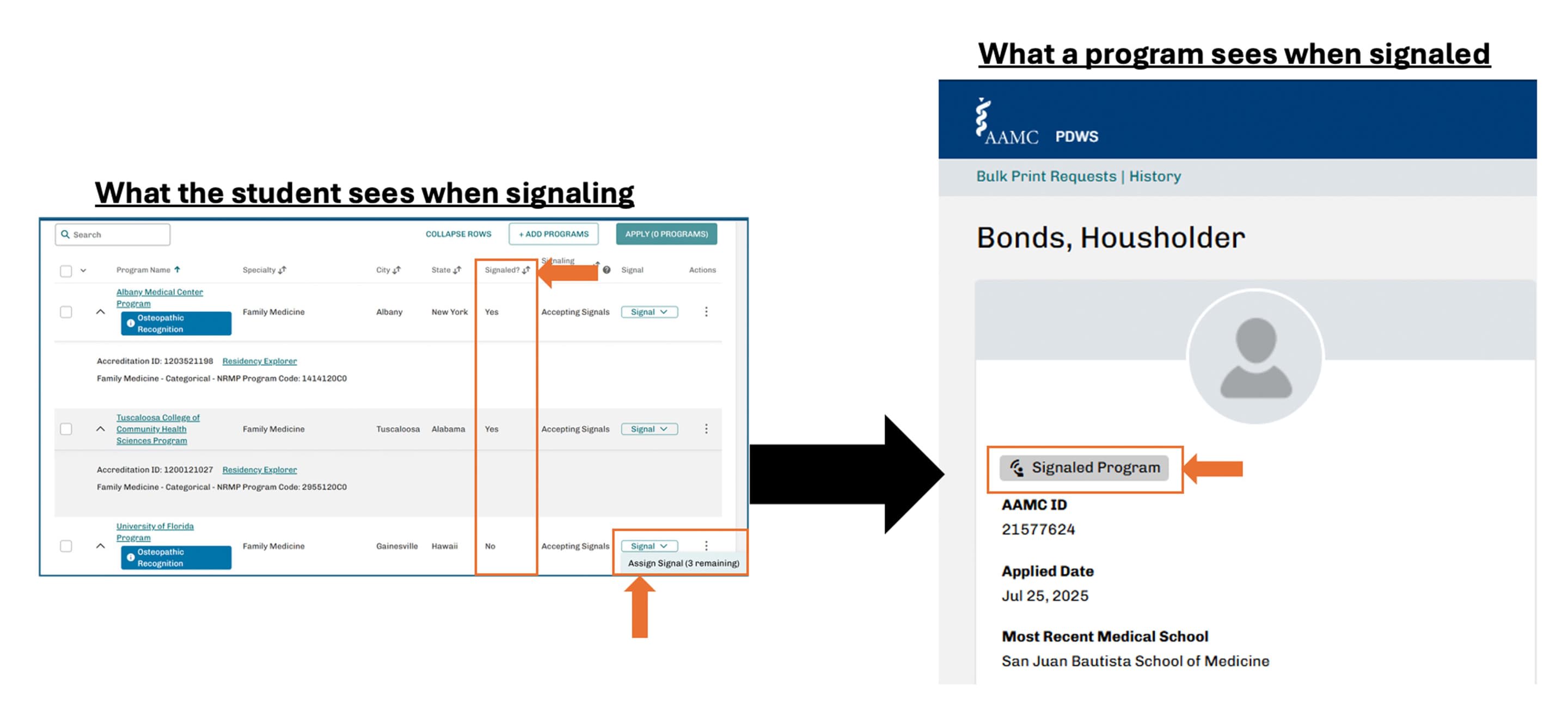
Image courtesy of AAMC
Using geographic preference effectively
How to indicate your preferred locations
ERAS allows you to share your geographic preferences—whether regional, state or “no preference.” If location is important to you for personal, professional or lifestyle reasons, be transparent. Programs appreciate clarity, especially if you have ties to an area through school, family or prior experience.
|
Division |
States |
|
New England |
Connecticut, Maine, Massachusetts, New Hampshire, Rhode Island, Vermont |
|
Middle Atlantic |
New Jersey, New York, Pennsylvania |
|
South Atlantic |
Delaware, District of Columbia, Florida, Georgia, Maryland, North Carolina, Puerto Rico, South Carolina, Virginia, West Virginia |
|
East North Central |
Illinois, Indiana, Michigan, Ohio, Wisconsin |
|
East South Central |
Alabama, Kentucky, Mississippi, Tennessee |
|
West North Central |
Iowa, Kansas, Minnesota, Missouri, Nebraska, North Dakota, South Dakota |
|
West South Central |
Arkansas, Louisiana, Oklahoma, Texas |
|
Mountain |
Arizona, Colorado, Idaho, Montana, New Mexico, Nevada, Utah, Wyoming |
|
Pacific |
Alaska, California, Hawaii, Oregon, Washington |
Setting preferences allow an applicant toindicate their preference for training in an urban, urban/suburban, suburban, suburban/rural or rural setting.
Applicants can include an explanation of why each geographic and/or setting selection was made. They also have the option to indicate “no preference” for geographic divisions or training setting and explain this response.
Residency programs are able to see if an applicant chose “no preference” in the geographic preferences section and the accompanying reason why it was selected. Residency programs within a preferred geographic area can see that an applicant chose their geographic location and the accompanying reason.
All programs are able to view applicants' setting preferences.
Filters for permanent address
Programs have the ability to filter by an applicant's county, state, city, postal code and setting. Applicants may wish to choose a permanent address that best aligns with their geographic interests. For instance, consider putting down an address where your medical school is located rather than your hometown address.
The AAMC provides additional guidance for using geographic and setting preference tools in its Supplemental ERAS Application Guide, including guidance based on the experiences of applicants and programs that piloted the supplemental application tools prior to the 2024 Match cycle.
Balancing geographic preference with program fit
While geography matters, don’t let it outweigh program quality and fit. A broad but thoughtful range of preferred locations can increase your options. If you express “no preference,” explain your flexibility in your personal statement or interviews. Balance is key—show that your choices are intentional, not limiting.
Highlighting past experience in your application
The experiences section allows applicants to capture and define/categorize up to 10 meaningful life experiences that complement other parts of their application. Residency programs can sort entries in this section as they screen applicants.
Choosing the right experiences to showcase
Programs look for evidence that you’ll thrive in their environment. When completing ERAS sections on experiences, focus on what shaped your clinical skills, teamwork and commitment to family medicine. Quality outweighs quantity—choose experiences that demonstrate growth, leadership and alignment with the specialty’s values.
Designate up to 10 meaningful experiences and provide a short description for each.
Select up to three experiences as your most meaningful. Applicants can include short descriptions of their reasons for assigning this designation.
Designate “experience types” (such as research, volunteer work, education/training or military service) with descriptive information.
Showcase mission-focused characteristics of your past experiences (such as rural focus or key characteristics).
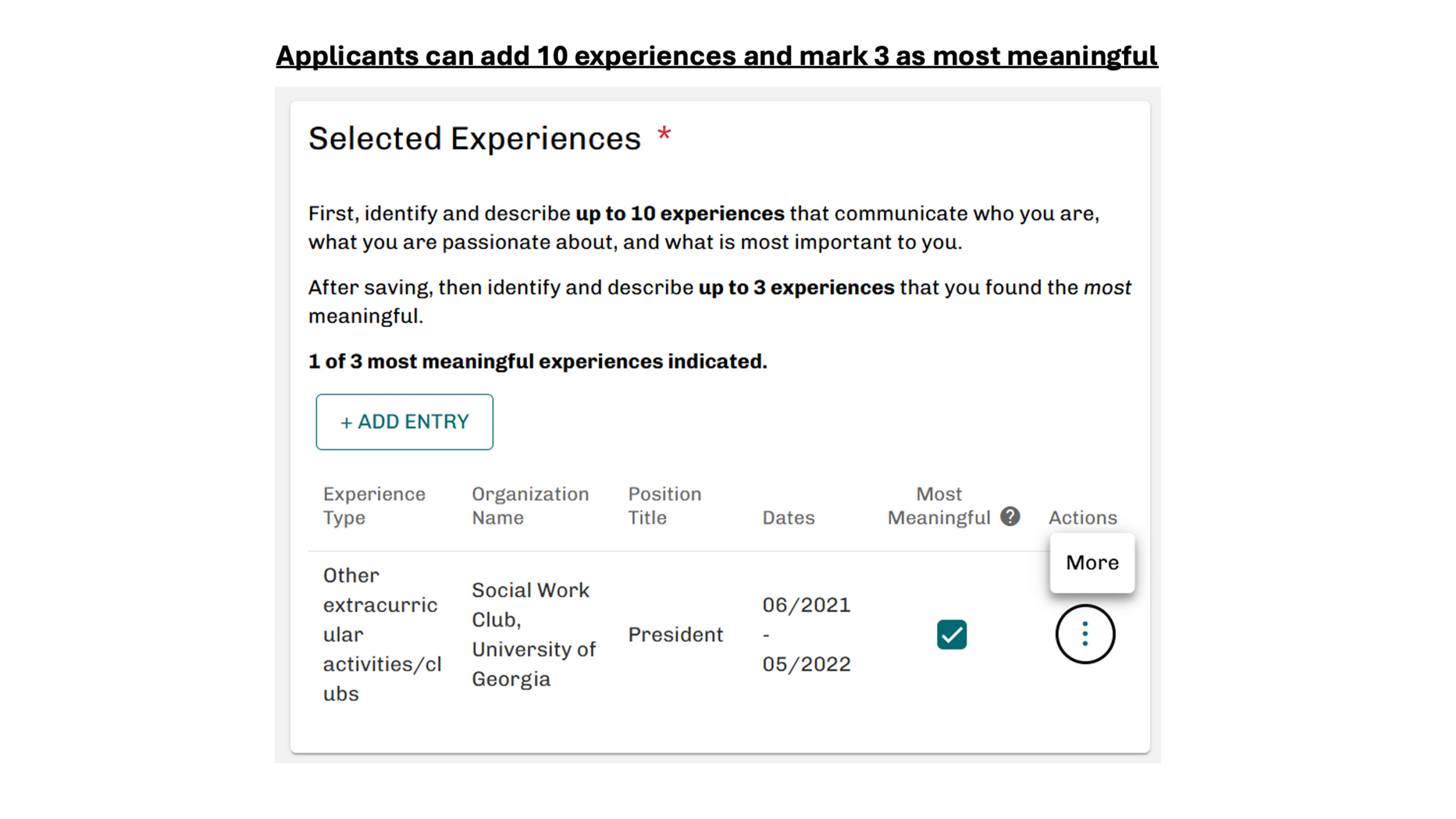
Image courtesy of AAMC
Applicants may also describe an “impactful experience” such as a challenge or hardship that influenced their journey to residency. The AAMC suggests that impactful experiences may include family background, financial background, community setting and educational or life experiences, and they are intended for applicants who have overcome major challenges.
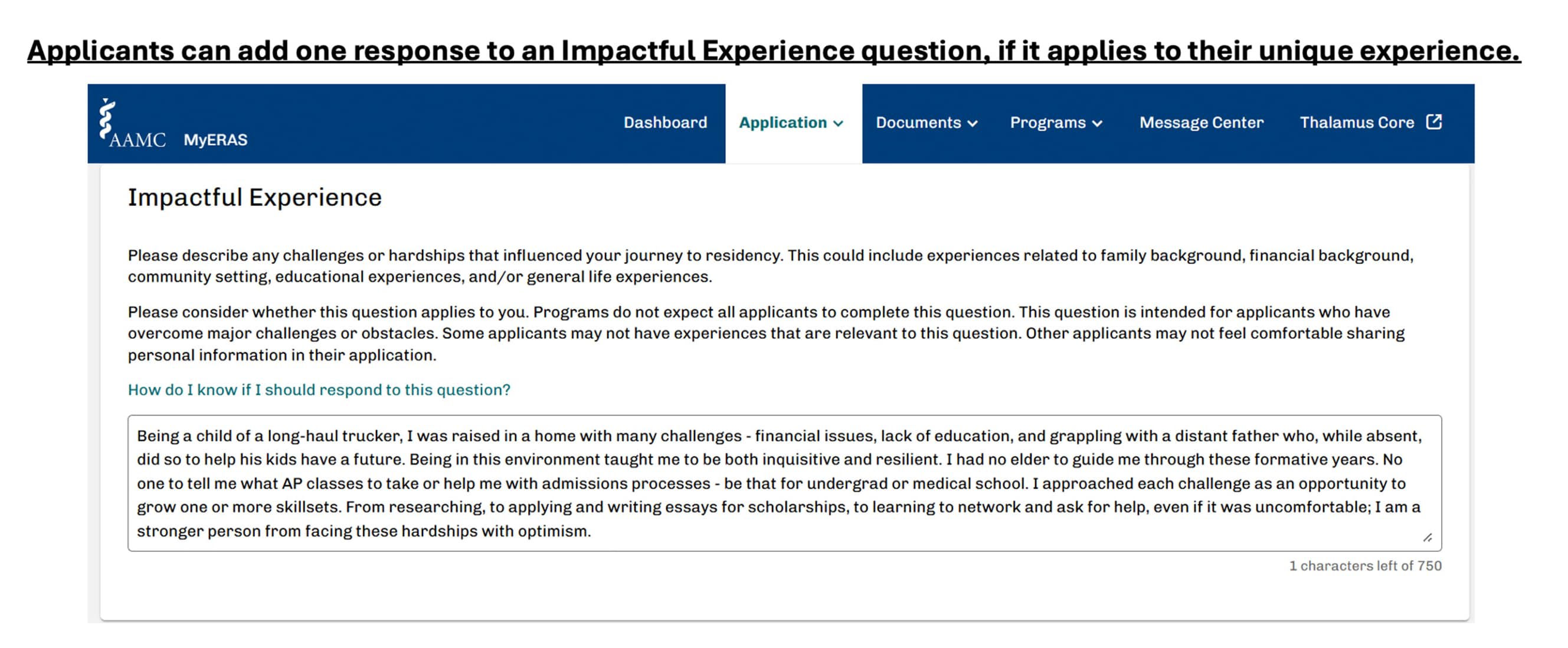
Image courtesy of AAMC
How past experience strengthens your match chances
Meaningful experiences help programs understand your journey. If you’ve worked with underserved populations, led a student organization, or completed a rural rotation, highlight what you learned and how it informs your career goals. Connect the dots between your past experiences and the communities or missions of the programs you’re signaling.