
Measles is back on the differential
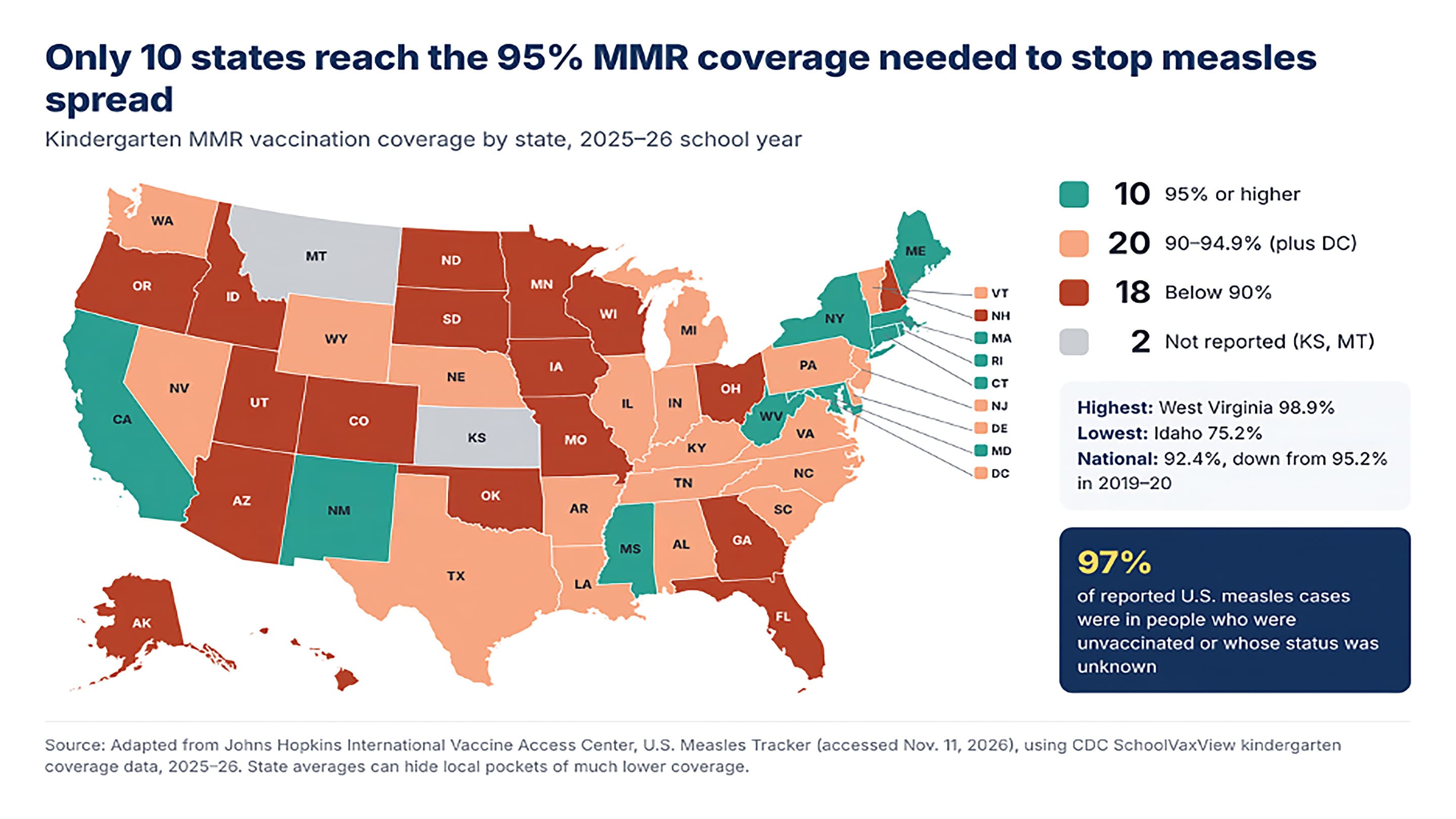
Lead image. Kindergarten MMR coverage by state, 2025–26. Adapted from the Johns Hopkins International Vaccine Access Center U.S. Measles Tracker (accessed Nov. 11, 2026), using CDC SchoolVaxView data.
For 26 years, measles elimination was one of those public health wins most of us could take for granted. That changed on Nov. 17, when the Pan American Health Organization confirmed that measles transmission has been re-established in the United States after outbreaks that began in January 2025 kept spreading for more than a year. More than 5,000 cases have been confirmed this year, more than double last year's total, and 97% are in people who were unvaccinated or whose vaccination status is unknown. As the AAFP said in our statement, this is a serious step backward, and we must use every available lever to stop it.
It does not mean the MMR vaccine has stopped working. It means too many people remain unprotected. Measles needs about 95% of a community to be immune to stop spreading, and only 10 states reached that mark among kindergartners last school year, according to the Johns Hopkins measles tracker. And measles is not harmless. Infants, young children, older adults, pregnant patients and people with underlying conditions face the greatest risk of pneumonia, encephalitis, hospitalization and death.
Put measles back on your differential
Like a lot of you, I've spent most of my career without seeing a single case of measles. Now it's showing up in the middle of respiratory season, when fever and cough fill every schedule. The clues that should make you stop: high fever with cough, runny nose and red eyes, followed a few days later by a rash that starts at the hairline and spreads down. Ask about vaccine status, travel and known exposures. If measles is possible, mask and isolate first, and call public health before you test.
Measles is airborne and can linger in a room for up to two hours, so one unrecognized case in a waiting room can expose dozens of people. A little planning now saves a lot of contact tracing later. Document staff immunity, build fever-and-rash screening into phone and front-desk triage, pick your isolation room, stock fit-tested N95s and post your health department's number where everyone can see it. CDC's infection control guidance covers the details.
Help patients say yes
As family physicians, our recommendation is still the strongest tool we have. MMR is safe, two doses are about 97% effective, and protection lasts for life. Use every visit to check status, including adults born in 1957 or later and patients born outside the U.S. whose records may have been lost along the way. No records? Don't wait for a titer. Vaccinate.
Patients are going to have questions, and many of them are good ones. Here are the ones coming up most, with answers you can use in the room.
| Patients ask | You can say |
| “Does the vaccine stop working? Why are vaccinated people getting measles?” | I can understand why the news reports about people getting measles would make you wonder whether the vaccine is still working. Two doses protect about 97 of every 100 people. In a big outbreak, a few vaccinated people can still get sick, usually more mildly. Almost all cases are in people who weren't vaccinated. |
| “Is MMR safe? Does it cause autism?” | It makes sense to ask about safety when you’re making a decision for yourself or your child. MMR has been studied carefully, and the evidence shows no link to autism. We've used the MMR vaccine for more than 50 years, and the risks from measles are much greater than the risks from the vaccine. Most people have nothing more than a sore arm or a mild fever. |
| “Do I need a booster?” | Two documented doses protect you for life. If you've had one dose, whether you need a second depends on things like travel, you work in health care or you are in college. |
| “I was born before 1957.” | That’s helpful to know. People born before 1957 are generally considered protected because measles was so common then. There are some exceptions, especially for people working health care. Let’s talk about your situation. |
| “I don't have my records.” | That’s pretty common, and we don’t have to let missing records keep you unprotected. We can talk through your history and about giving you another dose today. An extra dose is safe, and I’d rather see you protected sooner than waiting on a blood test to see if you’re already immune. |
| “Can my baby get it early?” | Yes, in some situations we can protect babies earlier. Starting at 6 months of age, babies can receive an early dose before international travel or if our health department recommends it. That early dose doesn't count toward the usual two doses they need after their first birthday. |
| “I'm pregnant.” | We don’t give the MMR during pregnancy, so we'll give it to you after the baby is born. For now, the best protection is making sure everyone around you is vaccinated. |
| “I think I was exposed. What now?” | Let’s figure this out quickly. First, call before you come in so we can protect others. We’ll check whether you’re already immune and when the exposure happened. If you're not immune, MMR within 3 days or immune globulin within 6 days can prevent or soften the illness. |
Answers reflect CDC measles vaccine recommendations and clinical guidance.
When patients or parents hesitate, shared decision-making doesn't mean presenting MMR as optional. It means leading with a clear recommendation, then really listening. The Trusted Messenger Program‘s AIMS approach puts that into practice:
Announce: “Maya is due for her MMR today, and with measles in our area, I don't want to wait.”
Inquire: “You look hesitant. What's on your mind?”
Mirror: “You've seen posts linking it to autism, and you want to be sure she's safe.”
Secure: “I want that, too. That's been studied in millions of kids, and there's no link. Measles is the bigger danger right now. I recommend we do it today.”
The program offers free CME if you want to sharpen these skills. The AAFP's measles vaccine page and FamilyDoctor.org have more talking points and patient-friendly information, and the Measles Collaborative has resources for prevention and outbreak response. And remember that “not today” isn't “never.” Keep the door open.
We've done this before
Brazil lost its measles elimination status in 2019 and won it back in 2024. A drop in cases alone didn't do that; an organized, sustained response did, and the same will be true here. That means stronger support for state and local health departments, timelier surveillance and communication, clear information for families and an easier path to vaccination. Our practices are part of that response every time we report a suspected case quickly and offer MMR at every visit.
Elimination was never luck. Family physicians helped earn it the first time, when the AAFP joined ACIP and our pediatrician colleagues in recommending a second MMR dose in 1989. We can earn it back, one patient, one conversation and one dose at a time.
Thank you for the conversations you're already having, often at the end of a long day. They matter more now than ever.
Disclaimer
The opinions and views expressed here are those of the authors and do not necessarily represent or reflect the opinions and views of the American Academy of Family Physicians. This blog is not intended to provide medical, financial, or legal advice.