

Serum lactate testing is increasingly being used to predict mortality in patients with sepsis.1 Elevated serum lactate levels are associated with increased mortality, and guidelines recommend using lactate measurement to guide management in these patients.2,3
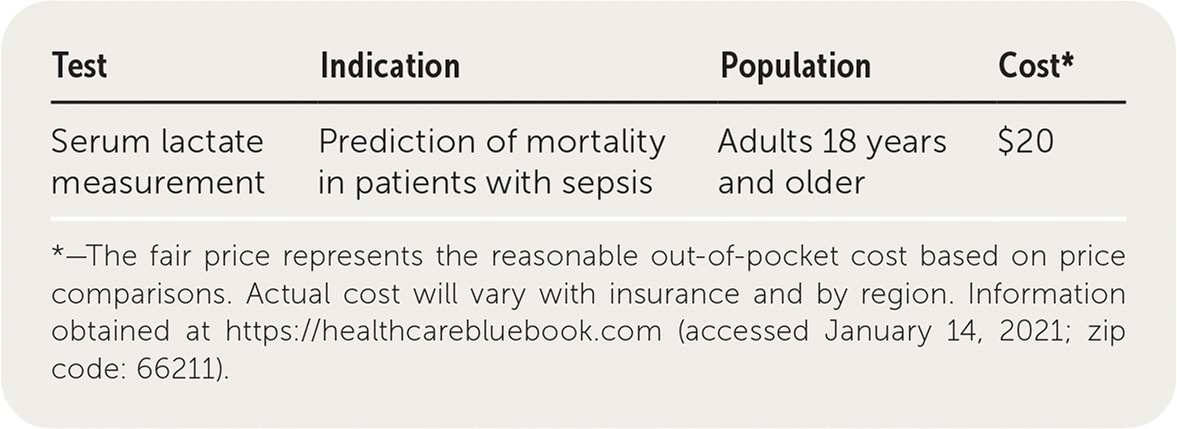
| Test | Indication | Population | Cost* |
|---|---|---|---|
| Serum lactate measurement | Prediction of mortality in patients with sepsis | Adults 18 years and older | $20 |
*—The fair price represents the reasonable out-of-pocket cost based on price comparisons. Actual cost will vary with insurance and by region. Information obtained at https://healthcarebluebook.com (accessed January 14, 2021; zip code: 66211).
Accuracy
Mortality in patients presenting with sepsis rises linearly with increasing serum lactate levels.2 In a single-center cohort study of 830 adults with sepsis who were admitted to the hospital from the emergency department, 28-day mortality was independently associated with increased lactate levels.2 Mortality was increased in patients with sepsis and an initial lactate level of 4.0 mmol per L (36.04 mg per dL) or greater, compared with a lactate level less than 2.0 mmol per L (18.02 mg per dL; odds ratio = 4.87). In this study, a single lactate level of 4.0 mmol per L or greater at the time of sepsis diagnosis had a sensitivity of 0.51, a specificity of 0.75, a positive likelihood ratio of 2.0, and a negative likelihood ratio of 0.65 for predicting 28-day mortality.2
Prospective data from nearly 20,000 patients in the Surviving Sepsis Campaign demonstrated that a single serum lactate level greater than 4.0 mmol per L in the presence of hypotension is associated with higher in-hospital mortality (odds ratio = 1.64) compared with either a serum lactate level of 4.0 mmol per L or less or the absence of hypotension.4
No single score or diagnostic tool fully characterizes sepsis prognosis.5 The Sequential Organ Failure Assessment (SOFA; https://www.mdcalc.com/sequential-organ-failure-assessment-sofa-score) and quick SOFA (qSOFA; https://www.mdcalc.com/qsofa-quick-sofa-score-sepsis) scores are routinely used for screening and identifying patients at higher risk of sepsis mortality. A retrospective cohort study of 1,865 adults with sepsis found that average lactate scores within the first 24 hours of hospital admission had a higher sensitivity, similar specificity, and greater area under the receiver operating characteristic curve (AUROC) than qSOFA for predicting 30-day mortality.6 The AUROC of lactate is similar to that of the SOFA score (0.664 vs. 0.686, respectively).6 These scores have marginal accuracy for predicting mortality because an AUROC of 0.6 to 0.7 is considered poor.7
Lactate clearance, defined as the reduction of lactate over time, may also be useful to predict mortality. A meta-analysis of a single randomized controlled trial and five prospective observational studies including a total of 927 adults with sepsis found that the relative risk of mortality associated with lactate clearance was 0.41 (95% CI, 0.28 to 0.60).8 Lactate clearance demonstrated a sensitivity of 0.67, specificity of 0.73, positive likelihood ratio of 2.52, and negative likelihood ratio of 0.45 for predicting mortality. Lactate clearance is often delayed in patients with hepatic failure and may not be a reliable prognostic marker in these patients.9
When lactate clearance is incorporated into clinical decision-making, it may improve sepsis mortality compared with early goal-directed therapy. In a meta-analysis of six randomized controlled trials including 917 adults with sepsis, early goal-directed therapy was associated with higher all-cause mortality (relative risk = 1.42; 95% CI, 1.19 to 1.70) compared with lactate-guided therapy. Although the use of red blood cell transfusions, dobutamine, vasopressor infusions, and mechanical ventilation did not differ between the two groups, lactate-guided therapy was associated with more treatment with fluids and vasodilators.10 Resuscitation guided by lactate clearance is not superior in reducing mortality compared with resuscitation guided by monitoring of capillary refill time.11
Benefit
Use of serum lactate could help clinicians make more appropriate decisions in sepsis management. An initial lactate level of greater than 4.0 mmol per L can be used to identify patients with sepsis who are at higher risk of mortality. Presence of lactate clearance may help identify patients who are appropriately responding to therapy. Based on low-quality evidence, an international guideline suggests “resuscitation to normalize lactate in patients with elevated lactate levels as a marker of tissue hypoperfusion.”3
Harms
Although a lactate level greater than 4.0 mmol per L clearly correlates with higher mortality in patients with sepsis, lactate levels between 2.0 and 4.0 mmol per L are often incorrectly used to identify septic shock, which could lead to overdiagnosis and the unnecessary initiation of aggressive treatment. Moreover, lactate can be elevated for other reasons, including hepatic disease. An overemphasis on lactate level without consideration of the clinical context could provide false reassurance or lead to unnecessary interventions, hospitalizations, or higher level of care.
Cost
A serum lactate test costs approximately $20.12 Sepsis is one of the most expensive conditions treated in United States hospitals. A cost-effectiveness analysis showed early point-of-care lactate testing has an incremental cost-effectiveness ratio of $31,590 per quality-adjusted life-year gained.13 However, the authors of this analysis were paid consultants for the company that makes the point-of-care test.
Bottom Line
Management of patients with sepsis is challenging and mortality is high. Early diagnosis and prompt initiation of therapy are essential.3 Higher lactate levels correlate with increased risk of mortality, particularly with lactate levels greater than 4.0 mmol per L and in the setting of hypotension. Serial lactate monitoring is associated with improved mortality in patients with sepsis but should not be used in isolation. Given the high mortality rate of sepsis, the need for early intervention, and the ease and cost-effectiveness of lactate testing, it is reasonable to incorporate lactate monitoring into clinical decision-making when managing sepsis and considering patient prognosis.
Editor's Note: Dr. Brown is a contributing editor for AFP.
