

Persistent Pink Nodules and Hyperpigmented Plaques on Trunk and Extremities

Daniela M. Mendez, MD,
Ministry of Public Health and Social Assistance, Santo Domingo, Dominican Republic
Shayna C. Rivard, MD,
Naval Medicine Readiness and Training Command Portsmouth, Portsmouth, Virginia

American Family Physician. 2024;109(5):465-466.

Author disclosure: No relevant financial relationships.

A 68-year-old woman presented to the dermatology clinic with persistent lesions on her trunk and extremities. Two years earlier, she had consulted her primary care physician regarding four scattered “lumps,” which she attributed to mosquito bites. Two years later, she was seen by a different primary care physician when she developed discoloration on her arm, which she believed was related to an aspirin allergy. The patient was seen twice more over the following 3 months before referral to the dermatology clinic.

The patient had a history of breast cancer 30 years previously, which was treated with radical mastectomy, chemotherapy, and radiation. She also had a history of controlled hypertension, type 2 diabetes mellitus, and an allergic reaction to iodine contrast media.

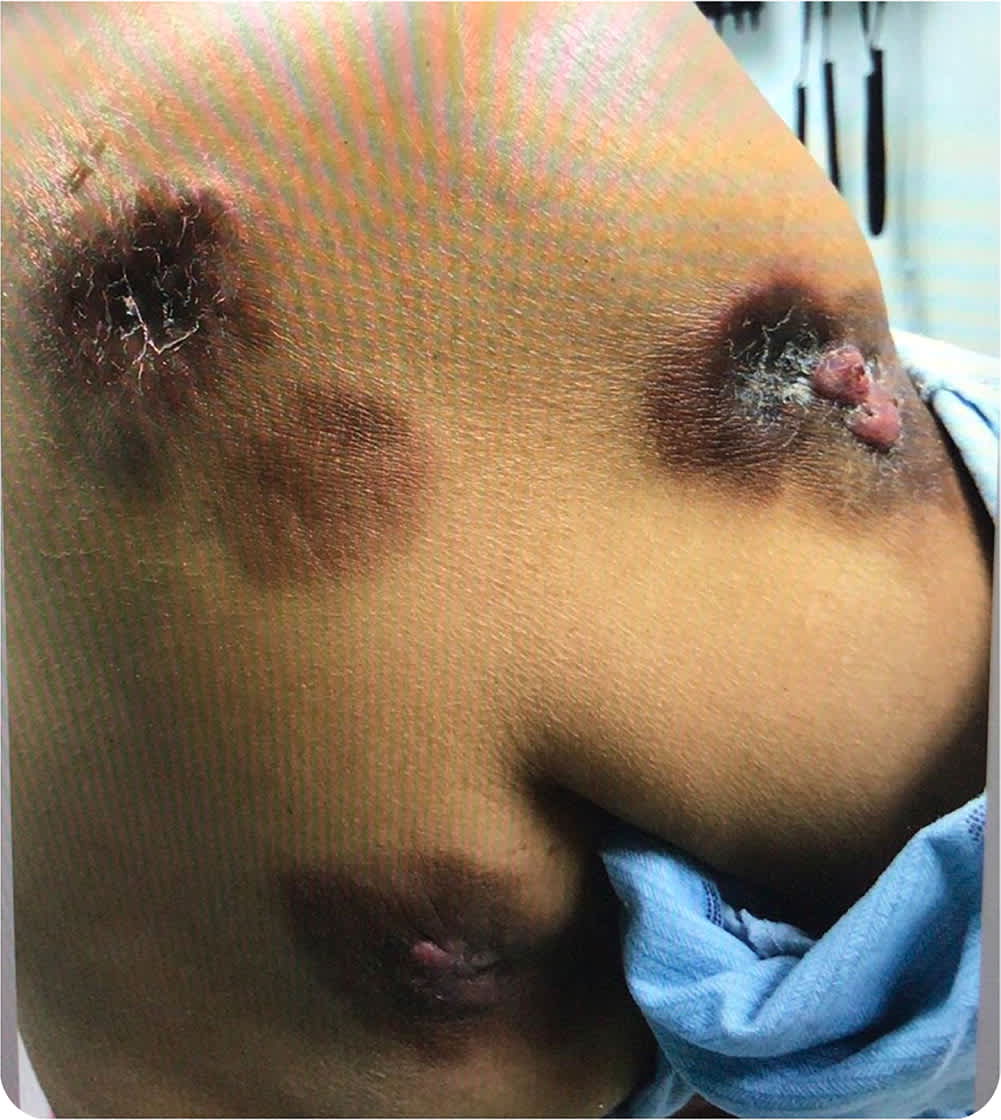
Examination revealed multiple firm, painless, hyperpigmented plaques scattered across her trunk and extremities (Figure 1). The plaques contained central pink nodules.

FIGURE 1
Question

Based on the patient's history and physical examination, which one of the following is the most likely diagnosis?

  • A. Angiosarcoma (Stewart-Treves syndrome).
  • B. Cutaneous metastasis from breast cancer.
  • C. Discoid lupus erythematosus.
  • D. Fixed drug eruption.
  • E. Keloids.

Discussion

The correct answer is B: cutaneous metastasis from breast cancer. The clinical presentation of cutaneous metastasis is broad and can mimic benign conditions such as keloids, dermatofibromas, prurigo nodularis, and discoid lupus erythematosus. The most common presentation is the combination of plaques and erythematous nodules involving the chest and arms, as in this case.1 The diagnosis depends on the clinical examination, as well as the histopathologic and immunohistochemistry analysis of a biopsy specimen.2 Lesions should be assessed for duration, growth, associated pruritus, bleeding, discharge, and pain. Any lesion demonstrating notable growth, pain, or bleeding requires further evaluation to exclude malignancy. Physicians should also ask the patient whether they have any history of malignancy.

This case illustrates the importance of early biopsy for diagnosis of skin lesions in patients who have had a history of cancer. The possibility of cutaneous metastasis must be considered, even years after treatment of the primary condition.2 Breast cancer is the leading cause of cutaneous metastasis, which is an unusual finding that suggests substantial disease progression.2,3 Patients with the condition are typically 50 to 70 years of age. Symptoms occur relatively soon after the initial cancer diagnosis, often within 3 years.2

Cutaneous metastasis typically presents as multiple firm, nontender nodules that appear suddenly, grow rapidly, and often demonstrate a fixed adherent nature to underlying tissues.4

Angiosarcoma, also known as Stewart-Treves syndrome, is a malignant tumor of the blood or lymph vessels. It can appear as an area of ecchymosis or a violaceous to red papule. The tumor can progress to invasion of underlying tissue, which may cause edema, ulceration, and bleeding due to tumor enlargement.5

Discoid lupus erythematosus classically appears on the face, ears, and scalp. Lesions often consist of erythematous or violaceous macules and scaling plaques. These lesions can lead to scarring, dyspigmentation, and alopecia.4

A fixed drug eruption is a unique form of drug allergy that produces red plaques or blisters that recur at the same cutaneous or mucosal site due to subsequent ingestion of the specific drug.4

Keloids are thickened scar tissue, which may involve the chest and shoulders.4 Patients often have a history of trauma, surgery, insect bites, vaccinations, burns, skin piercings, or acne.6 Keloids will grow beyond the initial border of a scar.4 In the authors' experience, keloids tend to demonstrate less of a fixed, hardened, and bound-down nature to underlying tissues, which may occur with cutaneous metastatic disease.

SUMMARY TABLE

ConditionCharacteristics
Angiosarcoma (Stewart-Treves syndrome)Malignant tumor; can initially appear as an area of ecchymosis or a violaceous to red papule, with progression to invasion of underlying tissue; may cause edema, ulceration, and bleeding due to tumor enlargement
Cutaneous metastasis from breast cancerPersonal history of cancer; multiple firm, nontender nodules that appear suddenly, grow rapidly, and often demonstrate a fixed adherent nature to underlying tissues
Discoid lupus erythematosusOften consists of erythematous or violaceous macules and scaling plaques; can lead to scarring, dyspigmentation, and alopecia
Fixed drug eruptionUnique form of drug allergy that produces red plaques or blisters; recurs at the same cutaneous or mucosal site due to subsequent ingestion of the specific drug
KeloidsThickened scar tissue that may occur on the chest and shoulders; patients often have a history of trauma, surgery, insect bites, vaccinations, burns, skin piercings, or acne; will grow beyond the initial border of a scar

The views expressed in this Photo Quiz are those of the authors and do not necessarily reflect the official policy or position of the Department of the Navy, Department of Defense, or the U.S. government.

I am an employee of the U.S. government. This work was prepared as part of my official duties. Title 17 U.S.C. 105 provides that “Copyright protection under this title is not available for any work of the United States Government” Title 17 U.S.C. 101 defines a United States Government work as a work prepared by a military service member or employee of the United States Government as part of that person’s official duties.

Address correspondence to Daniela M. Mendez, MD, at drmendezrocha@gmail.com. Reprints are not available from the authors.

Author disclosure: No relevant financial relationships.

  1. 1.Johnson C, Friedmann DP, Gade A, et al. Cutaneous manifestation as initial presentation of metastatic breast cancer: a systematic review. Cutis. 2021;107(3):E29-E36.
  2. 2.Ferreira VA, Spelta K, Diniz LM, et al. Exuberant case of cutaneous metastasis of breast cancer. An Bras Dermatol. 2018;93(3):429-431.
  3. 3.Vemulakonda SHP, Gaur NK, Shaikh O, et al. A rare occurrence of cutaneous recurrence in a patient of post modified radical mastectomy. Cureus. 2021;13(7):e16153.
  4. 4.Dinulos JGH. Habif’s Clinical Dermatology: A Color Guide to Diagnosis and Therapy. 7th ed. Elsevier; 2021.
  5. 5.Murgia RD, Gross GP. Stewart-Treves syndrome. StatPearls. Updated August 14, 2023. Accessed March 26, 2024. https://www.ncbi.nlm.nih.gov/books/NBK507833/
  6. 6.Ogawa R. Keloid and hypertrophic scars are the result of chronic inflammation in the reticular dermis. Int J Mol Sci. 2017;18(3):606.

The editors of AFP welcome submissions for Photo Quiz. Guidelines for preparing and submitting a Photo Quiz manuscript can be found in the Authors' Guide at https://www.aafp.org/afp/photoquizinfo. To be considered for publication, submissions must meet these guidelines. Email submissions to afpphoto@aafp.org.

This series is coordinated by John E. Delzell Jr., MD, MSPH, associate medical editor.

A collection of Photo Quiz published in AFP is available at https://www.aafp.org/afp/photoquiz.

Copyright © 2026 by the American Academy of Family Physicians.

This content is owned by the AAFP. A person viewing it online may make one printout of the material and may use that printout only for his or her personal, non-commercial reference. This material may not otherwise be downloaded, copied, printed, stored, transmitted or reproduced in any medium, whether now known or later invented, except as authorized in writing by the AAFP. See permissions for copyright questions and/or permission requests.
