Carpal Tunnel Syndrome: Rapid Evidence Review

Jennifer Wipperman, MD, MPH
Melissa L. Penny, DO

American Family Physician. 2024;110(1):52-57.

Author disclosure: No relevant financial relationships.

This clinical content conforms to AAFP criteria for CME.

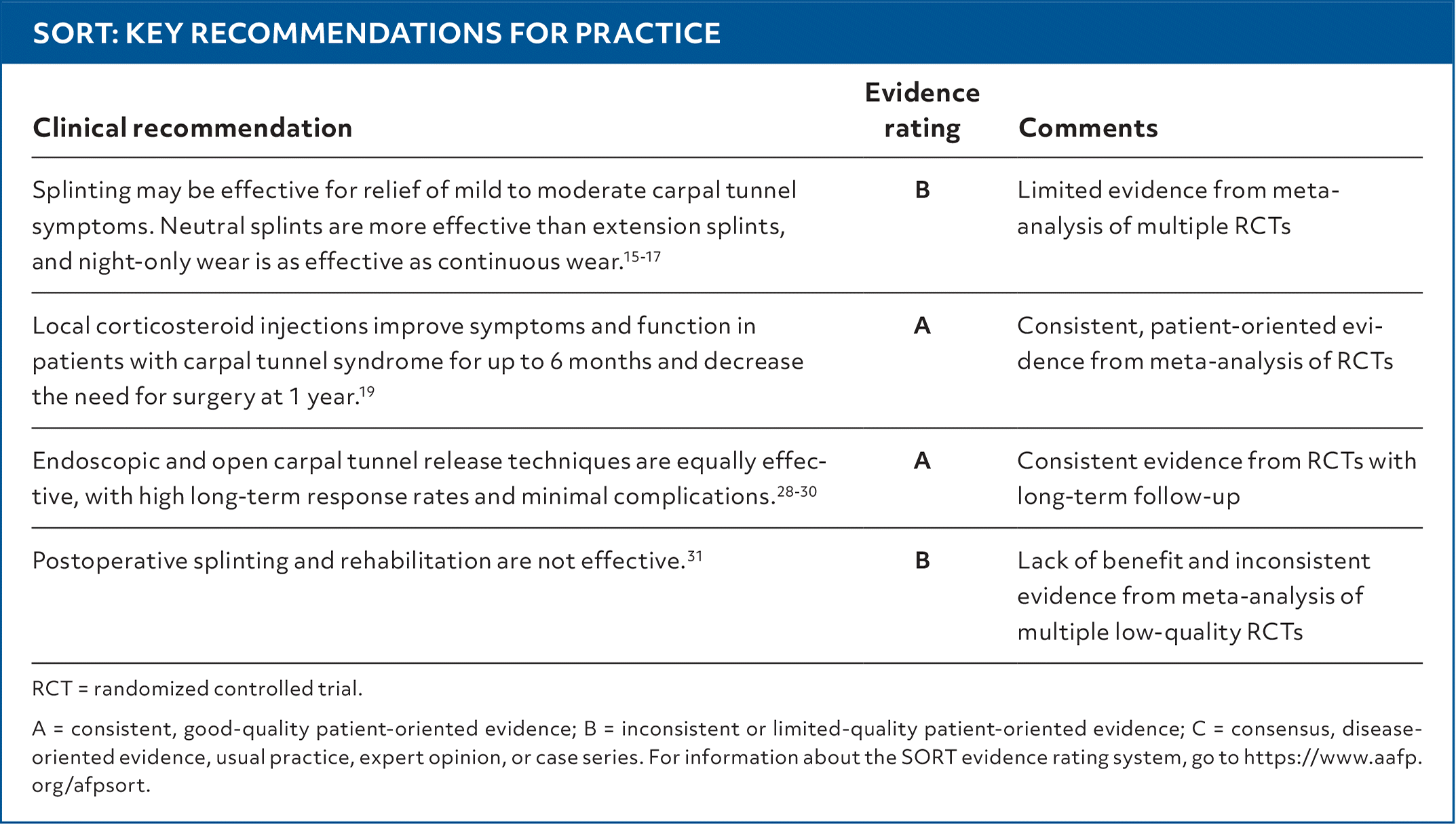
Carpal tunnel syndrome (CTS) is caused by compression of the median nerve as it travels through the carpal tunnel. Patients commonly experience pain, paresthesia, and, less often, weakness in the distribution of the median nerve. Provocative maneuvers, such as the Phalen test and Tinel sign, have varying sensitivity and specificity for the diagnosis of CTS. Thenar atrophy is a late finding and highly specific for CTS. Although patients with a classic presentation of CTS do not need additional testing for diagnosis, electrodiagnostic studies can confirm the diagnosis in atypical cases, exclude other causes, and gauge severity for surgical prognosis. An abnormal nerve conduction study is useful for ruling in CTS, but a normal test does not necessarily exclude it. Over-the-counter analgesics, such as nonsteroidal anti-inflammatory drugs and acetaminophen, have not shown benefit for CTS. Patients with mild to moderate CTS initially may be offered nonsurgical treatments, such as splinting or local corticosteroid injections. Night-only splinting is as effective as continuous wear. A neutral wrist splint may be more effective than an extension splint. In patients with recent onset of CTS, corticosteroid injections provide slightly greater improvement of symptoms compared with splinting at 6 weeks, with similar outcomes at 6 months. Patients with severe CTS, including objective weakness or sensory deficits, should be offered surgical decompression. Endoscopic and open carpal tunnel release techniques are equally effective.

JENNIFER WIPPERMAN, MD, MPH, is a clinical associate professor in the Department of Family and Community Medicine at the University of Kansas School of Medicine – Wichita Family Medicine Residency at Ascension Via Christi Hospitals.

MELISSA L. PENNY, DO, is a clinical assistant professor in the Department of Family and Community Medicine at the University of Kansas School of Medicine – Wichita Family Medicine Residency at Ascension Via Christi Hospitals.

Address correspondence to Jennifer Wipperman, MD, MPH, at afpjournal@aafp.org.

Author disclosure: No relevant financial relationships.

  1. 1.Gelfman R, Melton LJ, Yawn BP, et al. Long-term trends in carpal tunnel syndrome. Neurology. 2009;72(1):33-41.
  2. 2.Shiri R, Pourmemari MH, Falah-Hassani K, et al. The effect of excess body mass on the risk of carpal tunnel syndrome: a meta-analysis of 58 studies. Obes Rev. 2015;16(12):1094-1104.
  3. 3.Kozak A, Schedlbauer G, Wirth T, et al. Association between work-related biomechanical risk factors and the occurrence of carpal tunnel syndrome: an overview of systematic reviews and a meta-analysis of current research. BMC Musculoskelet Disord. 2015;16:231.
  4. 4.American Academy of Orthopaedic Surgeons. Management of carpal tunnel syndrome. Evidence-based clinical practice guideline. February 29, 2016. Accessed February 8, 2024. https://www.aaos.org/globalassets/quality-and-practice-resources/carpal-tunnel/cts-cpg_4-25-19.pdf
  5. 5.Katz JN, Stirrat CR, Larson MG, et al. A self-administered hand symptom diagram for the diagnosis and epidemiologic study of carpal tunnel syndrome. J Rheumatol. 1990;17(11):1495-1498.
  6. 6.Wipperman J, Goerl K. Carpal tunnel syndrome: diagnosis and management. Am Fam Physician. 2016;94(12):993-999.
  7. 7.Dabbagh A, MacDermid JC, Yong J, et al. Diagnostic test accuracy of provocative maneuvers for the diagnosis of carpal tunnel syndrome: a systematic review and meta-analysis. Phys Ther. 2023;103(6):pzad029.
  8. 8.Graham B. The value added by electrodiagnostic testing in the diagnosis of carpal tunnel syndrome. Bone Joint Surg Am. 2008;90(12):2587-2593.
  9. 9.De Kleermaeker FGCM, Meulstee J, Claes F, et al. Treatment outcome in patients with clinically defined carpal tunnel syndrome but normal electrodiagnostic test results: a randomized controlled trial. J Neurol. 2017;264(12):2394-2400.
  10. 10.Jablecki CK, Andary MT, Floeter MK, et al. Practice parameter: electrodiagnostic studies in carpal tunnel syndrome. Report of the American Association of Electrodiagnostic Medicine, American Academy of Neurology, and the American Academy of Physical Medicine and Rehabilitation. Neurology. 2002;58(11):1589-1592.
  11. 11.Demino C, Fowler JR. The sensitivity and specificity of nerve conduction studies for diagnosis of carpal tunnel syndrome: a systematic review. Hand (N Y). 2021;16(2):174-178.
  12. 12.Torres-Costoso A, Martínez-Vizcaíno V, Álvarez-Bueno C, et al. Accuracy of ultrasonography for the diagnosis of carpal tunnel syndrome: a systematic review and meta-analysis. Arch Phys Med Rehabil. 2018;99(4):758-765.e10.
  13. 13.American Academy of Orthopaedic Surgeons. Management of carpal tunnel syndrome. Appropriate use criteria. December 9, 2016. Accessed February 8, 2024. https://www.aaos.org/globalassets/quality-and-practice-resources/carpal-tunnel/cts-auc_hardcopy_1.4.17.pdf
  14. 14.Ortiz-Corredor F, Enríquez F, Díaz-Ruíz J, et al. Natural evolution of carpal tunnel syndrome in untreated patients. Clin Neurophysiol. 2008;119(6):1373-1378.
  15. 15.Karjalainen TV, Lusa V, Page MJ, et al. Splinting for carpal tunnel syndrome. Cochrane Database Syst Rev. 2023(2):CD010003.
  16. 16.Walker WC, Metzler M, Cifu DX, et al. Neutral wrist splinting in carpal tunnel syndrome: a comparison of night-only versus full-time wear instructions. Arch Phys Med Rehabil. 2000;81(4):424-429.
  17. 17.Page MJ, Massy-Westropp N, O’Connor D, et al. Splinting for carpal tunnel syndrome. Cochrane Database Syst Rev. 2012(7):CD010003.
  18. 18.Wong SM, Hui AC, Tang A, et al. Local vs systemic corticosteroids in the treatment of carpal tunnel syndrome. Neurology. 2001;56(11):1565-1567.
  19. 19.Ashworth NL, Bland JDP, Chapman KM, et al. Local corticosteroid injection versus placebo for carpal tunnel syndrome. Cochrane Database Syst Rev. 2023(2):CD015148.
  20. 20.Wang H, Zhu Y, Wei H, et al. Ultrasound-guided local corticosteroid injection for carpal tunnel syndrome: a meta-analysis of randomized controlled trials. Clin Rehabil. 2021;35(11):1506-1517.
  21. 21.Chesterton LS, Blagojevic-Bucknall M, Burton C, et al. The clinical and cost-effectiveness of corticosteroid injection versus night splints for carpal tunnel syndrome (INSTINCTS trial): an open-label, parallel group, randomised controlled trial. Lancet. 2018;392(10156):1423-1433.
  22. 22.Wu YT, Ke MJ, Ho TY, et al. Randomized double-blinded clinical trial of 5% dextrose versus triamcinolone injection for carpal tunnel syndrome patients. Ann Neurol. 2018;84(4):601-610.
  23. 23.Garfinkel MS, Singhal A, Katz WA, et al. Yoga-based intervention for carpal tunnel syndrome: a randomized trial. JAMA. 1998;280(18):1601-1603.
  24. 24.Abdolrazaghi HA, Khansari M, Mirshahi M, et al. Effectiveness of tendon and nerve gliding exercises in the treatment of patients with mild idiopathic carpal tunnel syndrome: a randomized controlled trial. Hand (N Y). 2023;18(2):222-229.
  25. 25.Page MJ, O’Connor D, Pitt V, et al. Exercise and mobilisation interventions for carpal tunnel syndrome. Cochrane Database Syst Rev. 2012(6):CD009899.
  26. 26.Choi GH, Wieland LS, Lee H, et al. Acupuncture and related interventions for the treatment of symptoms associated with carpal tunnel syndrome. Cochrane Database Syst Rev. 2018(12):CD011215.
  27. 27.Turner A, Kimble F, Gulyás K, et al. Can the outcome of open carpal tunnel release be predicted?: A review of the literature. ANZ J Surg. 2010;80(1–2):50-54.
  28. 28.Vasiliadis HS, Georgoulas P, Shrier I, et al. Endoscopic release for carpal tunnel syndrome. Cochrane Database Syst Rev. 2014(1):CD008265.
  29. 29.Atroshi I, Hofer M, Larsson GU, et al. Extended follow-up of a randomized clinical trial of open vs endoscopic release surgery for carpal tunnel syndrome. JAMA. 2015;314(13):1399-1401.
  30. 30.Li Y, Luo W, Wu G, et al. Open versus endoscopic carpal tunnel release: a systematic review and meta-analysis of randomized controlled trials. BMC Musculoskelet Disord. 2020;21(1):272.
  31. 31.Peters S, Page MJ, Coppieters MW, et al. Rehabilitation following carpal tunnel release. Cochrane Database Syst Rev. 2016(2):CD004158.
  32. 32.Padua L, Padua R, Aprile I, et al.; Italian CTS Study Group. Carpal tunnel syndrome. Multiperspective follow-up of untreated carpal tunnel syndrome: a multicenter study. Neurology. 2001;56(11):1459-1466.
  33. 33.Graham RG, Hudson DA, Solomons M, et al. A prospective study to assess the outcome of steroid injections and wrist splinting for the treatment of carpal tunnel syndrome. Plast Reconstr Surg. 2004;113(2):550-556.
  34. 34.LeBlanc KE, Cestia W. Carpal tunnel syndrome. Am Fam Physician. 2011;83(8):952-958.
  35. 35.Viera AJ. Management of carpal tunnel syndrome. Am Fam Physician. 2003;68(2):265-272.

Copyright © 2026 by the American Academy of Family Physicians.

This content is owned by the AAFP. A person viewing it online may make one printout of the material and may use that printout only for his or her personal, non-commercial reference. This material may not otherwise be downloaded, copied, printed, stored, transmitted or reproduced in any medium, whether now known or later invented, except as authorized in writing by the AAFP. See permissions for copyright questions and/or permission requests.