Bleeding and Bruising: Primary Care Evaluation

Pamela R. Hughes, MD
Meghan N. Lewis, MD
Shalease S. Adams, DO

American Family Physician. 2024;110(5):504-514.

Author disclosure: No relevant financial relationships.

This clinical content conforms to AAFP criteria for CME.

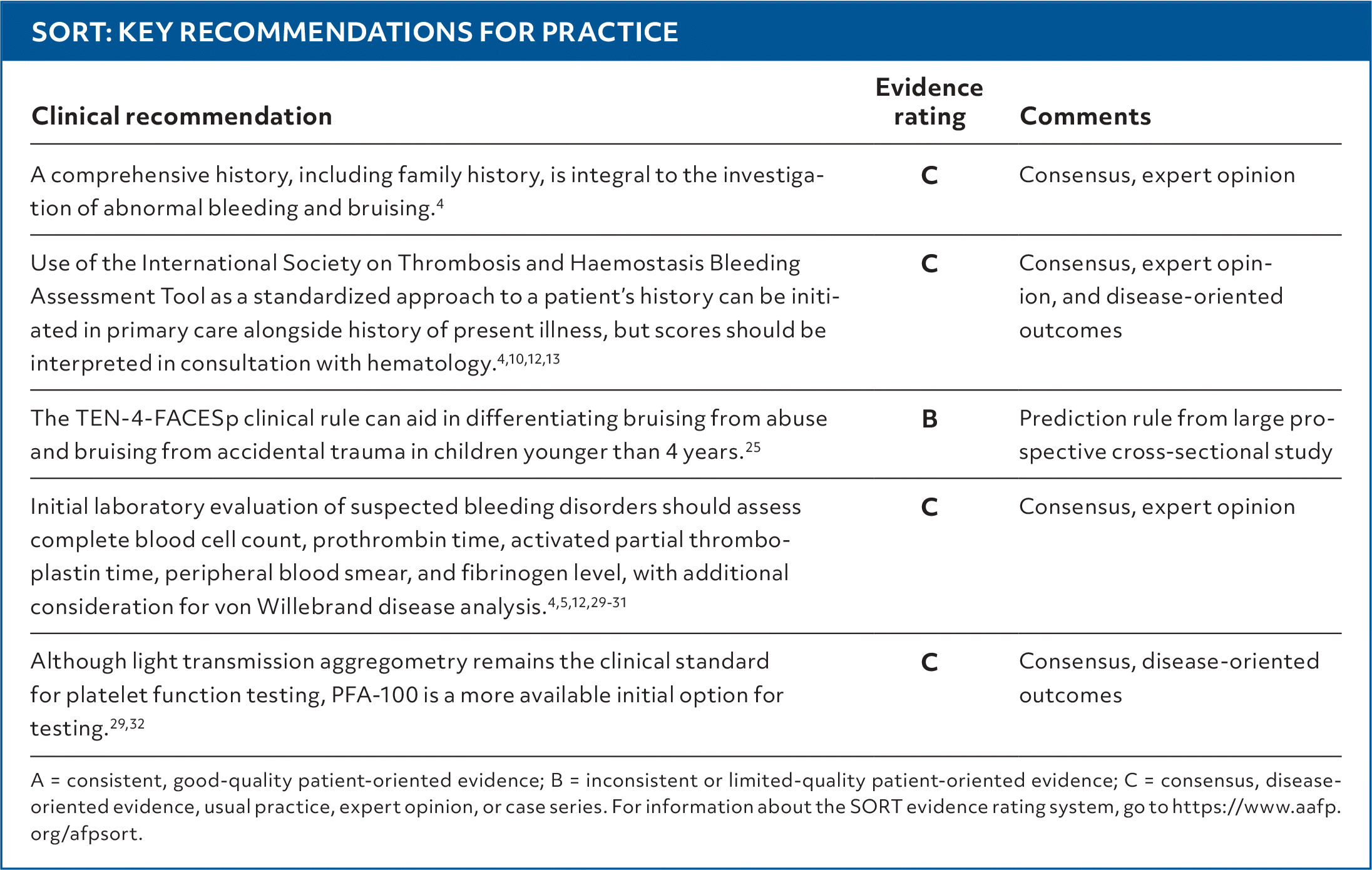
Easy bruising and bleeding are commonly seen in primary care. Use of a bleeding assessment tool and a comprehensive history, physical examination, and patient-provided photographs can help identify causes of abnormal bleeding and bruising. Family history can aid diagnosis of a heritable cause. Nonaccidental trauma should be considered, especially in vulnerable populations. Initial laboratory testing includes a complete blood cell count, peripheral blood smear, prothrombin time (PT), international normalized ratio, activated partial thromboplastin time (aPTT), and fibrinogen. Normal PT and aPTT results may indicate a platelet disorder. A normal PT result with a prolonged aPTT result indicates a disorder of the intrinsic coagulation pathway, and a prolonged PT result with a normal aPTT result may indicate a disorder of the extrinsic coagulation pathway. Consultation with a hematologist is recommended when initial evaluation indicates a bleeding disorder or when suspicion remains high despite a normal laboratory workup result.

PAMELA R. HUGHES, MD, FAAFP, is an associate professor in the Department of Family Medicine at the Uniformed Services University of the Health Sciences, Scott Air Force Base, Ill.

MEGHAN N. LEWIS, MD, is medical director of family health at Malcolm Grow Medical Clinics and Surgical Center, Joint Base Andrews, Md.; and assistant professor at the Uniformed Services University of the Health Sciences, Bethesda, Md.

SHALEASE S. ADAMS, DO, is an assistant professor in the Department of Family Medicine at the Uniformed Services University of the Health Sciences, Scott Air Force Base, Ill.

Address correspondence to Pamela R. Hughes, MD, FAAFP, at pamela.r.hughes4.mil@health.mil.

Author disclosure: No relevant financial relationships.

  1. 1.Mauer AC, Khazanov NA, Levenkova N, et al. Impact of sex, age, race, ethnicity and aspirin use on bleeding symptoms in healthy adults. J Thromb Haemost. 2011;9(1):100-108.
  2. 2.Rodeghiero F, Castaman G, Tosetto A, et al. The discriminant power of bleeding history for the diagnosis of type 1 von Willebrand disease: an international, multicenter study. J Thromb Haemost. 2005;3(12):2619-2626.
  3. 3.Menegatti M, Biguzzi E, Peyvandi F. Management of rare acquired bleeding disorders. Hematology Am Soc Hematol Educ Program. 2019;2019(1):80-87.
  4. 4.Neutze D, Roque J. Clinical evaluation of bleeding and bruising in primary care. Am Fam Physician. 2016;93(4):279-286.
  5. 5.James PD, Connell NT, Ameer B, et al. ASH ISTH NHF WFH 2021 guidelines on the diagnosis of von Willebrand disease. Blood Adv. 2021;5(1):280-300.
  6. 6.Kruse-Jarres R, Singleton TC, Leissinger CA. Identification and basic management of bleeding disorders in adults. J Am Board Fam Med. 2014;27(4):549-564.
  7. 7.Leung AK, Chan KW. Evaluating the child with purpura. Am Fam Physician. 2001;64(3):419-428.
  8. 8.Cohen AR. Rash—purpura. In: Fleisher GA, Ludwig S, et al., eds. Textbook of Pediatric Emergency Medicine. 3d ed. Williams & Wilkins; 1993: 430–438.
  9. 9.Harrison LB, Nash MJ, Fitzmaurice D, et al. Investigating easy bruising in an adult. BMJ. 2017;356:j251.
  10. 10.Rodeghiero F, Tosetto A, Abshire T, et al.; ISTH/SSC joint VWF and Perinatal/Pediatric Hemostasis Subcommittees Working Group. ISTH/SSC bleeding assessment tool: a standardized questionnaire and a proposal for a new bleeding score for inherited bleeding disorders. J Thromb Haemost. 2010;8(9):2063-2065.
  11. 11.Moenen FCJI, Nelemans PJ, Schols SEM, et al. The diagnostic accuracy of bleeding assessment tools for the identification of patients with mild bleeding disorders: a systematic review. Haemophilia. 2018;24(4):525-535.
  12. 12.Rodeghiero F, Pabinger I, Ragni M, et al. Fundamentals for a systematic approach to mild and moderate inherited bleeding disorders: an EHA consensus report. Hemasphere. 2019;3(4):e286.
  13. 13.Elbatarny M, Mollah S, Grabell J, et al.; Zimmerman Program Investigators. Normal range of bleeding scores for the ISTH-BAT: adult and pediatric data from the merging project. Haemophilia. 2014;20(6):831-835.
  14. 14.Gomez K, Anderson J, Baker P, et al. Clinical and laboratory diagnosis of heritable platelet disorders in adults and children: a British Society for Haematology Guideline. Br J Haematol. 2021;195(1):46-72.
  15. 15.Ballas M, Kraut EH. Bleeding and bruising: a diagnostic work-up. Am Fam Physician. 2008;77(8):1117-1124.
  16. 16.National Bleeding Disorders Foundation. MASAC recommendations regarding diagnosis and management of inherited bleeding disorders in girls and women with personal and family history of bleeding. Accessed May 22, 2024. https://www.bleeding.org/sites/default/files/document/files/MASAC-girls-and-women.pdf
  17. 17.ACOG Committee Opinion No. 785, screening and management of bleeding disorders in adolescents with heavy menstrual bleeding: correction. Obstet Gynecol. 2023;141(1):228.
  18. 18.Abebe W. Review of herbal medications with the potential to cause bleeding: dental implications, and risk prediction and prevention avenues. EPMA J. 2019;10(1):51-64.
  19. 19.Gentile S, Guarino G, Della Corte T, et al.; AMD-OSDI Study Group. Bruising: a neglected, though patient-relevant complication of insulin injections coming to light from a real-life nationwide survey. Diabetes Ther. 2021;12(4):1143-1157.
  20. 20.Anderst J, Carpenter SL, Abshire TC, et al.; AAP Section on Hematology/Oncology, American Society of Pediatric Hematology/Oncology/American Academy of Child and Adolescent Psychiatry; Centers for Disease Control and Prevention. Evaluation for bleeding disorders in suspected child abuse. Pediatrics. 2022;150(4):e2022059276.
  21. 21.Asnes AG, Leventhal JM. Bruising in infants: an approach to the recognition of child physical abuse. Pediatr Rev. 2022;43(7):361-370.
  22. 22.Rosen T, Stern ME, Elman A, et al. Identifying and initiating intervention for elder abuse and neglect in the emergency department. Clin Geriatr Med. 2018;34(3):435-451.
  23. 23.Wiglesworth A, Austin R, Corona M, et al. Bruising as a marker of physical elder abuse. J Am Geriatr Soc. 2009;57(7):1191-1196.
  24. 24.Legano LA, Desch LW, Messner SA, et al.; Council on Child Abuse and Neglect; Council on Children With Disabilities. Maltreatment of children with disabilities. Pediatrics. 2021;147(5):e2021050920.
  25. 25.Pierce MC, Kaczor K, Lorenz DJ, et al. Validation of a clinical decision rule to predict abuse in young children based on bruising characteristics. JAMA Netw Open. 2021;4(4):e215832.
  26. 26.Crumm CE, Brown ECB, Thomas-Smith S, et al. Evaluation of an emergency department high-risk bruising screening protocol. Pediatrics. 2021;147(4):e2020002444.
  27. 27.Sugar NF, Taylor JA, Feldman KW; Puget Sound Pediatric Research Network. Bruises in infants and toddlers: those who don’t cruise rarely bruise. Arch Pediatr Adolesc Med. 1999;153(4):399-403.
  28. 28.Schulte R, Jordan LC, Morad A, et al. Rise in late onset vitamin K deficiency bleeding in young infants because of omission or refusal of prophylaxis at birth. Pediatr Neurol. 2014;50(6):564-568.
  29. 29.Sivapalaratnam S, Collins J, Gomez K. Diagnosis of inherited bleeding disorders in the genomic era. Br J Haematol. 2017;179(3):363-376.
  30. 30.Committee on Adolescent Health Care; Committee on Gynecologic Practice. Committee Opinion No. 580: von Willebrand disease in women. Obstet Gynecol. 2013;122(6):1368-1373.
  31. 31.Nichols WL, Hultin MB, James AH, et al. von Willebrand disease (VWD): evidence-based diagnosis and management guidelines, the National Heart, Lung, and Blood Institute (NHLBI) Expert Panel report (USA). Haemophilia. 2008;14(2):171-232.
  32. 32.Hayward CPM, Harrison P, Cattaneo M, et al.; Platelet Physiology Subcommittee of the Scientific and Standardization Committee of the International Society on Thrombosis and Haemostasis. Platelet function analyzer (PFA)-100 closure time in the evaluation of platelet disorders and platelet function. J Thromb Haemost. 2006;4(2):312-319.
  33. 33.Nogami K. The utility of thromboelastography in inherited and acquired bleeding disorders. Br J Haematol. 2016;174(4):503-514.
  34. 34.Franchini M, Zaffanello M, Mannucci PM. Bleeding disorders in primary fibrinolysis. Int J Mol Sci. 2021;22(13):7027.
  35. 35.Johnsen JM, MacKinnon HJ. JTH in clinic - obstetric bleeding: VWD and other inherited bleeding disorders. J Thromb Haemost. 2022;20(7):1568-1575.
  36. 36.Srivastava A, Santagostino E, Dougall A, et al. WFH Guidelines for the Management of Hemophilia, 3rd ed. Haemophilia. 2020;26(suppl6):35-48.
  37. 37.Mensah PK, Gooding R. Surgery in patients with inherited bleeding disorders. Anaesthesia. 2015;70(suppl 1):112-120.
  38. 38.Nurden AT, Nurden P. Inherited disorders of platelet function: selected updates. J Thromb Haemost. 2015;13(suppl1):S2-S9.
  39. 39.Paniccia R, Priora R, Liotta AA, et al. Platelet function tests:a comparative review. Vasc Health Risk Manag. 2015;11:133-148.
  40. 40.Ver Donck F, Downes K, Freson K. Strengths and limitations of high-throughput sequencing for the diagnosis of inherited bleeding and platelet disorders. J Thromb Haemost. 2020;18(8):1839-1845.
  41. 41.Quiroga T, Goycoolea M, Panes O, et al. High prevalence of bleeders of unknown cause among patients with inherited mucocutaneous bleeding. A prospective study of 280 patients and 299 controls. Haematologica. 2007;92(3):357-365.

Copyright © 2026 by the American Academy of Family Physicians.

This content is owned by the AAFP. A person viewing it online may make one printout of the material and may use that printout only for his or her personal, non-commercial reference. This material may not otherwise be downloaded, copied, printed, stored, transmitted or reproduced in any medium, whether now known or later invented, except as authorized in writing by the AAFP. See permissions for copyright questions and/or permission requests.